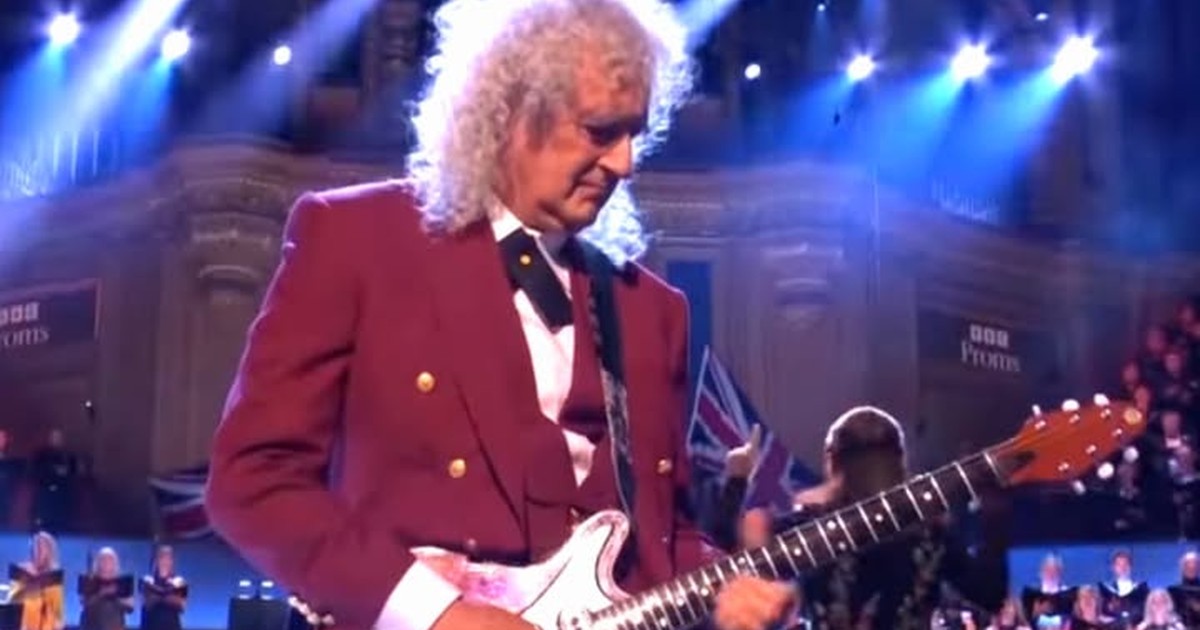
Calling the 2025 Last Night of the Proms “Bohemian Rhapsody” appearance a Queen performance identifies an important connection, but it leaves out much of the musical partnership. Brian May and Roger Taylor participated in a symphonic presentation with orchestral players, choral singers, and featured performers.
May’s official site describes the occasion as marking half a century of the song. The National Youth Choir, one of the participating organizations, supplies a fuller list of collaborators, including the BBC Symphony Orchestra and Chorus, BBC Singers, Louise Alder, Sam Oladeinde, Alison Balsom, and conductor Elim Chan.
Watch on YouTube ↗
Begin with the whole performing group
The familiar Queen names give the viewer an immediate point of recognition. The complete musical event, however, depends on more than those names. A symphonic setting distributes material among resources that do not have the same roles as the members of a rock band.
That creates an arranging question: which musical ideas should remain associated with a familiar sound, and which can be carried by another part of the ensemble? Recognition can survive a change of resource, while a recognizable instrumental voice can supply continuity.
For example, a passage associated with several layered voices on a record can become a task for a present-day vocal group. The comparison concerns how the musical idea is realized, not whether the new group somehow recreates the original recording session.
Changing sections requires more than changing volume
“Bohemian Rhapsody” is particularly useful for following transitions because its musical material does not stay in one repeated mode of presentation. Notice what makes each new section intelligible: the entering part, the supporting pulse, the texture, or the change in vocal responsibility.
A larger ensemble does not need every available performer to remain equally active throughout. Contrast can depend on restraint as well as accumulation. Describe who or what carries a passage rather than assuming that the arrangement’s scale must produce constant maximum sound.
The conductor’s presence also belongs to the account. Coordinated entrances involve a group realizing one sequence together, even when attention naturally moves toward a famous guest or a prominently filmed soloist.
Queen’s video supplies another kind of construction
Watch on YouTube ↗
The official Queen music video returns to the recording most closely associated with the band. Use it as a comparison of musical design and presentation, rather than as evidence that the Proms performers used the same recording methods.
Choose one transition and compare how the two releases establish the next section. Keep the task narrow enough to describe clearly. “Another set of voices takes over” can be more useful than declaring an entire arrangement more operatic without explaining why.
Coachella offers a separate guest configuration
Watch on YouTube ↗
Benson Boone’s official Coachella 2025 release identifies May as a special guest on the same song. The shared guitarist and composition create continuity, while the credited lead performer and occasion change.
The three recordings therefore support a specific comparison: one composition moves among Queen’s recorded presentation, a symphonic collaboration, and another artist’s festival set. Identify what supplies recognition in each and what the particular ensemble adds. That makes the Proms appearance legible as a group achievement rather than an undifferentiated meeting of “rock” and “classical.”