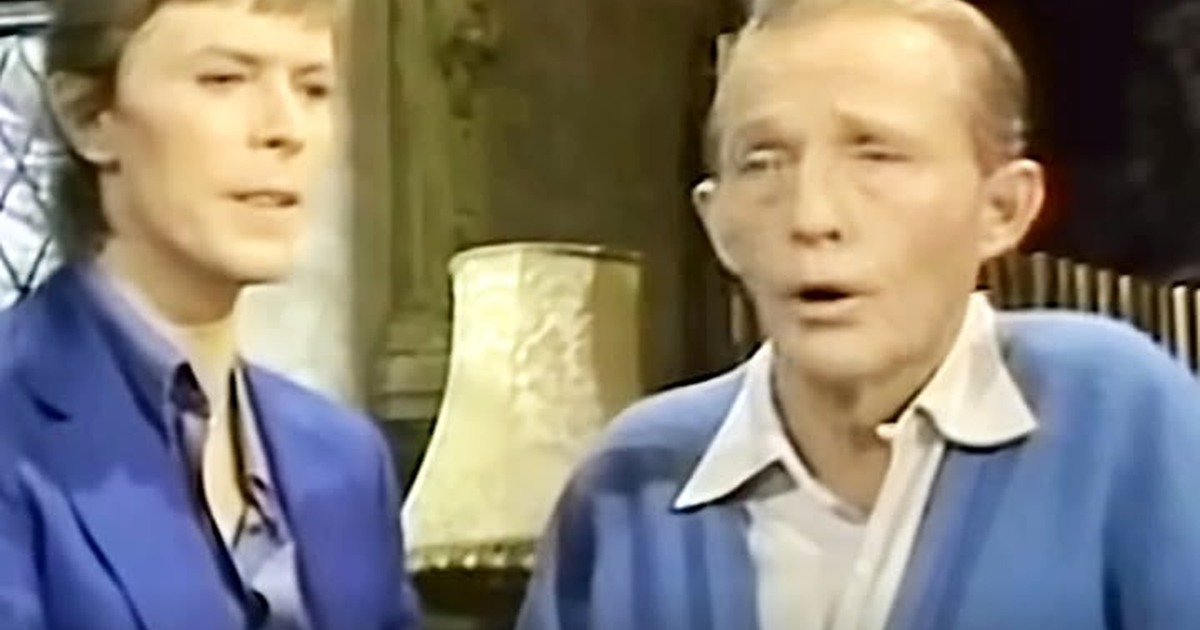
A duet does not have to divide one melody between two singers. Bing Crosby and David Bowie’s Peace on Earth/Little Drummer Boy identifies two connected parts within one presentation. The arrangement gives the contrasting performers a musical relationship, rather than relying only on the novelty of their appearing together.
Bowie’s official archive dates the recording of Crosby’s Merrie Olde Christmas special to September 11,1977, at Elstree near London. It distinguishes the November 30 United States broadcast from the Christmas Eve United Kingdom transmission. The recording date and the two broadcast dates belong to different stages in the item’s history.
The television duet
Watch on YouTube ↗
Follow a line, then change your focus
A familiar melody gives listeners a reference that can remain available while another line develops. Hearing the two together differs from hearing one complete solo followed by another. Attention can move between them without the arrangement becoming two separate songs placed back to back.
For a focused listening, follow one line long enough to recognize its direction, then attend to the other. The purpose is not to ignore the combination, but to understand what is being combined. A shared result becomes clearer when its distinct responsibilities remain identifiable.
That distinction also explains why vocal difference can be useful. Two performers do not need identical identities to make a coherent arrangement. Their separate contributions can help a listener keep track of the relationship.
A television scene and a musical item
The performance belongs to a named seasonal special, giving it a frame beyond the song titles. A television presentation establishes an encounter for viewers, while the arrangement supplies something the participants can undertake within it.
The later life of the recording is another layer. An official contemporary upload makes an older item available without turning its publication date into a new performance date. Viewers can discover it in different decades while the original television history remains specific.
This is worth preserving because the phrase “Christmas duet” alone can hide both the date and the structure. The item is a 1977 television collaboration and a combination of two melodic contributions. Each fact explains something different about why the recording is distinctive.
A seasonal song in a concert frame
The second official upload is labeled Last Christmas at Wembley Arena in December 2006. It introduces another familiar seasonal title and another kind of presentation: a concert recording rather than the Crosby television encounter.
Watch on YouTube ↗
The link is a shared season, not identical arranging work. A song presented by a concert performer need not solve the same problem as a duet organized around two connected lines. Keeping the formats distinct makes the comparison more useful.
A vocal ensemble widens the set
Pentatonix’s official Silent Night selection adds another way of distributing material among voices. An ensemble can create relationships beyond the two-person pairing in the main clip.
Watch on YouTube ↗
These recordings share a holiday frame while offering different musical structures. Crosby and Bowie’s contribution remains distinctive through the partnership of two lines and two performers. Its history explains when the encounter was made; its arrangement explains how the encounter becomes more than an unexpected photograph.


