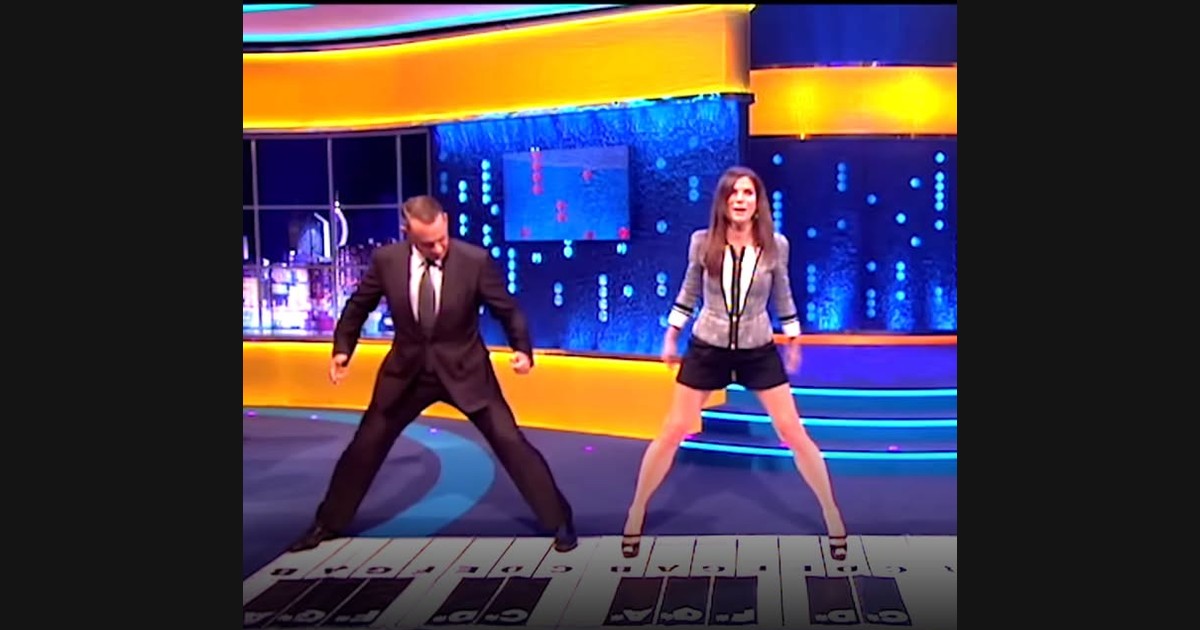
When Tom Hanks and Sandra Bullock approach a giant floor piano on The Jonathan Ross Show, the prop carries a film memory before the first tune is completed. The programme explicitly connects the segment with Big, the 1988 comedy directed by Penny Marshall.
The original film pairs Hanks with Robert Loggia at the keyboard. Bullock’s participation belongs to the later television recreation. That distinction matters because the pleasure comes partly from a new encounter with a remembered idea, rather than an unchanged scene simply happening again.
Watch on YouTube ↗
The film makes play a way of seeing
The studio’s synopsis of Big describes young Josh Baskin waking in an adult body and eventually working at a toy company. The premise creates a gap between how he looks and how he experiences the world. Play becomes a useful expression of that gap.
A toy can therefore do more than provide a joke. It offers a common activity through which people occupying different positions can relate. The floor piano supplies rules simple enough to share, while its unusual scale makes the act visible.
That is part of why the scene can survive outside a full retelling of the plot. Its central relationship is readable through action: people discover that they can make something together.
A recreation changes the participants’ responsibilities
On television, Hanks appears as himself rather than as Josh. The film association remains available, but the task belongs to people in the current studio. The audience can recognize a source while also following a new attempt.
Bullock does not have to become Loggia’s character for the pairing to work. She joins a shared musical activity whose film history gives it an added layer of recognition. A recreation can preserve a premise without preserving every original role.
This distinguishes homage from literal continuity. The television segment acknowledges an earlier work, then gives its action to another combination of people. The new relationship is part of its appeal, not an error to be corrected by demanding a perfect copy.
Watch on YouTube ↗
The source scene restores the narrative frame
The Big excerpt supplies the piano activity inside the film’s world. It lets the viewer compare an action that belongs to a fictional story with the later use of that action in a public conversation.
Both can be playful while doing different work. A dramatic scene develops characters through what they do together. A talk-show segment can use the same recognizable activity to connect guests and offer a compact piece of entertainment.
Watch on YouTube ↗
A prop can carry a cultural reference
The final upload, presented by Big Piano, gives another recording of the Jonathan Ross segment. It returns to the same television encounter rather than establishing a second meeting between Hanks and Bullock.
The piano’s usefulness is its combination of a clear task and a remembered association. People can recognize the film without remembering every line, and they can understand the shared activity without having seen the movie. That balance allows a scene about play to become something others can play with.


