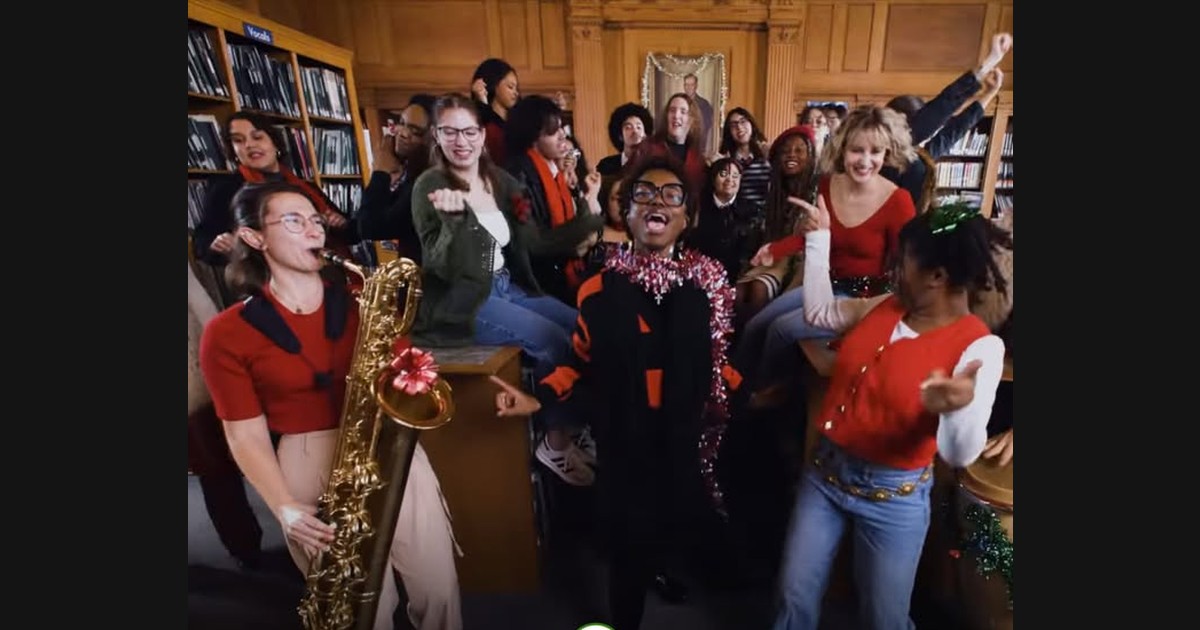
Berklee’s “December” holiday video is a collaboration between places as well as performers. The institution identifies contributions from Boston, Valencia, New York and Abu Dhabi, with singers, instrumentalists and dancers participating in one released presentation. The common musical reference is Earth, Wind & Fire’s holiday adaptation of “September.”
The president’s December 2025 message describes the video as part of an annual tradition. It also identifies a guest appearance by alumnus B. David Whitworth, a longtime Earth, Wind & Fire member. Those details connect the student project with both an institutional occasion and the repertoire being interpreted.
Watch on YouTube ↗
A shared piece gives varied contributions a frame
A multi-location production needs a musical identity that can continue while the featured people change. A familiar recurring idea provides one kind of continuity; a consistent sense of pulse provides another. The viewer can recognize the work while attention moves among different contributions.
This does not require pretending that every participant was in the same room at the same moment. A produced collaboration can combine recorded contributions into one presentation. The important musical issue is whether those parts relate clearly, not whether the video resembles a single uninterrupted concert.
Read the credits as an arrangement map
The original description names featured vocalists including Keeme Tajudeen, Keisha Sanchez, Ivonne Fernandez, Wajd Bou Said, Cybèle Fasquelle and Ike Moemeka. It also identifies drums, congas, bass, guitar, piano, horns and the vocal group Pitch Slapped.
These credits suggest useful listening routes:
- Follow the rhythmic foundation while the featured voice changes.
- Notice what a horn or supporting vocal contribution adds around the main melody.
- Consider how dance gives the shared musical pace a visible form.
The purpose is not to memorize a personnel list. It is to connect the finished presentation with distinct kinds of work. The people carrying a melody, supporting it and shaping its visual setting contribute differently to the same overall result.
September provides the underlying reference
Earth, Wind & Fire’s official “September” video supplies the composition behind the seasonal adaptation. “December” is not a title invented by the students for an unrelated new song; Berklee explicitly identifies the relationship.
Watch on YouTube ↗
Compare how recognition survives the changed seasonal frame. A returning figure or melodic idea can remain familiar while the immediate occasion shifts. Adaptation does not necessarily require changing everything that gives a song its identity. Sometimes it redirects a familiar work toward a new use.
That is particularly apt for a holiday greeting. The project needs to communicate both a shared institutional message and the individual activity of the musicians involved. Recognizable repertoire provides a meeting point for those aims.
Another Berklee interpretation
The Bernard Jonathan Collective’s “September,” also published by Berklee, offers another ensemble treatment of the underlying song. It changes the performing group while keeping the repertoire reference in place.
Watch on YouTube ↗
Listening across the three recordings makes the distinction between song, adaptation and production clearer. Berklee’s holiday video adds an occasion and a network of collaborators to an existing musical relationship. Its extensive credits make that network visible, allowing a seasonal greeting to remain grounded in the specific people and musical jobs that created it.


