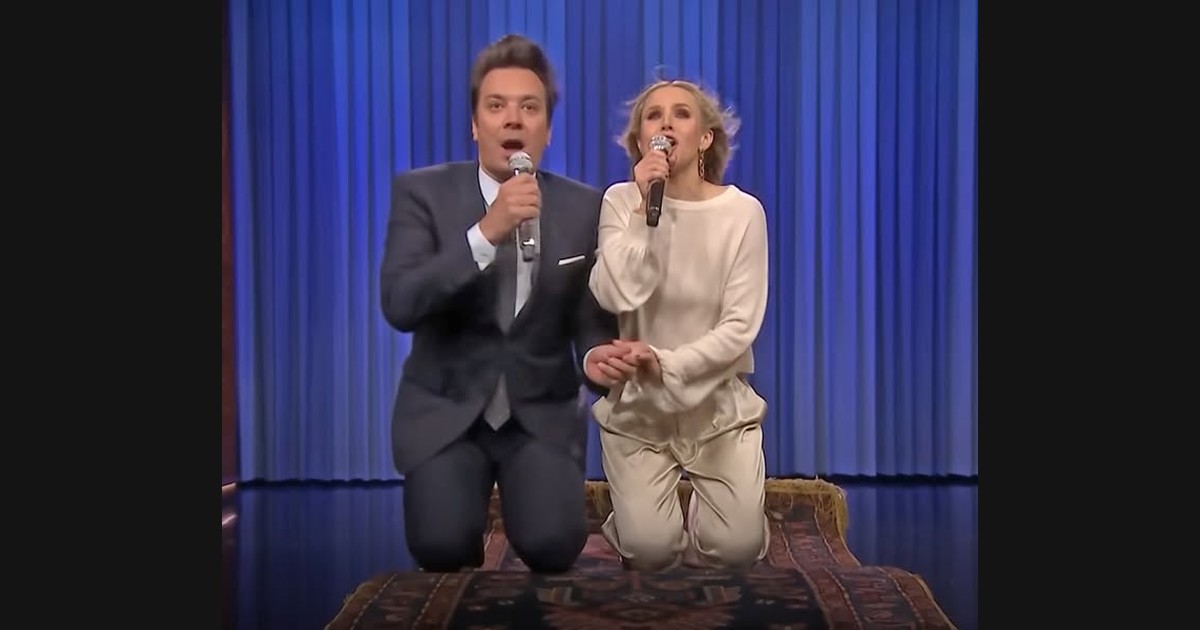
A song has at least two kinds of pace: the movement of its music and the rate at which its words arrive. Kristen Bell and Jimmy Fallon’s Disney medley provides a useful setting for noticing the difference. A succession of familiar excerpts can direct attention toward changing ways of placing language inside musical time.
The two related Frozen selections allow that attention to settle within individual works. The purpose is to hear how text is set, rather than assign a technical label to every phrase or assume that a busy musical passage always contains more words.
Watch on YouTube ↗
One syllable does not always mean one note
A largely syllabic passage gives individual syllables individual notes. A melisma places several notes on one syllable. Neither approach is inherently more expressive; each creates a different relationship between verbal information and musical movement.
Imagine a word’s final syllable lasting across several changing pitches. The melody continues to develop while no new syllable arrives. By contrast, several short words can move quickly through a passage whose musical pattern remains relatively stable.
That distinction helps explain why the impression of speed can be misleading. Rapid verbal delivery, active melody, and a quick underlying pulse are separate subjects. They may occur together, but a listener should not assume that one establishes all three.
Start with a small unit
Choose a short statement in the medley and follow it from its first word to its completion. Notice where the musical emphasis and the verbal emphasis seem to align. Then identify whether the statement ends quickly or leaves a syllable carrying the line onward.
The exercise does not require counting every note. Its value is in separating the changing information of the words from the changing direction of the melody. A familiar selection can become newly clear when those two activities receive distinct attention.
The medley’s compression also makes a single phrase carry substantial identifying work. The selected words and melodic shape have limited time to establish which piece has arrived.
A duet gives the words another course
Disney’s “Love Is an Open Door,” performed by Bell and Santino Fontana, gives a single composition more room. Follow the rate at which new verbal information appears as the musical exchange develops.
Watch on YouTube ↗
A reply can feel conversational even when it is sung. The effect depends partly on how a statement is paced and answered, rather than only on the presence of two singers. A held sound can also delay the arrival of another thought.
A sing-along makes the text visible
Menzel’s official “Let It Go” sing-along provides a different route. The presentation invites attention to the words alongside the music, making it useful to notice when a line continues after its principal verbal information has arrived.
Watch on YouTube ↗
Allow the song to determine which distinction matters in a particular passage. The aim is not to reward the largest number of notes per syllable.
Returning to the medley, the excerpts can now be heard as different solutions to a shared problem: making language move musically. That gives Bell and Fallon’s changing selections another point of interest beyond identifying titles, while leaving each song’s own phrasing available to explore.