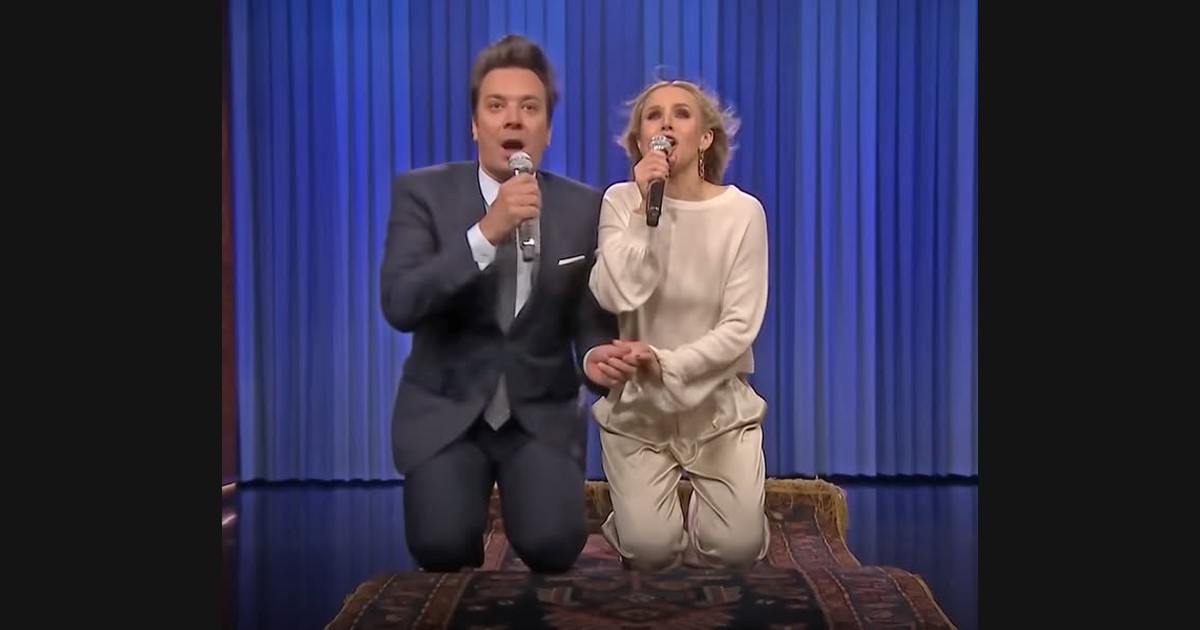
A two-person medley has more roles available than simply dividing its songs in half. One performer can establish a phrase while the other answers, supports, redirects attention, or creates a comic counterpoint. Kristen Bell and Jimmy Fallon’s “History of Disney Songs” is useful for following that shifting partnership.
The official Tonight Show presentation combines a familiar song catalog with a continuing pair of performers. Each excerpt changes the musical material, but Bell and Fallon remain the connection from one selection to the next.
Watch on YouTube ↗
Three jobs to follow
Rather than decide which singer is doing more, distinguish the kinds of work a shared performance can contain. The categories can overlap, and neither performer has to occupy the same one throughout.
| Function | What to follow |
|---|---|
| Establishing the music | A phrase makes the next selection recognizable. |
| Answering or supporting | A second contribution changes how the first statement is heard. |
| Addressing the audience | A reaction or comic beat comments on the musical situation. |
Choose one short exchange and identify its changing center of attention. A reaction can become important without carrying the main melody. A supporting contribution can hold a passage together without being its most conspicuous moment.
Comedy has to connect with the musical pace
A comic response needs room to register, while a medley needs to keep moving. Those demands can pull in different directions. Too little space can obscure the joke; too much can make the next song feel disconnected.
The useful viewing subject is the connection between a musical ending and the next action. Is the response part of the phrase, an interruption, or a bridge toward another selection? Naming its place gives a more concrete account than treating all visible humor as decoration around the singing.
The segment’s game with familiar material does not reveal its entire preparation process. Public ease is a quality of presentation, rather than proof that no rehearsal was involved.
Change the partner and keep Bell
“Love Is an Open Door,” performed by Bell and Santino Fontana in Disney’s official selection, changes the framework. Here one composition gives the partnership its continuing musical situation.
Watch on YouTube ↗
Carry the same three functions into this performance, but allow the balance to change. An answer may develop the song’s conversation rather than comment on the fact that a medley is happening. A shared passage can become a destination within the composition, not simply a connection to another title.
This comparison separates the singer from one particular partnership. The same performer can take part in different forms of exchange without making them interchangeable.
Participation with an absent partner
Idina Menzel’s “Let It Go” sing-along offers a final variation. Its invited additional voice is potentially the viewer’s, rather than another featured performer standing beside her.
Watch on YouTube ↗
That changes the task again: a presentation can make participation legible even when the participating audience is outside the recording. The viewer may recognize, sing, or simply follow.
Bell and Fallon’s medley sits among these possibilities as a particular television partnership. Its continuity comes from the performers’ relationship to each other and to the audience, while the changing songs give that relationship fresh material to organize.