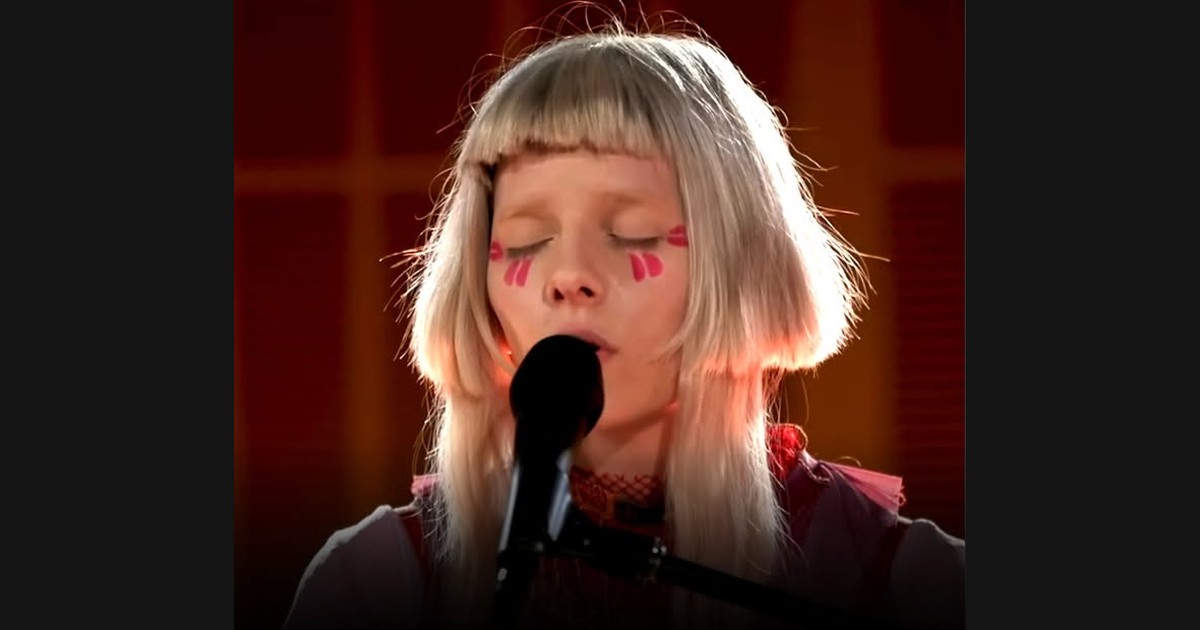
Natural imagery can do different work in two songs. AURORA’s Like A Version pairing places the Beatles’ Across the Universe beside her own The Seed, allowing that distinction to become a concrete part of the listening.
Triple j’s published interview identifies The Seed as an environmental song in AURORA’s own account. She connects it with concern for the earth and people acting on its behalf. That statement gives the original song a documented purpose without turning every natural image in the companion cover into the same argument.
The Beatles cover
Watch on YouTube ↗
An image is more than a decorative subject
In a composition, an image can organize the relationship among ideas. It gives a listener something to imagine while the music establishes a direction through time. Merely finding similar nouns in two songs does not establish identical meaning.
Across the Universe moves through perceptions and thoughts within an expansive frame. The listener follows a succession rather than a straightforward sequence of external events. Its recurring material supplies orientation while the images change.
That is different from assuming that every piece mentioning nature makes an explicit environmental statement. The writing’s function matters alongside its vocabulary. A shared kind of image can serve distinct kinds of address.
A public concern creates another direction
AURORA’s explanation of The Seed directs attention toward dependence on a material world. The concern is not only a private feeling about scenery. It involves the relationship between human priorities and what sustains life.
A song can communicate such a concern through an image rather than an essay. The image provides a compact reference that can be developed and returned to. Its musical setting gives the statement a form people can undertake and remember.
The writer’s account supplies useful context while leaving room for interpretation. It does not determine what every listener must feel, nor does it turn the performance into a detailed scientific or political policy document.
The original-song companion
The second recording presents The Seed for the same broadcaster’s format. The featured artist remains, while the writing changes from a Beatles composition to her own repertoire.
Watch on YouTube ↗
That pairing makes an interpretive identity available through two tasks. AURORA undertakes existing material and presents another piece with a stated purpose of her own. The performances can illuminate each other without being required to make the same statement.
The Beatles in another publication form
The final catalogue item is Across the Universe in its 2021 Mix. It provides another route into the cover’s source composition, distinct from the Like A Version session.
Watch on YouTube ↗
The useful comparison preserves three identities: a Beatles work, AURORA’s interpretation and her environmental original. Imagery connects them at one level, but the songs’ directions remain distinct. Hearing those functions gives the pair more substance than a generalized description of atmosphere. Natural images become ways of organizing attention, with one song opening perception outward and another focusing a particular public concern.