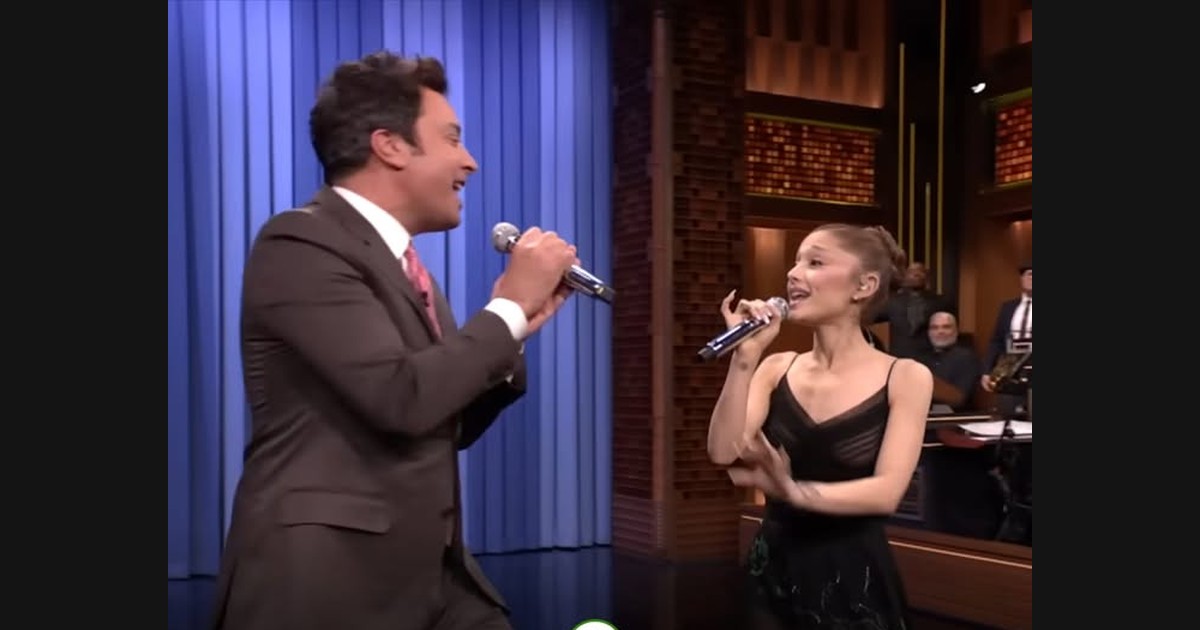
A duet is not defined only by the number of singers. Two voices can agree, answer each other, compete or share a statement. Ariana Grande and Jimmy Fallon’s “History of Duets” brings several established partnerships into one medley, making that variety the organizing idea.
The Tonight Show’s official description names selections including “For Good,” “Ain’t No Mountain High Enough,” “Shallow,” “The Boy Is Mine,” “APT.” and “(I’ve Had) The Time of My Life.” That is a curated selection of recognizable duets, rather than a complete chronological history of every kind of shared singing.
Watch on YouTube ↗
A new pair inherits the roles
When Grande and Fallon take material associated with other partnerships, they need to establish each selection quickly. A familiar melody can provide recognition, but the relationship between the voices also matters. A line addressed to another person works differently from two people delivering the same declaration together.
This gives the medley a continuing dramatic task. The performers remain the same while the material changes the kind of exchange available to them. Their partnership has to accommodate more than one musical attitude.
Three ways to hear a duet
- Conversation: one contribution creates a reason for the other to respond.
- Shared statement: two voices give the same idea a combined presence.
- Contrast: different perspectives or vocal characters remain audible together.
These are listening categories, not a claim that each song uses only one of them. A duet can move between functions within a single passage. The interest often lies in the shift.
For a focused pass, follow the moment a new selection becomes recognizable. Ask what establishes it first: the melody, a change of vocal character or the way the performers address one another. That keeps the comparison specific without requiring a list of every musical excerpt.
Impressions change the task
The “Wheel of Musical Impressions” segment places Grande in another Tonight Show format. Here recognition concerns a performed vocal identity as well as the selected song.
Watch on YouTube ↗
An impression asks the audience to connect a new performance with a familiar artist’s signature. A duet medley asks the performers to inhabit a relationship between musical parts. The skills can overlap, but the premise is different: one foregrounds who a voice evokes, while the other foregrounds what two voices do together.
A second medley partnership
Grande and Kelly Clarkson’s “Mixtape Medley” from That’s My Jam supplies another pairing inside a television music-game setting. The partner changes while the idea of moving through recognizable material remains.
Watch on YouTube ↗
Compare how continuity is maintained as each selection ends. A medley needs enough time for recognition, then a convincing reason to move on. The returning performers can provide a stable thread even when the musical references change rapidly.
The “History of Duets” works as a route into that shared work. It compresses repertoire without making every partnership identical. Listening for conversation, agreement and contrast gives the sequence a clearer shape than simply counting how many familiar songs appear.