A performer does not always need to be the person making the largest movement to carry a scene. A look, a pause or a change of attention can tell an audience how to understand what just happened. Apollo High School’s “Funny Talent Skit” makes that relationship a useful way into a compact student act.
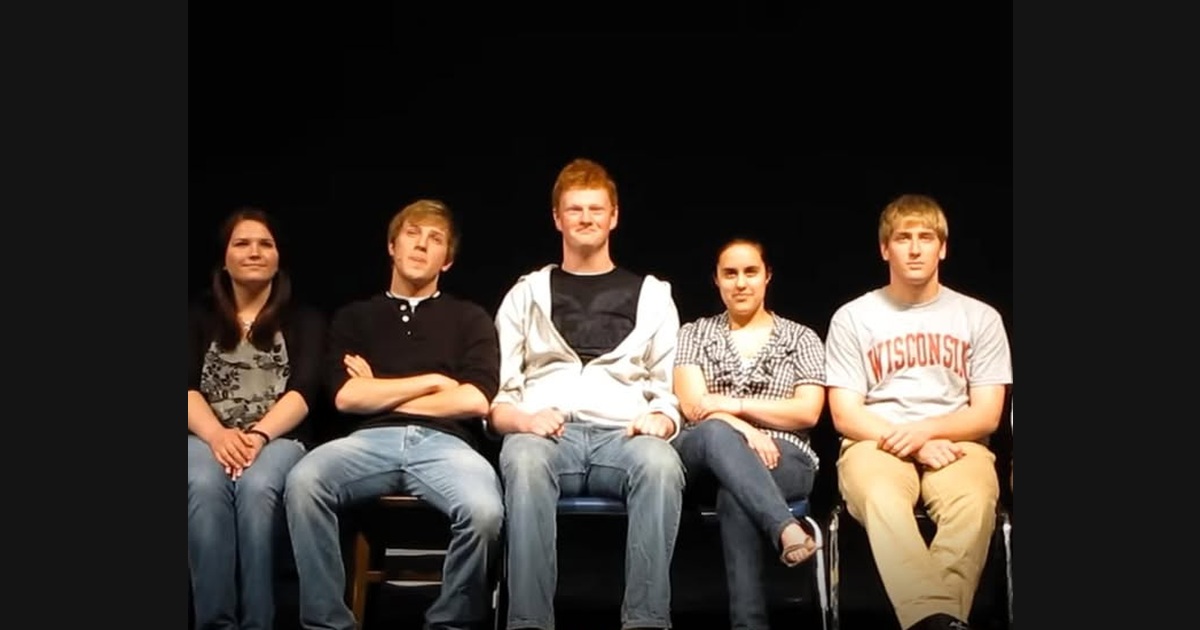
The original upload identifies the occasion simply as “Variety Show 2011 @ Apollo High School.” It does not name a professional troupe or supply a detailed production history. The recording can be appreciated as a school-stage performance, where a straightforward group arrangement gives small actions room to communicate.
Watch on YouTube ↗
An action needs someone to register it
Physical comedy often works through an exchange. One person does something; another responds; the audience understands the relationship between them. The response might agree, resist, misunderstand or redirect attention. Its importance comes from what it makes legible, not from how much space it occupies.
A seated group provides a clear frame for that process. When people remain in place, the viewer can follow their relationships without constantly locating them again. An apparently minor change in posture or attention can become significant against that stable background.
Follow attention rather than only movement
For a focused viewing, choose one performer and notice where that person’s attention seems directed. Then widen your view to the neighboring figures. The audience’s own focus can move with those relationships, even when no one crosses the stage.
This is different from assuming that every visible expression reveals a performer’s genuine private feeling. In a skit, reaction is part of the presentation. A character can appear puzzled, surprised or unimpressed because that response serves the scene. Viewers need not turn the stage behavior into a biography.
A hypothetical example illustrates the dramatic principle: if one person begins a small repeated gesture, another person’s delayed glance can make the audience notice it. The glance gives the action a new meaning without changing the gesture itself. This explains a performance tool rather than claiming that exact sequence appears in the recording.
Compare a more explicitly rhythmic group act
The “Hand Clap Skit” offers another seated-group performance. Its original uploader identifies a youth-conference talent show. Here hand actions supply audible events as well as visible ones, creating a different relationship between action and response.
Watch on YouTube ↗
Ask what helps the audience follow each act. An audible clap can mark a boundary directly; a quieter gesture may need the surrounding performers’ reactions to make its significance clear. These are alternative ways to organize attention, not stages on a scale from simple to sophisticated.
A farewell performance has another kind of context
The final recording comes from Breaking Barriers United. Ryan Tillman’s original description identifies it as a dance goodbye to Don Lugo High School students when he left his school-resource-officer position for patrol.
Watch on YouTube ↗
That context gives the performance a different relationship with its audience. The school skit creates characters within an act; the farewell communicates an existing public role through dance. In both, what surrounding people recognize helps an action become meaningful. Apollo’s recording is a reminder that staging is as much about directing attention as it is about producing movement.