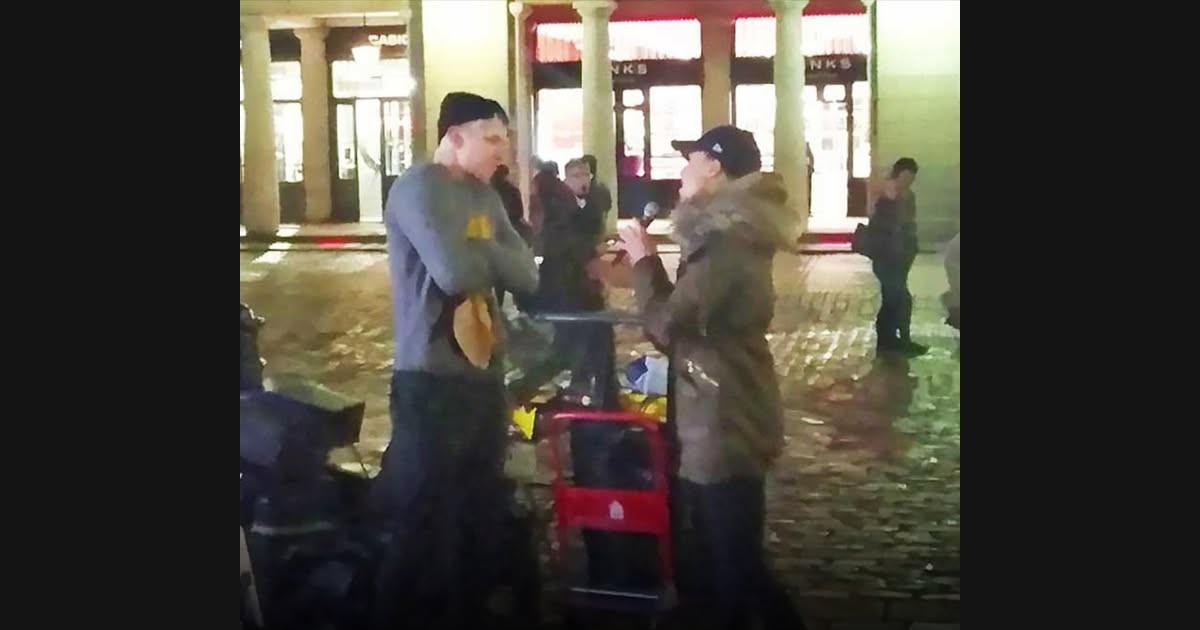
“All I Ask of You” can leave its theatrical scenery behind without losing its essential relationship between two voices. Stephen Barry and Celinde Schoenmaker’s Covent Garden performance places the song in a public setting, where the singers carry an exchange that a staged production would surround with characters, plot, and design.
Barry’s own upload identifies both performers and the song. It provides a direct participant source for the pairing. That is enough to establish the collaboration without adding a detailed chance-meeting story, assuming what either singer knew beforehand, or treating every circulating account as a verified transcript.
The duet carries a relationship, not just two vocal parts
In The Phantom of the Opera, “All I Ask of You” belongs to Raoul and Christine. A production program distinguishes that duet from its separately listed reprise. The title therefore names a particular dramatic exchange, not merely a generic showcase for two strong voices.
Watch on YouTube ↗
A concert or street performance can preserve that exchange even when neither singer is appearing in full character. One voice addresses another; a response changes the direction; shared material brings the two into a common musical space. The relationship gives the song continuity beyond the individual phrases.
For someone unfamiliar with the musical, that is a useful starting point. You do not need to reconstruct the entire plot to hear the duet as communication. Follow who is addressing whom, and notice when the song’s statement becomes shared rather than individual.
What the public setting removes and retains
| Usually supplied by a production | Still carried by the song |
|---|---|
| Scenery and a defined fictional location. | A relationship between the two vocal parts. |
| Costumes identifying the characters. | Contrasting entries and musical responses. |
| Scenes before and after the number. | An internal progression toward a shared statement. |
Removing theatrical surroundings does not make the performance less prepared or more authentic by definition. It changes which information the singers and listeners have immediately available. The voices must carry more of the relationship because the surrounding production is absent.
The second view documents the same pairing
The next upload labels Barry and Schoenmaker in Covent Garden and gives a November 2016 date. It supplies another perspective on the encounter, rather than a new cast. A different angle may clarify how the performers face one another or use the available space, while the partnership remains the same.
Watch on YouTube ↗
Keep the camera’s contribution distinct from the singers’. A close frame can make an exchange feel especially direct; a wider frame can reveal how public activity surrounds it. Those differences help explain how the viewer experiences the duet without establishing a different musical arrangement.
A different partner changes the comparison
The final video identifies Michael Xavier singing the same song with Schoenmaker. It retains one performer and the composition while changing her partner. That makes it more informative than treating every clip as another document of the Covent Garden appearance.
Watch on YouTube ↗
Compare the relationship between the parts rather than assigning scores to individual notes. An entrance can feel like an answer because of what precedes it; a shared line can feel like an arrival because the voices were previously separate. Those larger connections are the duet’s dramatic structure.
The Covent Garden setting makes that structure portable. A number written for a theatrical story becomes a self-contained encounter between performers, while its two-way musical conversation remains the reason it works as a duet.


