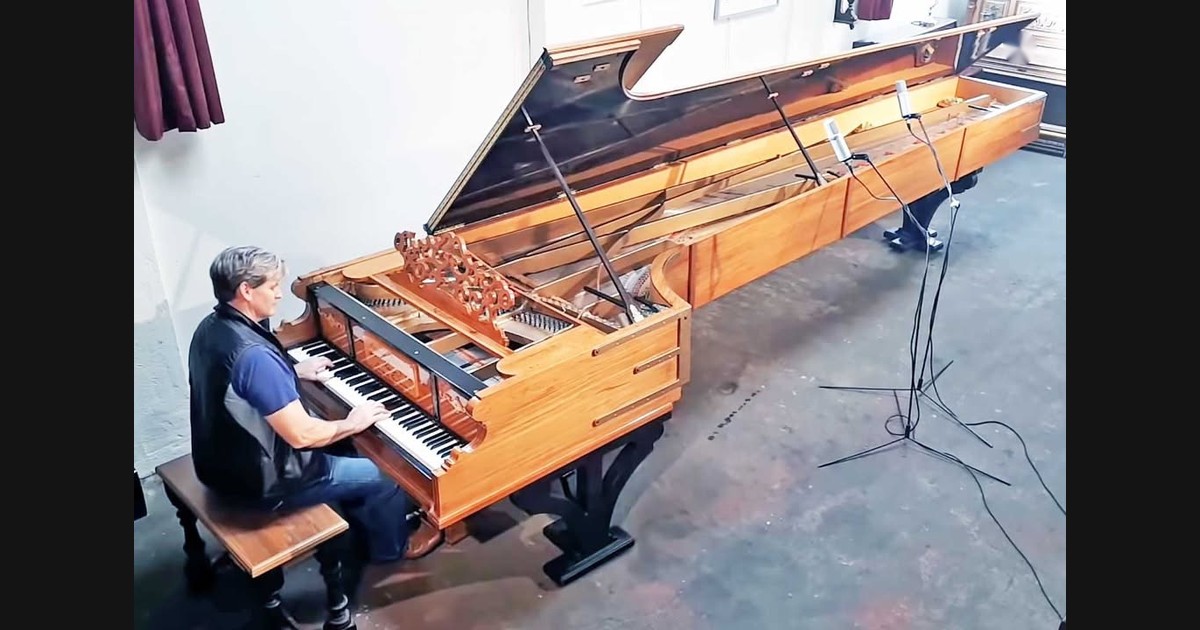
The Alexander Piano is interesting beyond the superlative attached to it. Adrian Mann’s own account gives a concrete object to consider: a grand piano measuring 5.7 metres, completed on 24 October 2009 after he began building it as a teenager.
The three videos offer different kinds of access. A comparison with a small upright demonstrates contrasting instruments; a construction account concerns how the project came about; Hyperion Knight’s performance brings the extended instrument into a piece of repertoire.
Watch on YouTube ↗
A comparison needs a clearly defined question
The opening Alexander Pianos upload invites listeners to compare a long grand piano with a small upright, drawing particular attention to the bass. The publisher also identifies a chromatic scale and a low-register example as part of the demonstration.
That provides a useful listening task, but not a universal ranking of pianos. Instrument design, the way a passage is played and the recording arrangement all contribute to what reaches the viewer. A short video comparison can illustrate differences without establishing that one instrument is better for every purpose.
For a focused pass, follow a note from its initial attack into its decay. Then consider how one note relates to the next. Bass weight, clarity and duration are different qualities; describing only loudness leaves much of the comparison unexplained.
Size is a design choice, not a complete musical description
The measured length identifies the object’s scale. It does not by itself specify every acoustic property or tell a listener what all repertoire will sound like. The instrument still has to be played, voiced and maintained as a working piano.
Mann’s business history supports that practical perspective. His official site describes moving from building the Alexander Piano into restoration, tuning and a workshop in Dunedin. The large instrument exists within continuing work with pianos, rather than only as a completed headline.
Watch on YouTube ↗
The building story answers another question
The construction video offers a route into the project as something made over time. It belongs alongside the demonstration, but it cannot replace hearing the instrument in use. Knowing how much work an object required and understanding its musical possibilities are related forms of interest.
That distinction helps prevent scale from becoming the only topic. The question moves from how large the piano is to what a musician can do with it.
Watch on YouTube ↗
A demonstration can deliberately isolate a register that makes a difference easy to notice. A musical performance has another responsibility: integrate that register with everything around it. The contrast between those tasks is useful even before making a judgment about either instrument.
Repertoire brings the instrument back to phrasing
Alexander Pianos identifies Hyperion Knight’s selection as Bach’s Jesu, Joy of Man’s Desiring and describes the recording as informal. A named musical work gives the piano another task: sustaining relationships between lines and shaping a continuous phrase.
In that setting, a striking bass sound is one resource among others. It has to belong to the music around it. The most useful sequence is therefore object, demonstration and performance: understand the construction’s scale, hear a focused comparison, then let a complete musical idea test the instrument’s possibilities.


