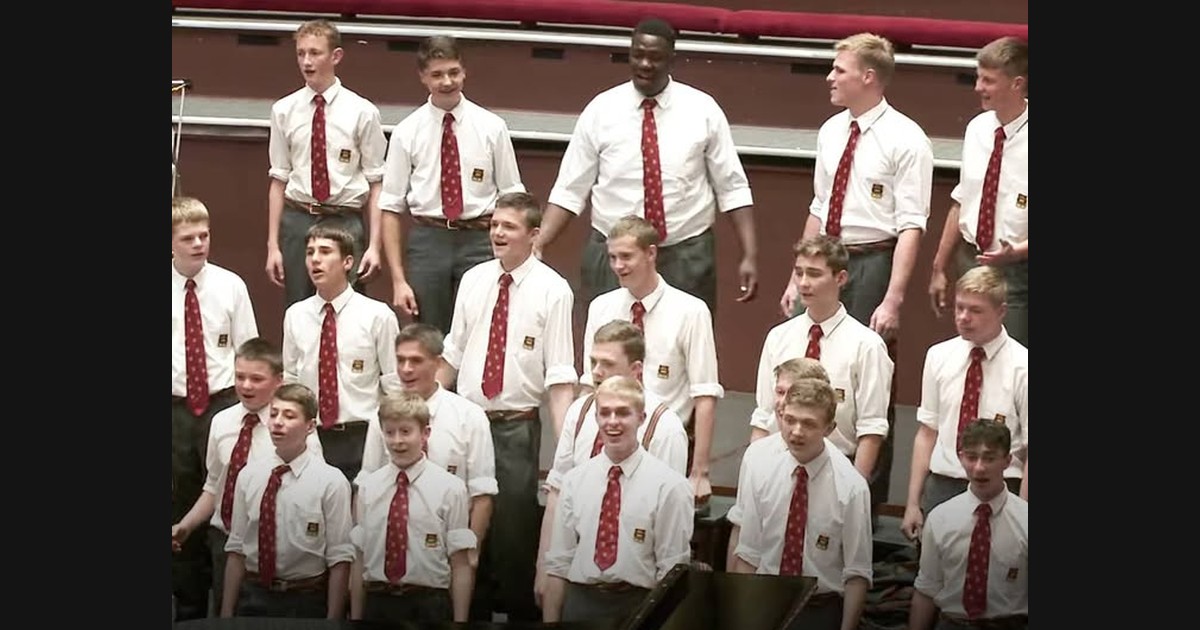
A broad label such as African medley leaves many useful musical questions unanswered. Affiekoor’s own description of Afrika-Keurspel is more specific: traditional isiXhosa material, arranged by Mpumelelo Manyathi, with named soloists and djembe accompaniment. Those details give the performance a clear starting point.
The opening recording comes from the national final of the 2024 ATKV Applous choir competition. ATKV’s contemporary programme placed that year’s national final in Cape Town City Hall. The choir is presenting a prepared arrangement within a school-choir event, with individual contributions situated inside a larger ensemble.
Watch on YouTube ↗
Traditional material and a named arrangement
Calling material traditional does not mean that every modern performance uses the same form. An arranger can decide how musical ideas are ordered, which voices take them, and how passages connect. Crediting Manyathi recognizes that act of organization without inventing an individual author for the underlying traditional material.
It also prevents geography from doing too much explanatory work. The isiXhosa identification is more precise than treating all the continent’s languages and musical practices as interchangeable. The recording’s description does not provide translations or a detailed history of each component, so those should not be guessed from movement or vocal energy.
A useful approach is to separate what a programme tells us from what musical attention can discover. Language and arrangement credits establish context. The relationship between a featured line and an ensemble response can then be followed without pretending that recognizing a pattern amounts to understanding every word.
Individual names inside a collective sound
The competition upload lists Mpumi Rakhudu, Deon Spies, Ronan Cilliers, JD Hatting and Stef Pretorius as soloists, and Henri Potgieter on djembe. These credits distinguish responsibilities within the performance. A choir is collective, but collective music is not anonymous.
That distinction matters when considering balance. A solo line can introduce material, redirect attention or provide contrast, while the ensemble supplies another scale of sound. Percussion may relate to both. These are roles to follow across the complete arrangement, rather than reasons to rank one contributor above another.
Watch on YouTube ↗
A different work, with different credits
Loof Hom gives the same choir another musical setting. Its official description identifies Franco Prinsloo as composer and names Totius’s text from the 1956 hymnbook, drawing on Psalms 150 and 148. It also credits Marthinus van Rooyen on cello alongside other instrumentalists.
That companion prevents a single performance from becoming a complete definition of the ensemble. A choir can work with traditional material and a newly composed setting while making different decisions about text, instruments and musical shape.
Watch on YouTube ↗
Compare the credited versions carefully
The other Afrika Keurspel upload retains the Manyathi arrangement and Potgieter’s djembe credit, but its listed soloists are not identical to the final’s list. The difference is a reason to keep each recording’s credits attached to that recording, rather than silently merging them.
Programme information will not replace listening. It gives listening better questions: who is carrying this part, which musical responsibility is changing, and how does the group connect the individual with the whole? Here, the names and arrangement details make the ensemble’s work more legible.


