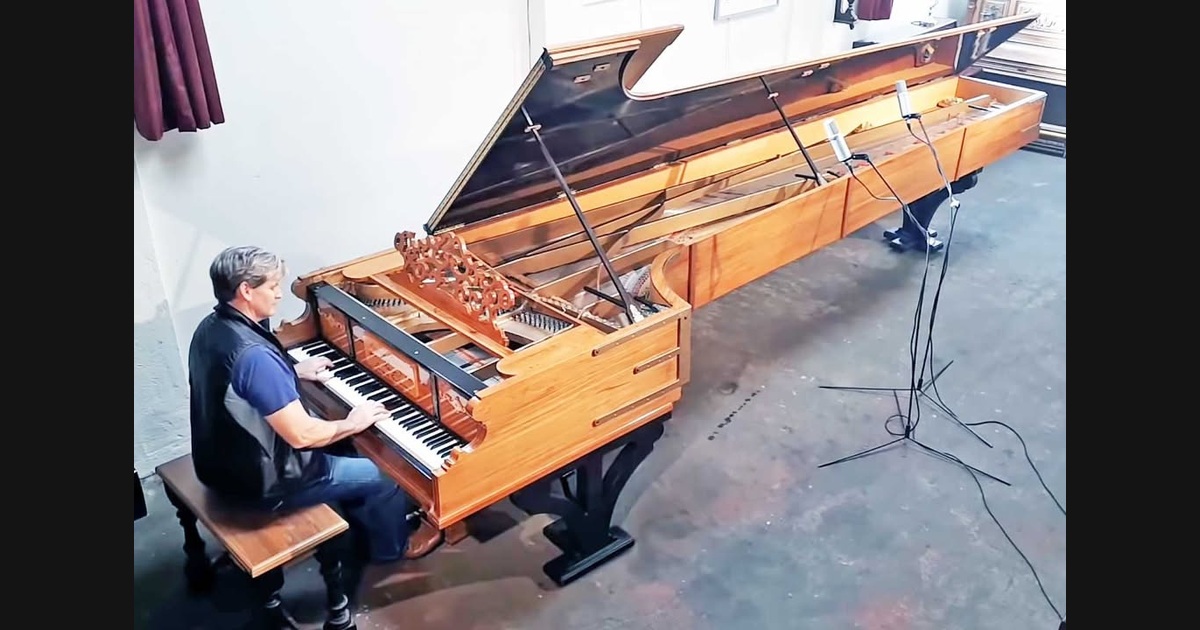
The Alexander piano began with a question about a string, rather than a plan to win a size contest. Adrian Mann’s own account describes his teenage curiosity about how long a bass string would need to be without the familiar copper winding. A long-wire experiment suggested a sound he wanted to develop into a complete instrument.
The result was an unusually long grand piano. Mainfreight, which transported it, identifies its length as 5.7 metres. That measurement establishes its scale without requiring a claim that it remains the world’s largest piano under every possible definition.
Watch on YouTube ↗
A question becomes a design constraint
Mann noticed that pianos differed inside, particularly where their wound bass strings began. His experiment was not merely an attempt to enlarge an existing case. He wanted a particular kind of string to be part of a playable instrument, and the instrument’s size followed that interest.
This distinction makes the project musically interesting. A practical design question can concern the character of a note, the way a string responds, or the transition between registers. Solving it changes more than the outline of the furniture surrounding the keyboard.
The maker’s preference for the resulting sound should remain a preference. Greater length does not automatically make every instrument better for every room, player, or piece of music. It creates a different set of possibilities and constraints.
A recording is one encounter with the instrument
The first video is published by Mann as an Alexander piano recording. It lets viewers encounter the instrument as something played, rather than only as an object in a photograph. Follow the relationship between lower notes and the material above them, allowing complete phrases to establish a sense of scale.
A web recording is not a laboratory comparison between pianos. The player, room, microphones, and playback system all affect what reaches a listener. It can still reveal a musical performance without proving that every difference comes from string length alone.
The builder explains the route
Mann’s TEDxYouth@Auckland talk provides another kind of evidence: the creator explaining the project. It is useful to distinguish that account from an independent technical evaluation. The account tells us which question motivated him and how he presents the route from curiosity to construction.
Watch on YouTube ↗
For a close reading of the story, identify three stages: the initial question, the small experiment that made it tangible, and the larger instrument that gave it a musical use. This sequence is more informative than an isolated description of a prodigious teenager producing a giant object overnight.
An early close-up changes the view
The final maker upload is labelled as an opening close-up from April 2009. It provides an early view of the instrument’s physical scale and construction context. That is a different task from the recording or the talk: it helps connect a sounding instrument with a tangible mechanism.
Watch on YouTube ↗
The three videos therefore offer complementary routes: hear the piano, hear the maker’s explanation, and examine an early close view. None has to stand in for all the others.
The Alexander piano’s strongest story is the movement from a precise question to a working musical object. Its unusual length is part of that answer, while the performances give the experiment a life beyond the measurement.


