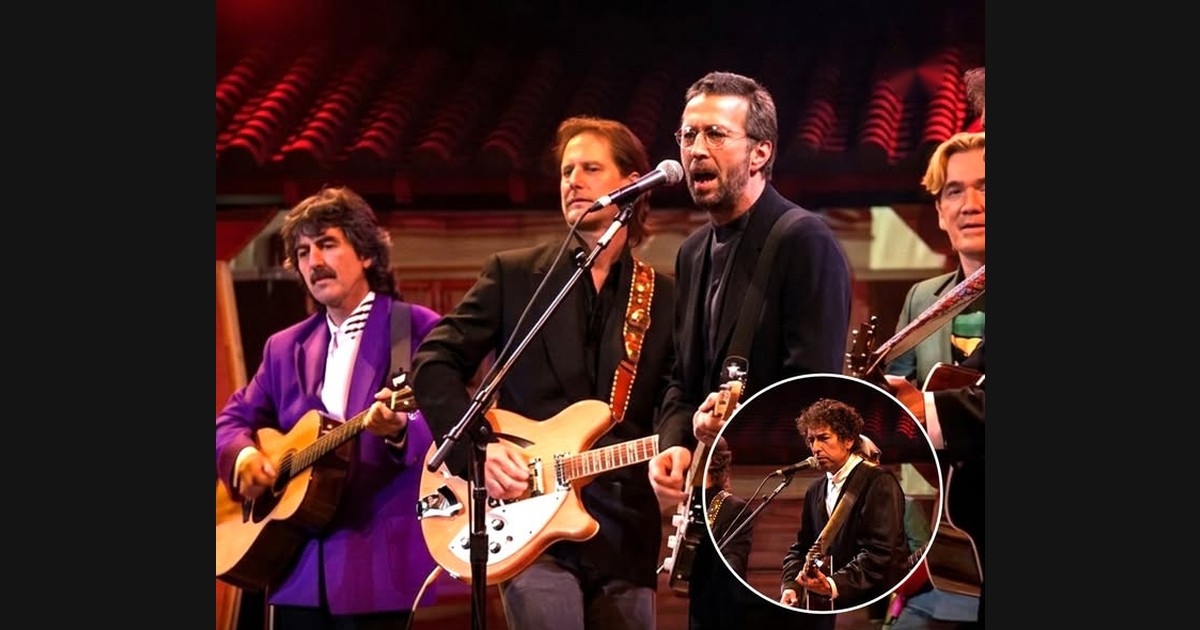
An anniversary concert looks back over a public career. My Back Pages looks back in another way: its speaker reconsiders former certainty. That relationship gives the song a particular place within Bob Dylan’s 1992 thirtieth-anniversary celebration.
Dylan’s official concert release credits him alongside Roger McGuinn, Tom Petty, Neil Young, Eric Clapton and George Harrison. The song itself belongs to Another Side of Bob Dylan from 1964. A later group of interpreters therefore undertakes writing already concerned with the instability of looking backward.
The anniversary performance
Watch on YouTube ↗
A retrospective can question its own earlier judgments
Looking back does not have to mean confirming that every earlier belief was correct. A composition can revisit a previous way of understanding the world and recognize its limits. That is a different dramatic task from celebrating an unbroken line of certainty.
The interest lies in the relationship between an earlier position and the current act of reconsidering it. The speaker does not become meaningful only through a list of events. Changes in judgment supply the movement.
This makes an anniversary context especially suggestive without proving a private confession by every participant. Established artists can share a song about revision while retaining separate histories and views. Undertaking the composition is not identical to issuing an autobiographical statement.
Several voices do not create several unrelated songs
The credited group allows different performers to carry material from one composition. A change of voice can provide another point of address while recurring writing preserves continuity.
That relationship differs from a medley, where different compositions supply the variety. Here the piece remains constant. The musical and verbal framework gives the participants common material rather than requiring each person to introduce a separate title.
The broader ensemble also deserves a place in the account. Dylan’s release lists supporting instrumental contributors as well as the featured singers. A shared song needs continuity around its individual addresses, not only a procession of recognizable names.
The person being celebrated also participates
Dylan’s presence makes the occasion different from a tribute undertaken entirely in a writer’s absence. He is both the anniversary’s subject and one of the credited performers.
Those roles can coexist without dictating what every phrase means. The event supplies public history; the song supplies a speaker with a particular relationship to earlier beliefs. Keeping the two levels distinct allows the performance to do more than illustrate a biography.
Another anniversary collaboration
Simon, Crosby and Nash’s Here Comes the Sun comes from the Rock Hall’s 2009 anniversary concerts. The composition and performer relationship change, while an institutional celebration again creates a place for shared repertoire.
Watch on YouTube ↗
A different writer’s tribute
The official Harrison-channel selection presents McCartney and Clapton performing Something. It provides another relationship between an existing composition, its writer’s history and later interpreters.
Watch on YouTube ↗
The companions clarify what is particular about My Back Pages. Several established artists share a song in which retrospective understanding is itself unsettled. The anniversary honors a body of work, while the chosen composition leaves room to reconsider rather than simply preserve an earlier position.


