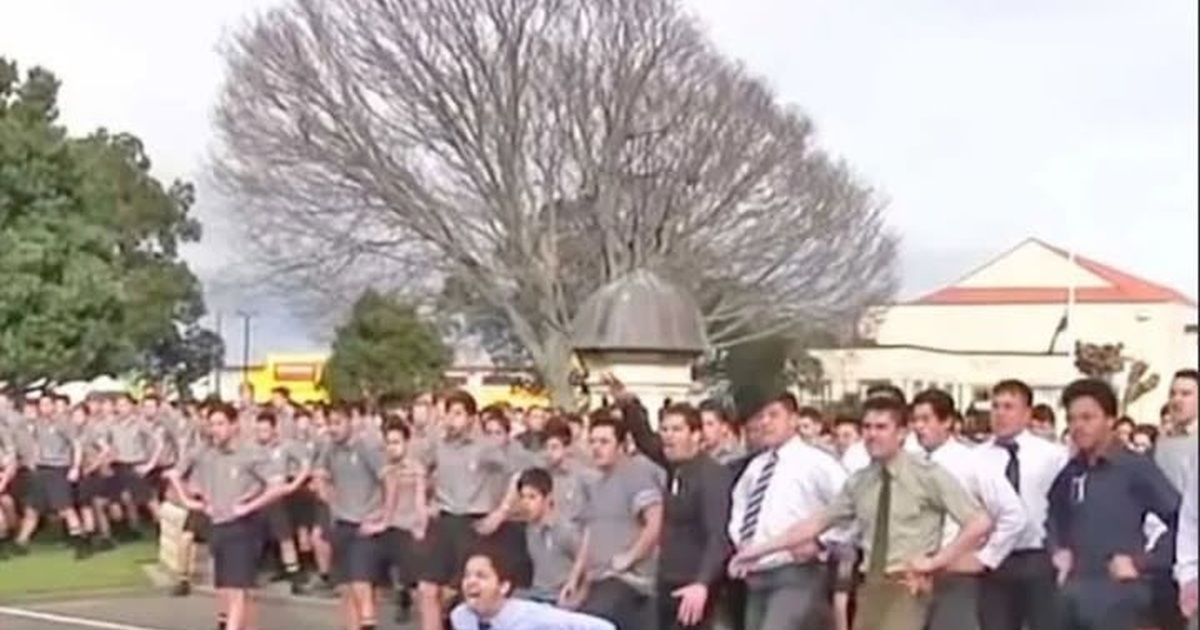
The school’s own description gives this recording a precise starting point: Palmerston North Boys’ High School performing its school haka as the hearse carrying teacher Dawson Tamatea arrives for his funeral service. It is a named community addressing the loss of a named person. That context is more informative than a generic description of an intense group performance.
The video was published by the school in 2015. Its contemporary newsletter records nearly thirty years of Tamatea’s teaching there, including Te Reo Māori, Social Studies, Maths and PE. It also connects him with the school’s kapa haka work and says he helped bring about the writing of the school haka. The farewell therefore involved a form with a connection to his work, not simply a dramatic item chosen for an audience.
The school’s record of the farewell
Watch on YouTube ↗
Why the phrase ‘school haka’ matters
Identifying the performance as the school’s haka preserves a particular relationship among words, place and participants. A familiar haka seen in another setting cannot simply be substituted in its description. Nor does recognizing the general form establish the name or meaning of this specific composition.
The distinction resembles the difference between naming a kind of song and identifying the song being sung. Knowing that something is a lament, a hymn or a celebration does not identify its writer, words or local associations. The broad category begins an explanation; it cannot complete one.
Here, the school supplies an authoritative point of identification because it published the recording of its own service. Its account also helps keep the teacher’s connection to the performance visible. A clip detached from that context can become a demonstration of group force while the person being honored recedes from view.
A wider tradition than the sporting image
Te Ara, New Zealand’s national encyclopedia, explains that haka serves different occasions, including welcoming people and paying respect to the dead. It describes kapa haka as a living art form. The funeral setting in this recording therefore belongs within a broader range of purposes than the “war dance” shorthand suggests.
That wider context does not require an outside viewer to pretend to understand every word or gesture. It provides a better starting point for attention. The question becomes what this community is doing on this occasion, rather than how closely the recording matches a sporting image already familiar to the viewer.
It is also useful to separate intensity from a single presumed emotion. A strong collective delivery cannot, on its own, tell an outsider whether every movement expresses anger, grief, pride or something more specific in the text. Meaning is carried through language and context as well as the qualities a distant viewer can readily notice.
Another teacher, another farewell
The next school upload identifies a tribute haka for Steve Burnley’s funeral service on November 24, 2015. Keeping his name attached to the selection matters. This is a different farewell, not extra footage of Tamatea’s service.
Watch on YouTube ↗
The pairing offers continuity at the level of a school community using a shared form, while preserving the difference between the people and occasions. A meaningful comparison keeps both parts intact. The presence of a similar kind of performance does not make two lives interchangeable.
Hereworth’s own school performance
The final recording is published by Hereworth and identified as its school haka for Mr Bibby. That credit introduces another institution and another specific address. It belongs alongside the earlier examples because it extends the selection, not because it proves all school haka are the same.
Watch on YouTube ↗
Three pieces of information provide a sound foundation for each viewing: who published the record, whom the performance addresses and how that community names the occasion. In Tamatea’s farewell, those details bring the focus back to a teacher and the school with which his work was intertwined. The performance’s public visibility should enlarge that context rather than replace it.