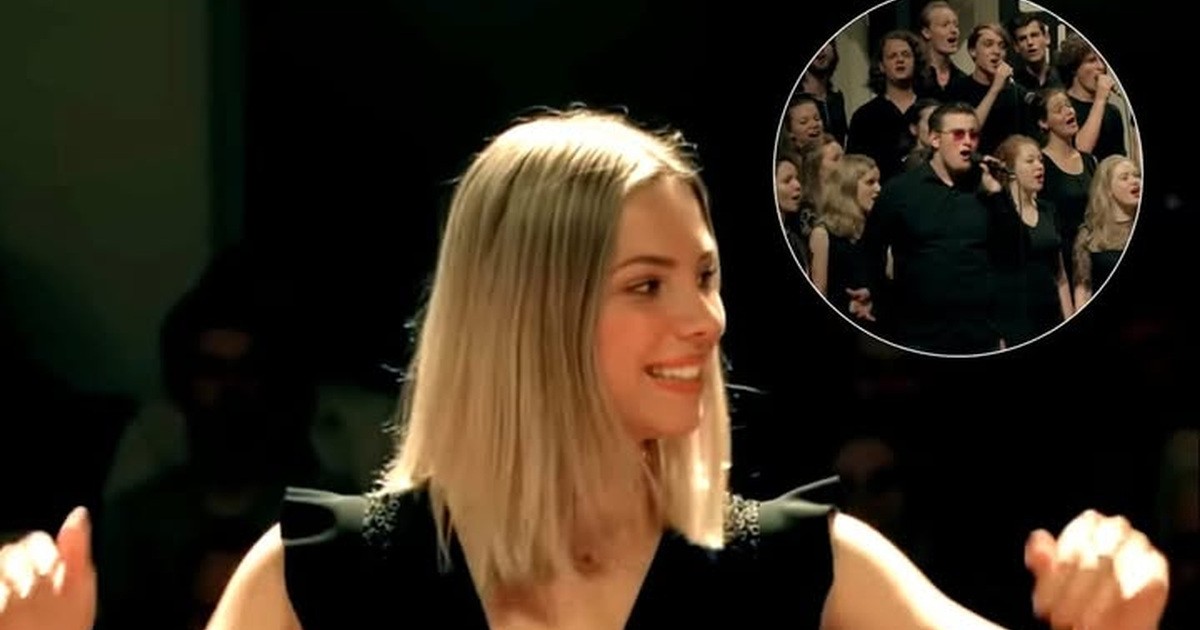
An orchestral cover can easily be credited only to the person whose name appears in its title. Emma Wieriks’s Copacabana provides a more complete account. She identifies arranging and conducting as her graduation project, names Job Uitgeest as lead vocalist and credits Félipe Pipi for the video.
Wieriks describes graduating in Music Education at the Utrechts Conservatory in the Netherlands. She also records three shared rehearsals of forty-five minutes each. That is 135 minutes of scheduled group rehearsal, not evidence that every participant had only that much preparation in total.
The student ensemble project
Watch on YouTube ↗
Arranging creates a workable distribution
An arranger decides how a composition can be undertaken by the available resources. Musical material has to be distributed, connected and made clear enough for participants to understand their responsibilities.
That differs from simply assigning the same tune to more people. A lead line needs a relationship with supporting parts; transitions need somewhere to go; an ensemble needs a shared sequence. The arranger’s work makes a particular performance possible without claiming authorship of the original composition.
Wieriks’s title and description preserve that distinction. Barry Manilow’s song is the repertoire reference, while the new arrangement belongs to this student project. Both credits can remain visible.
Conducting connects the plan with a group
A completed arrangement does not perform itself. Conducting provides another kind of responsibility: people need a shared sense of timing, preparation and continuation while they undertake their separate parts.
One person may do both jobs, but the jobs remain distinct. Arranging establishes relationships within the material; conducting helps the present ensemble realize relationships through time. The second task involves responding to musicians, rather than only preserving a document.
The lead vocalist adds another responsibility. A narrative song needs its sung address to remain intelligible within the ensemble. Naming Uitgeest recognizes that interpretive contribution instead of describing every musical result as the conductor’s alone.
Limited shared time makes priorities matter
Three forty-five-minute rehearsals supply a concrete production constraint. Shared time can be used to establish entrances, clarify transitions and identify places where responsibilities depend on one another. It is different from the preparation each person may undertake separately.
The arithmetic is useful because it limits the claim. A concise rehearsal schedule can show the need for coordination without becoming a story that the entire piece was created in just over two hours.
A catalogue reference for the song
The next official catalogue selection presents Copacabana under Manilow’s name. It supplies another route into the composition while changing the performance and publication frame.
Watch on YouTube ↗
The official remix video
The final Manilow video is labeled as a remix. That label identifies another production presentation, rather than a new Wieriks performance or proof that all versions use identical musical materials.
Watch on YouTube ↗
The three items make credit especially valuable. Writing, arranging, conducting, singing and filming are connected contributions with different jobs. Wieriks’s own account gives the student project its specific shape: a named educational purpose, a shared rehearsal constraint and a group undertaking a new arrangement together.


