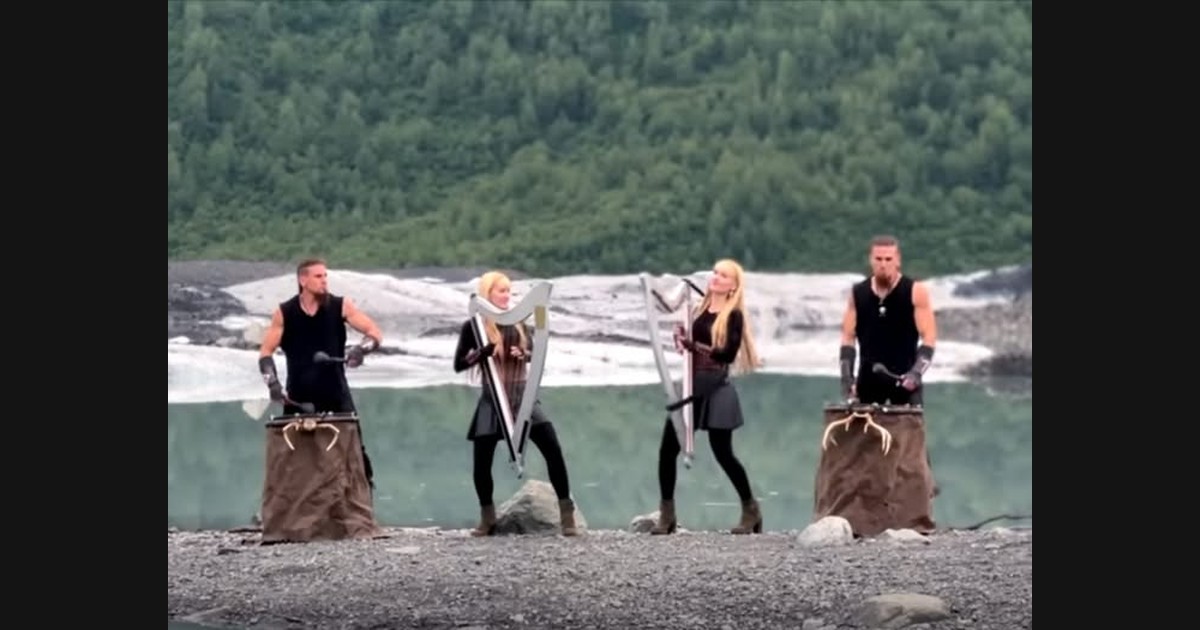
A performance video is a collaboration even when only a few people appear in the image. The Harp Twins and Volfgang Twins make that particularly easy to see in the official credits for Paint It Black. They name music production, mixing and mastering, filming and editing as separate contributions.
Those credits provide a stronger starting point than guessing how the recording was made from the scenery. They do not reveal every step of the workflow, but they identify several kinds of work that meet in the finished video.
The credited collaboration
Watch on YouTube ↗
The artists credit the music production to the Harp Twins and Volfgang Twins. Kevin Bartlett is named for mixing and mastering, Diane Carlson for filming and the Harp Twins for video editing. These are specific contributions to a new presentation of the Rolling Stones song, rather than claims to have written the original composition.
Four kinds of work, four different questions
| Credit | What it helps explain |
|---|---|
| Music production | The creative organization of the recorded performance. |
| Mixing and mastering | The preparation of recorded sound for its finished presentation. |
| Filming | The creation of the images used in the video. |
| Editing | The selection and arrangement of images into the final sequence. |
These descriptions are a map of responsibilities, not a reconstruction of the session. A credit does not tell us the number of takes, the exact order of recording or the equipment used. The useful point is that sound and image have related but distinct production histories.
For example, a camera cut can direct attention toward one performer while a musical part continues unchanged. The visual decision shapes the viewer’s focus; it does not necessarily mark a new sound entering the arrangement. Separating those events helps a viewer hear the music more accurately.
What the picture establishes and what it leaves open
A location can contribute atmosphere and a shared visual identity. It does not, by itself, prove that every sound was captured there during the photographed action. Equally, a produced soundtrack does not make the performers’ musical contributions disappear.
The credits allow both things to remain visible: musicians have created an arrangement, and a team has created a finished audiovisual presentation. There is no need to invent a choice between completely unmediated performance and meaningless fabrication.
A concert collaboration has another production frame
Watch on YouTube ↗
Metallica’s official Nothing Else Matters selection with the San Francisco Symphony changes the event and the ensemble. Compare how the images direct attention among the available musical contributors. A wide shot and a close-up can make different parts seem central even while the arrangement continues.
Keep the visual emphasis separate from the part you hear. This is especially useful in a large ensemble, where not every audible contributor can be on screen at once.
The same artists in another video
Watch on YouTube ↗
The Harp Twins’ electric-harp Paranoid selection gives a second reference for how an instrumental arrangement is presented through images. The song and instrumental setting change, so the purpose is to compare presentation rather than assume an identical workflow.
Reading the Paint It Black credits turns an attractive video into a useful example of collaborative craft. The performance, the recorded sound and the finished images are connected contributions. Naming their roles gives the viewer more concrete information than an unsupported claim that the clip shows exactly how every sound was captured.


