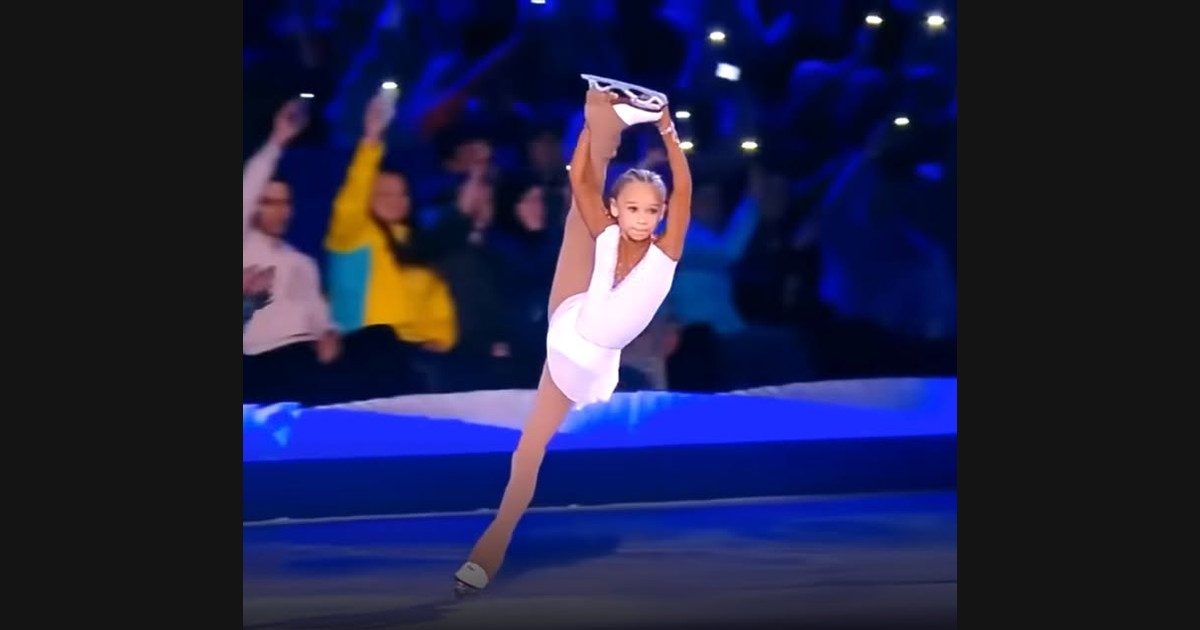
Veronika Zhilina’s “Hallelujah” is often encountered as a short skating clip, but its program identity supplies a more specific frame. The Ice Age: Children channel describes the appearance as an exhibition and identifies Alexandra Burke’s rendition as the music. Its episode fragment is labelled September 1, 2019.
The embedded YouTube upload has another distinguishing label: no commentators talking. That describes the way the excerpt is presented to the online viewer. It does not make it a different competition program or establish a new performance date.
Watch on YouTube ↗
An exhibition answers a different question
A television exhibition is a performance within a program. It should not automatically be treated as a scored competitive routine whose placement can be reconstructed from the video. The program’s own description is the appropriate starting point for identifying its purpose.
This frees a viewer from trying to turn every movement into an entry on a scorecard. The performance can be followed as a complete short presentation with a beginning, development, and ending. Technical ability remains relevant, but a claimed result needs an actual competition record rather than an assumption based on impressive skating.
The difference commentary can make
Spoken commentary offers an additional line of interpretation. It may name a participant, explain a context, or direct attention toward a detail. A version presented without that speech gives viewers a different distribution of information: the performance and soundtrack occupy more of their attention, while some surrounding explanation may be less apparent.
Neither presentation is automatically more truthful. A no-commentary label does not establish that the remaining audio is unprocessed or that every sound comes directly from the rink. It identifies one aspect of the viewing experience, not a complete production history.
For a thoughtful viewing, separate the excerpt’s boundaries from the performance’s boundaries. The beginning of a web video may be the beginning of the routine, or it may follow an introduction left outside the clip. The same applies at the end. An excerpt can be complete as a musical presentation while still belonging to a larger television program.
The soundtrack has its own publication history
“Hallelujah” is a Leonard Cohen composition included on Various Positions in 1984. Its familiar title should not by itself be used to classify the skating appearance as a religious ceremony or a personal dedication. The television program and the song have separate identities.
The related Alexandra Burke video is an official X Factor performance. It allows the vocalist to become the visible subject rather than the voice accompanying the skating presentation. It is a comparison recording, not proof that this exact television take was used in the rink.
Watch on YouTube ↗
One composition in another institutional frame
The United States Air Force Band’s Singing Sergeants provide the final vocal performance. The ensemble and publishing context change again. The common title connects the material, while the performers and occasions remain distinct.
Watch on YouTube ↗
Seen through these layers, the Zhilina clip is easier to place: an exhibition within a television program, accompanied by an identified recording and later encountered in an upload with its own presentation choices. That context lets the skating stand as a performance without surrounding it with an invented result or an unsupported personal story.


