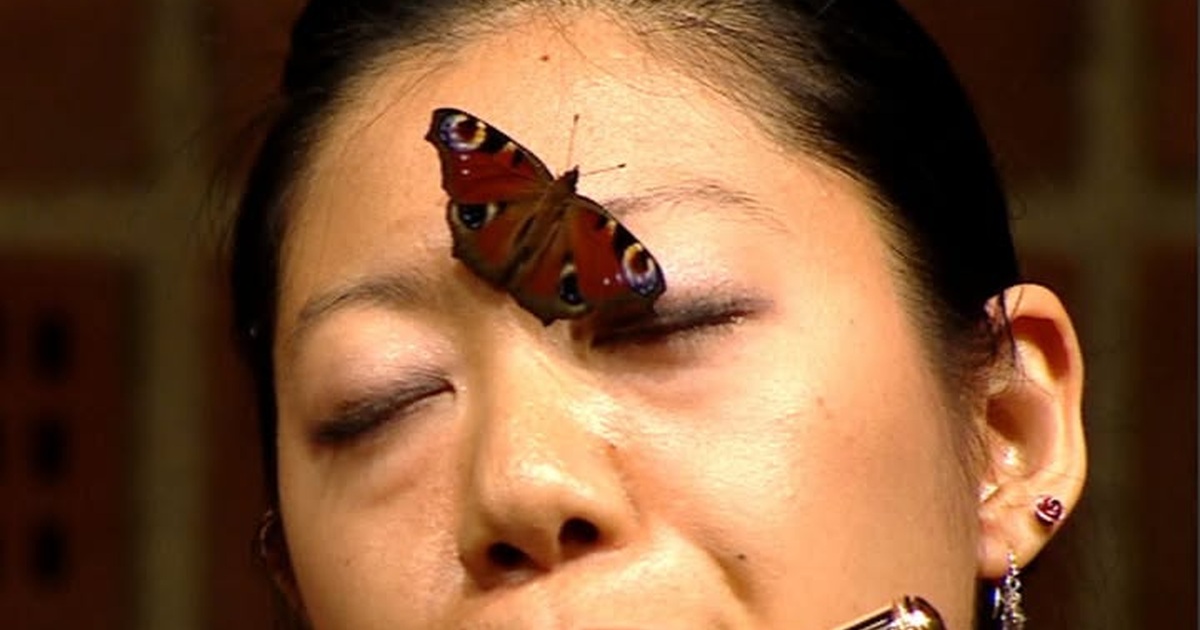
A butterfly landing on a musician creates an image that is easy to remember and difficult to stop watching. In Yukie Ota’s 2014 Carl Nielsen International Flute Competition appearance, the unexpected visitor briefly gives viewers something other than the performance to follow. The more interesting story is that a musical partnership remains in progress around it.
The Odense Symphony Orchestra’s upload identifies the Japanese flutist, the competition at Odense Concert Hall and Sancan’s Sonatine for Flute and Piano. It credits Anne Mette Stæhr at the piano. Those details restore the people and work behind a clip often encountered primarily as an unusual animal moment.
The competition recording
Watch on YouTube ↗
Two events occupy the same frame
The orchestra’s description reports the butterfly settling on Ota’s forehead while the music continues. That is the documented incident. It does not tell viewers exactly what she felt, whether she noticed every movement or how she would explain her response afterward. The image is striking enough without inventing an inner monologue for its performer.
There are two different kinds of attention available here. One follows an unpredictable visual event. The other follows a piece whose musical sequence continues to matter to the players. The butterfly can change what viewers notice without becoming the organizing principle of the performance itself.
That distinction explains why the clip can reward a return visit after the surprise is known. The initial question is what happens when the butterfly arrives. A second viewing can instead restore the work’s continuity: the flute and piano still have phrases to shape, entrances to coordinate and a musical direction to sustain.
The pianist belongs in the story
The title of Sancan’s piece names two instruments. The piano is not merely an invisible support service for the player holding the flute. A chamber work asks listeners to consider relationships: when an instrument introduces an idea, when another responds and how the two parts make a coherent span.
Stæhr’s credit is therefore more than a detail to append beneath a famous image. It identifies another performer participating in the musical situation. Keeping her name attached to the clip resists the tendency for a short visual incident to reduce an ensemble performance to a story about one person alone.
A useful way back into the music is to follow a shared phrase across both instruments. Notice what you can distinguish, rather than trying to diagnose the effect of the interruption. The point is to hear a partnership continuing, not to manufacture a technical account of a moment the recording cannot fully explain.
From a chamber partner to an orchestra
The related Nielsen Flute Concerto recording changes the setting. Clara Andrada de la Calle appears with the Frankfurt Radio Symphony under Jaime Martín. The solo instrument now relates to an orchestra rather than one pianist, giving the flute a different field of musical partners.
Watch on YouTube ↗
That expansion is more useful to consider than a simple increase in loudness or prestige. A concerto can place the soloist within a broader set of exchanges, with different instrumental groups contributing to the surrounding texture. Follow who carries an idea when the flute is not your immediate focus.
A second concerto, a fresh comparison
The final recording presents Ibert’s Flute Concerto with the same soloist, conductor and orchestra. Keeping those performers constant while changing the composition offers a more focused comparison of the different musical tasks the works create.
Watch on YouTube ↗
You do not need to decide which piece is more demanding to find something useful in the sequence. The Sonatine introduces flute and piano as partners; the concertos widen the relationship. Ota’s unexpected visitor remains a memorable reason to discover the first clip, while the named musicians and repertoire provide reasons to stay after its novelty has passed.