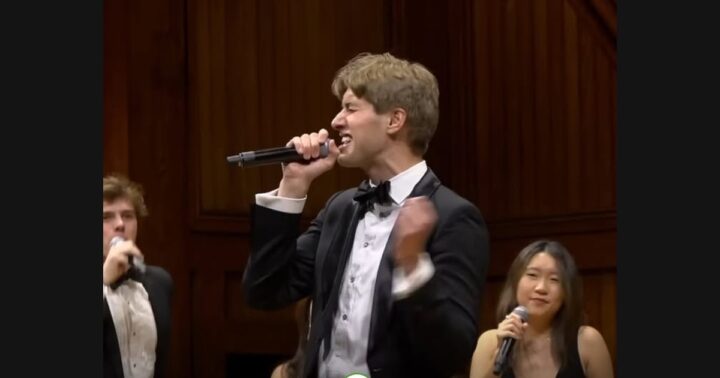
David Armand’s “Don’t Stop Me Now” routine adds a visual game to Queen’s recording. In the BBC’s Fast and Loose clip, Hugh Dennis introduces Armand while Pippa and Ruth are asked to identify the song. The television viewer already has a useful advantage: a title, a soundtrack, and a view of the clues being presented.
That difference in information is central to the comedy. A movement can be obvious to someone who knows the phrase behind it and puzzling to someone who has only the gesture. The routine allows both experiences to exist within the same short performance.
Watch on YouTube ↗
A visual clue has two jobs
A clue has to suggest an idea, but it also has to arrive at the right moment. A perfectly recognizable gesture can lose its usefulness if the song has already moved several thoughts ahead. The recorded track supplies a fixed sequence that the mime must keep addressing.
This creates a comic form of translation. Words can refer to something concrete, use a figure of speech, or suggest more than one meaning. A physical response can make one possible reading conspicuous. The humor often comes from the distance between a song’s fluent expression and the deliberately concrete image a body can offer.
Why recognition changes the experience
If you already know the song, you can follow the relationship between clue and phrase. If you do not, you may read the gestures as an unusual scene whose logic only becomes clear afterward. Neither viewing position is wrong; the difference is part of the format.
For a useful second pass, attend to the point at which you recognize a clue rather than merely its final shape. Does recognition happen as the movement starts, when it is completed, or only when the next clue clarifies it? That question focuses on comic timing without requiring a list of lyrics or an invented account of individual gestures.
The performer is not replacing the recording
Queen’s music continues to provide melody, pulse, and a sequence of phrases. Armand contributes another layer: a moving visual interpretation. The act would be misdescribed as a live vocal cover or as a new recording by Queen.
It is also unnecessary to assume the mime was invented entirely on the spot. The series includes improvised games, but that program description does not establish the preparation behind every particular routine. A prepared sequence can still involve demanding timing and produce surprise for viewers.
Try a different song inside the same game
The BBC’s “You’re So Vain” selection keeps the interpretative format while changing the material. A different song supplies a different pace of ideas and a different relationship between direct description and implication. The challenge is not just to move quickly; it is to find clues that remain readable.
Watch on YouTube ↗
“Eternal Flame” offers another variation on that task. A familiar title may give viewers an initial foothold, but the routine still has to continue after recognition. The performance’s interest cannot depend on the first clue alone.
Watch on YouTube ↗
Across the three routines, Armand’s subject is the gap between musical fluency and visual explanation. A song can feel effortless to hear while being surprisingly awkward to turn into gestures. The game makes that awkwardness visible, giving familiar recordings another kind of comic life.