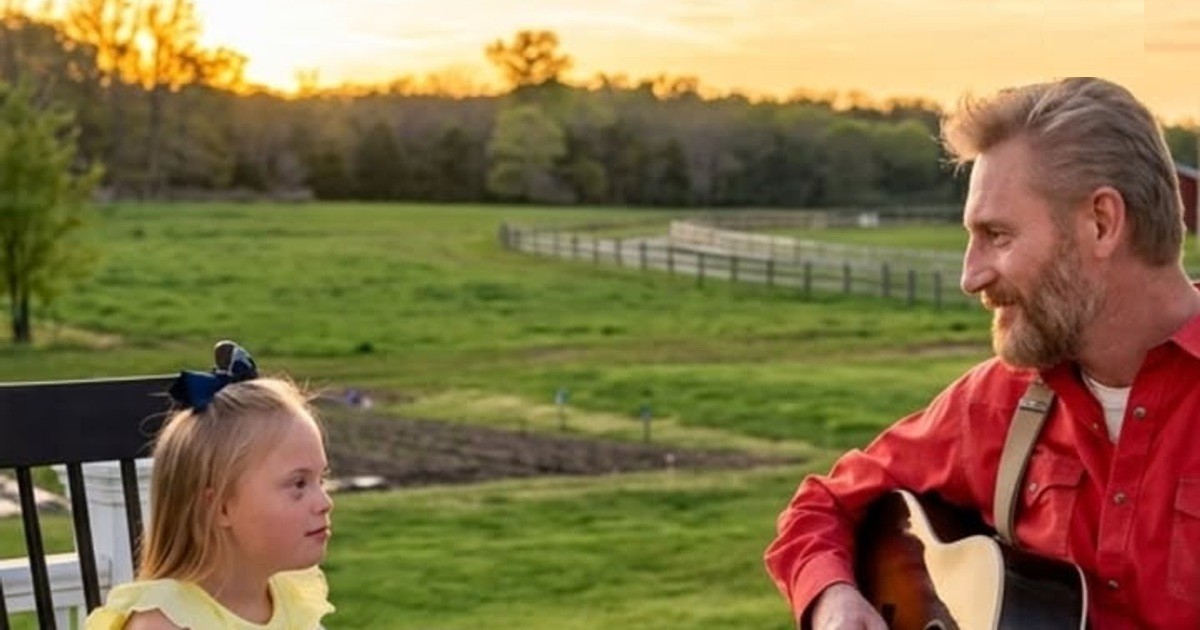
A question-and-answer song gives two performers different jobs before either begins. One voice opens a possibility; the other responds. Rory and Indy’s official Papa What If video makes that conversational design a useful subject in its own right, beyond the simple appeal of a parent and child appearing together.
Rory Feek’s own description credits the song to Shel Silverstein and presents the video as a Father’s Day release in June 2022. It also credits a production team. Those facts let the family relationship and the crafted musical presentation remain visible together, without pretending the recording is an unplanned private moment.
The official song video
Watch on YouTube ↗
In a question-and-answer structure, contrast does not depend on two voices sounding alike. Their difference can make the roles easier to follow. A question creates an opening; an answer gives that opening a direction or changes its scale.
The repeated conversational pattern also establishes expectations. After hearing one exchange, a listener understands how another might begin. The interest then lies in what varies inside that familiar frame. Repetition provides orientation rather than simply repeating the same information.
Three small pieces of songwriting craft
- A recognizable role: the listener can distinguish who initiates an exchange and who responds.
- A repeatable frame: a new question can arrive without requiring an entirely new musical structure.
- A changed perspective: an answer can turn a small imagined problem into a different way of looking at it.
This kind of construction is useful to notice because its apparent simplicity can conceal careful organization. A song does not need dense language or constant melodic change to develop an idea. A stable frame can let the relationship between its participants supply the movement.
For example, a question can feel open because its musical phrase has not fully settled. An answering phrase can supply a point of arrival. The exchange then works through sound as well as through the words, even for a listener who does not follow every detail of the text.
A live appearance changes the frame
Watch on YouTube ↗
The related Rory and Indiana selection is presented as a special event at the Mulehouse. It places the family pairing within another public performance context. Compare how attention is shared between the participants rather than assuming a live appearance is automatically more sincere than a produced video.
A recording and a stage event offer different resources. A produced video can organize images and sound into a finished presentation; a public appearance also includes the circumstances of the room. Neither format provides a complete account of the family outside the performance.
Another family duet, another song design
Watch on YouTube ↗
James Taylor’s official selection with Henry Taylor, labeled at the Honda Center in 2021, offers a useful contrast. A family connection can be part of a performance without the song itself being written as the same kind of question-and-answer exchange.
Compare the musical roles rather than the private relationships. Are voices alternating, supporting or combining? Those distinctions help explain what the song asks of its singers. In Papa What If, the conversational design gives each participant a clear place, allowing the shared performance to grow from an accessible, repeatable songwriting idea.