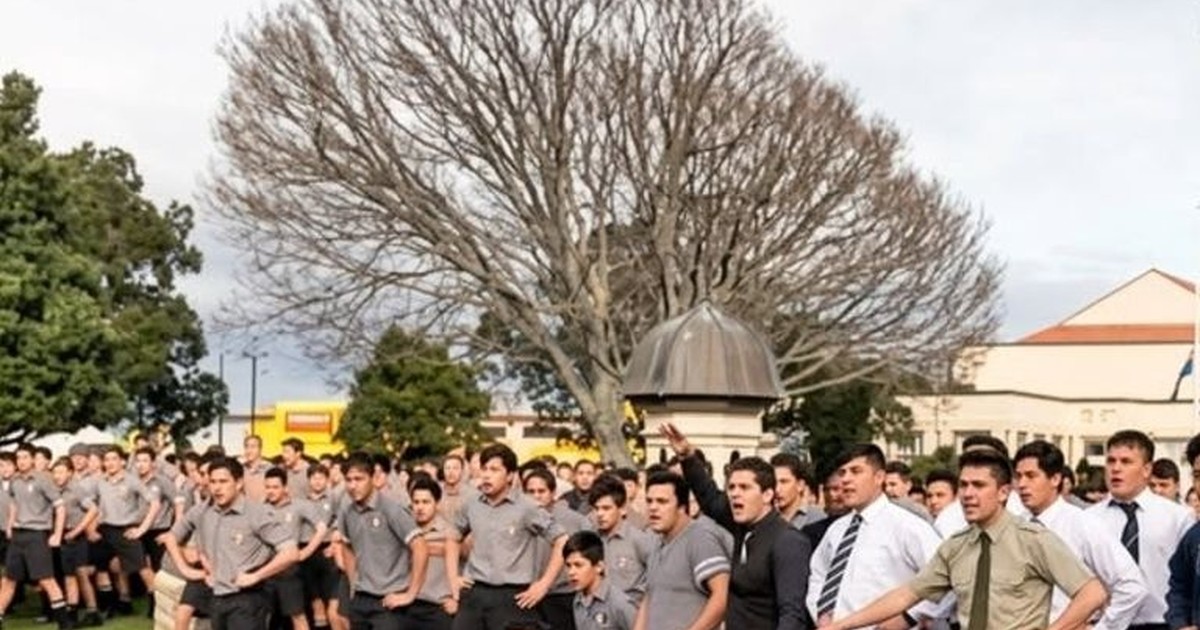
A school’s recurring performance form can connect different generations without making their occasions identical. The Palmerston North Boys’ High School haka for Dawson Tamatea’s funeral offers a specific example: a community uses its own repertoire to address the loss of someone connected with that community.
The school’s contemporary newsletter says Tamatea helped bring about the writing of its haka. That detail gives the recording an additional relationship to institutional memory. The form through which he is acknowledged also connects with work he helped make possible.
The school’s published farewell record
Watch on YouTube ↗
Shared repertoire survives through use
Institutional memory can be stored in documents, names and images. Repertoire supplies another form: people learn something that can be undertaken again. Its continuity depends on present participants doing the work, rather than only on preserving an earlier recording.
A repeated form can therefore remain active. The next performance belongs to another group of participants and another moment, even where a school identity supplies a connection. Continuity does not mean that every use must repeat exactly the same social situation.
In Tamatea’s recording, the school identifies a funeral service and the arrival of his hearse. That purpose matters as much as the institution’s name. The performance is directed toward an immediate farewell, not merely toward a future audience that might encounter the video.
A recording preserves one use, not every meaning
Once published, a performance becomes available to people outside the original gathering. The recording supplies access, but it cannot transfer every relationship or piece of knowledge the participants bring to the occasion.
This is why the label remains important. The name of the person, the school and the event provides a compact history that should travel with the clip. Without it, a viewer may receive only a generalized impression of collective intensity.
The record can invite further understanding without making an outsider an automatic translator. A viewer can recognize that something is a school haka while still needing the institution’s or knowledgeable participants’ account to understand particular words and associations.
Another PNBHS farewell
The second official upload identifies a tribute haka for Steve Burnley’s funeral service on November 24,2015. The same school name creates continuity, while the person and occasion remain separate.
Watch on YouTube ↗
That is the practical meaning of repertoire extending beyond one event. A community can have a shared form available for different addresses. Its familiarity does not make the individuals being acknowledged interchangeable.
Compare the credits before making a broad claim about the two recordings. The exact relationship begins with what the school names, rather than an assumption that every similar-looking clip belongs to the same service.
Another school’s own record
Hereworth identifies the final selection as its school haka for Mr Bibby. Another institution now supplies the repertoire relationship. The shared general form does not establish identical composition or local history.
Watch on YouTube ↗
Across these records, institutional memory is both continuous and specific. People inherit a form they can undertake together, then direct it toward a person and occasion in the present. The published video preserves that use. Keeping the names attached allows the memory to reach further without dissolving into an anonymous performance category.


