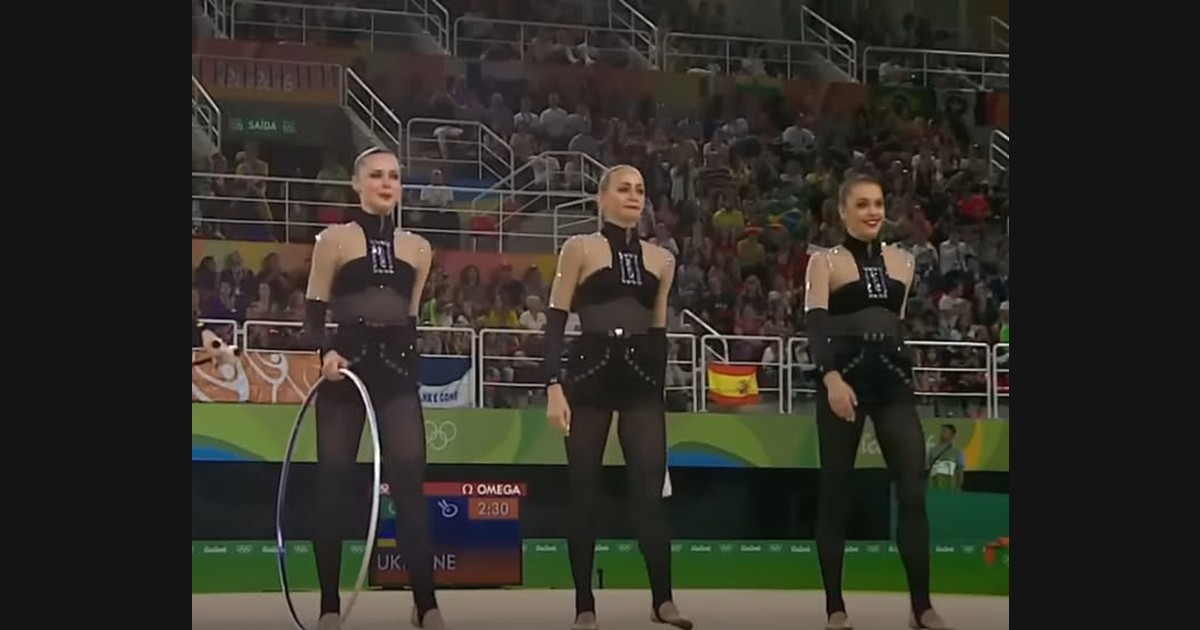
A group routine can look unified without every gymnast doing the same thing. That distinction is a rewarding way into Ukraine’s rhythmic gymnastics recordings: music provides a common timeline, while bodies, apparatus and formations can occupy different parts of it. Togetherness is a relationship between actions, not simply a row of matching gestures.
The Olympic Games channel identifies the first two recordings with Ukraine’s rhythmic gymnastics team at Rio 2016 and Madonna’s “Vogue.” Its description of the second specifies hoops and clubs. The third recording comes from the Paris 2024 group all-around final and features five hoops. These are different Olympic editions, rather than three angles on a single routine.
Watch on YouTube ↗
Three things can be organized at once
Start by separating the performers, the objects and the space between them. A gymnast’s movement is one element. An apparatus has its own path and duration. The group’s arrangement across the floor creates another pattern. Watching all three simultaneously can make a short routine difficult to take in; following one layer gives the next viewing a clearer purpose.
For example, following a hoop means tracing an object rather than choosing a favourite performer. Following formation means noticing how the shape of the group changes, even when an individual detail attracts attention. These are viewing strategies, not a claim that a particular exchange happens at a specific point in these recordings.
Music supplies a reference that continues while attention moves between layers. A returning phrase or accent can help a viewer recognize a boundary between sections without needing to identify every technical element. It also explains why a routine should be considered across time rather than judged from a dramatic still image.
Unison and coordination are not synonyms
In unison, matching actions make a shared time point easy to see. Complementary actions work differently: one performer’s task can help make another task possible. A group can therefore remain closely coordinated while its members have visibly different responsibilities.
The hoops-and-clubs description is useful here. Different apparatus can make differences in action especially noticeable, yet all participants still belong to one composition. A viewer does not need to convert those differences into a judgement about who is doing more. The relevant question is how the parts connect to the whole.
Watch on YouTube ↗
Compare the organization, not the scores
The Paris 2024 recording provides a different reference because its five-hoop context is explicitly identified by the Olympic channel. With the apparatus type held in common, a viewer can concentrate on how placement and timing distinguish individual contributions.
This does not establish that the same athletes appear across the two editions or that the routines can be ranked by a casual comparison. It supplies two examples of a group coordinating around different apparatus arrangements. Keeping the event labels straight makes that comparison more informative.
Try describing one section in ordinary language before looking for specialist terminology: where is the group’s centre of attention, when does it change, and what helps make that change legible? A description of an observable relationship is more useful than calling every striking moment an impossible trick.
Watch on YouTube ↗
The musical choice also deserves to remain a choice within a sporting routine. A “Vogue” soundtrack identifies the recording’s musical reference; it does not automatically mean that the choreography reproduces Madonna’s performance. The interesting connection is how a recognizable piece of music can become a shared clock for several athletes and several moving objects, producing one sequence from interdependent tasks.


