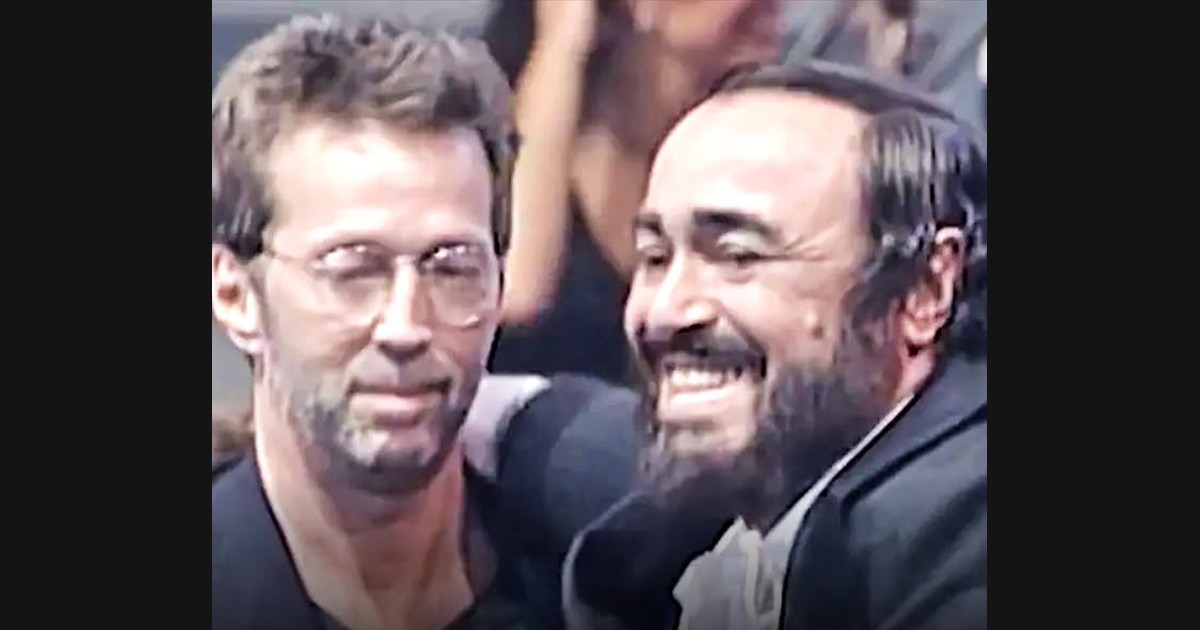
Eric Clapton and Luciano Pavarotti are the names that usually introduce “Holy Mother.” The recording’s credits reveal a more useful story than a meeting between two famous singers: a song passes through several kinds of creative responsibility before it reaches a listener. Understanding those jobs makes a large concert performance easier to discuss precisely.
The official live video names Clapton, Pavarotti and the East London Gospel Choir. The Universal Music Group audio listing also identifies writers, an arranger, a conductor, a producer and balance engineers. These credits concern related work, but they are not interchangeable badges for whoever deserves the most applause.
Watch on YouTube ↗
The song and the setting are different contributions
The composition is credited to Eric Clapton and Stephen Bishop. That credit concerns the underlying song. A performance can change its scale, instrumentation or delivery while retaining that authorship. Seeing Pavarotti’s name prominently on an upload does not make him the songwriter; recognizing the writers does not diminish what an interpreter contributes.
Rob Mathes receives the arrangement credit. Arrangement concerns how a song is set out for particular musical resources. In a project bringing together soloists, a choir and an orchestra, that is an especially useful distinction: the composition supplies material, while an arrangement determines a workable setting for the assembled performers.
The credit does not, by itself, tell us which individual proposed every musical decision. It identifies responsibility without giving us a transcript of rehearsals. That boundary prevents a familiar mistake: turning a short personnel list into an invented story about a collaborator’s intentions.
Leading the ensemble is another job
The listing names the Orchestra Filarmonica Di Torino and conductor Marco Armiliato. Conducting and arranging can overlap in one person’s career, but they are separate credits here. One concerns the musical setting; the other concerns directing an ensemble’s realization of that setting.
This separation gives a listener a concrete framework. A question about which instruments carry a passage belongs to the arrangement and performance. A question about how participants coordinate entrances belongs to ensemble execution. Neither can be answered simply by noting that the two soloists come from different musical traditions.
Watch on YouTube ↗
A recorded concert has another layer of authorship
Phil Ramone is credited as producer, with John Pellowe and Philip Siney as balance engineers. Those names remind us that a recording is also an organized sound document. Musical forces perform in a space; listeners encounter a version captured and presented through recording work.
A balance-engineering credit is not proof of a particular microphone placement, edit or technical correction. It establishes the people credited for that part of the production. Without session documentation, precise claims about how an individual voice was processed would go beyond the evidence.
A helpful comparison is a theatre programme and a screen credit roll. Both describe collaboration, but the recorded version adds responsibilities that are not fully visible from a seat in the venue. The person leading the orchestra and the people shaping a recorded balance solve different practical problems.
Watch on YouTube ↗
A more accurate way to describe the collaboration
Instead of compressing everything into a rock-and-opera crossover, separate three questions: who wrote the song, who prepared and performed this setting, and who produced the recorded document? “Holy Mother” has named contributors at each level. Following those distinctions gives credit more fairly and makes the music’s collaborative structure clearer without pretending that a personnel list reveals every decision made behind the scenes.


