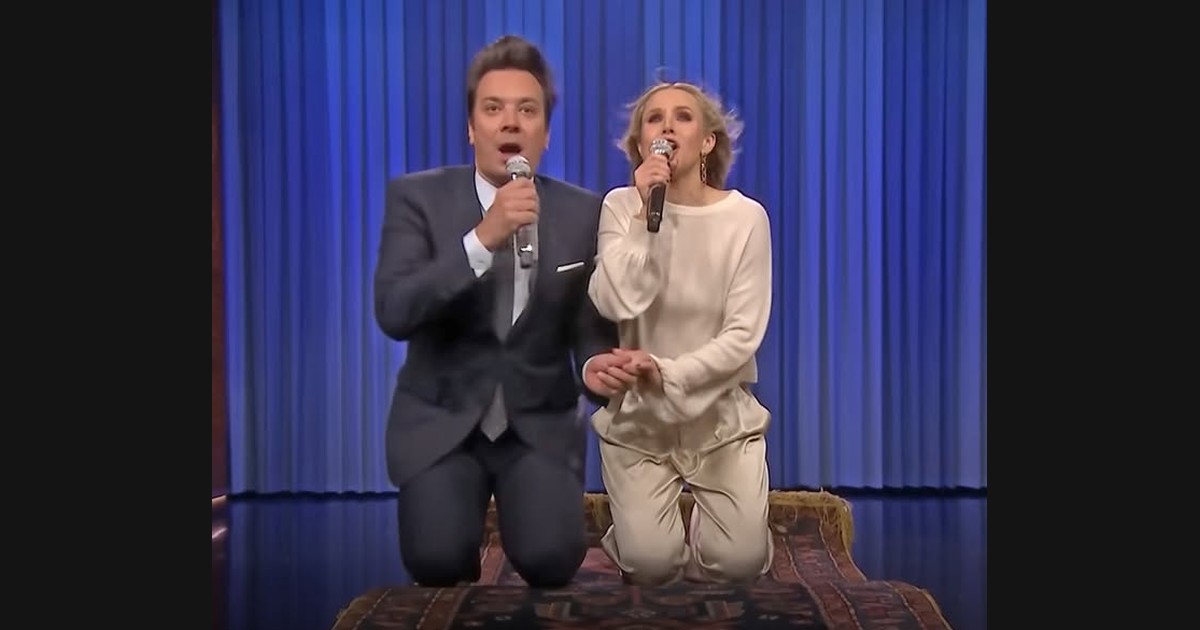
A medley is remembered through its familiar pieces, but its joins help make those pieces one performance. Kristen Bell and Jimmy Fallon’s History of Disney Songs invites attention to that construction. Instead of identifying every fragment as quickly as possible, follow how one musical idea gives way to the next.
The companion selections provide two useful contrasts: Bell and Dave Grohl’s specifically identified Frozen–Metallica mashup, and a fan karaoke presentation of the Disney sequence. Each organizes continuity differently.
Watch on YouTube ↗
An ending becomes somebody else’s beginning
A complete song normally has time to prepare its own introduction, development, and conclusion. A medley excerpt may leave before that full arc is complete. Its endpoint has to work locally while also connecting with another recognizable beginning.
Listen for the mechanism of a join. Does a continuing pulse connect the fragments? Does a brief space make the change clear? Does one ending seem to prepare the next entrance, or does an abrupt contrast supply the effect?
Those are different solutions, and a medley need not use only one. A smooth connection can preserve momentum; a conspicuous change can create a joke or make the new reference immediately legible. The important question is what the transition does within the sequence.
A history title identifies a selection
The Tonight Show’s title gives the number a broad historical frame, but a performance medley is still a selection. It does not need to include every Disney song or reproduce the complete dramatic context of each one.
That makes curation part of the entertainment. Familiarity helps a listener bridge missing material, while the arrangement determines how long a reference remains in the foreground. The joins expose the process: each choice creates a new neighboring relationship that the separate source songs did not originally have.
Watch on YouTube ↗
Snowman and Sandman create another relationship
Kimmel’s own description identifies Bell and Grohl’s pairing as a mashup of “Do You Want to Build a Snowman?” and Metallica’s “Enter Sandman.” Those specific source titles explain the premise more clearly than a general statement that Disney became rock music.
Compare source relationships rather than simply counting tunes. A medley typically moves between selections; a mashup brings source material into a combined relationship. Actual arrangements can cross that boundary, so attend to how the references interact in this particular presentation.
The two television segments are separate productions. Their shared guest does not make them one performance or establish that the same collaborators arranged both.
Watch on YouTube ↗
Karaoke turns the sequence into a navigation task
The fan karaoke presentation invites another form of participation: following cues through the sequence. A viewer now has to anticipate a change rather than only recognize it after it occurs.
A karaoke label does not guarantee that every printed word or timing cue is authoritative. Use the official performance as the reference when a detail is uncertain, keeping the fan presentation’s practical role separate from its source status.
For a final pass, ignore the individual titles briefly and describe three joins. Name the connection or contrast that makes each work. That reveals a medley’s distinctive craft: familiar fragments become a new continuous number because their boundaries have been given musical jobs.


