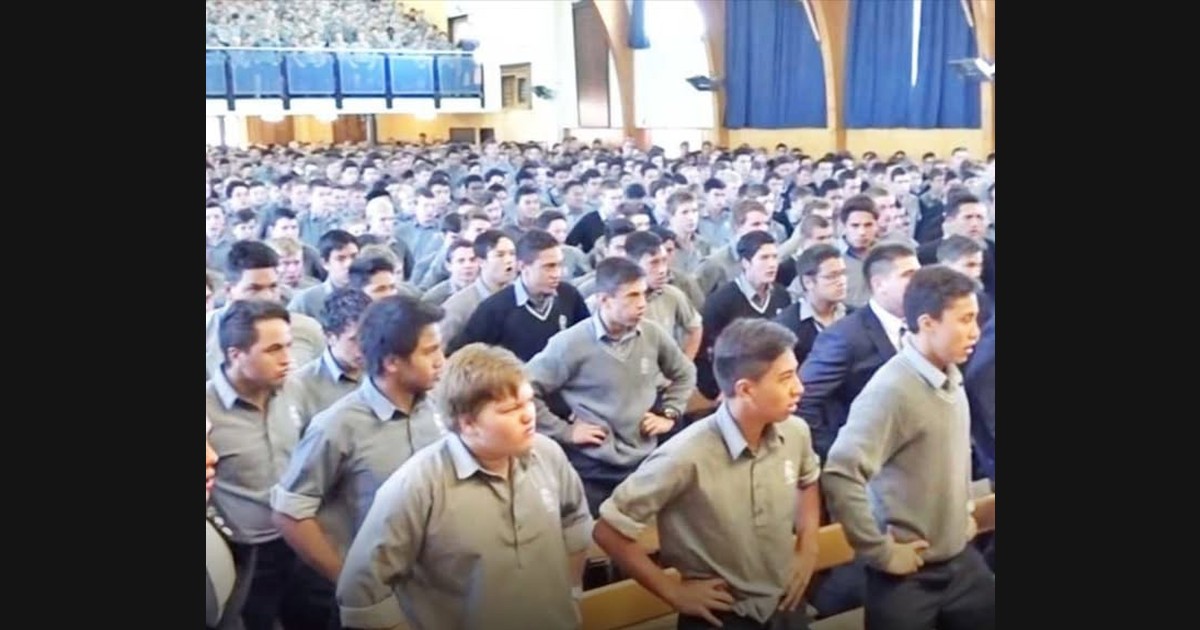
A school can acknowledge a departing member through more than one form of expression. Palmerston North Boys’ High School publishes both a farewell haka for John Adams and a rector’s spoken farewell. Hearing them as complementary tributes offers a more specific account than treating the collective performance as an isolated display of intensity.
The school’s 2016 newsletter places Adams’ departure within its own assembly history. That institutional reference identifies the occasion, while the two recordings show different public ways of acknowledging the same person.
Watch on YouTube ↗
A collective form changes the speaker
In a speech, an individual can name a contribution and address the audience through a continuous verbal account. In a collective performance, the group becomes part of the statement. Shared timing, voice, and movement can make participation itself visible.
That distinction does not give an outside viewer permission to invent a translation. The language and cultural context matter; a general impression from sound or gesture cannot substitute for verified meaning. It is possible to appreciate coordination while remaining clear about what has and has not been explained.
Te Ara’s account of Māori performance describes haka as a living art with varied social purposes, including praise and respect. That broader context helps a viewer avoid treating every haka as a generic expression of aggression, while leaving this school’s particular words to their own documented explanation.
Watch the relationship, not an imagined emotional script
The useful relationship is between the group performing and the person being acknowledged. Notice how the collective account is organized in time: the establishment of a shared reference, the continuation of a phrase, and the preparation of an ending.
Those features can be described without claiming that every participant felt the same thing or that a recipient’s expression reveals a complete private response. The public tribute has a clear purpose even when individual experiences remain private.
Watch on YouTube ↗
The rector’s farewell supplies another kind of detail
The school’s upload of rector David Bovey’s farewell gives the occasion a spoken reference. Rather than forcing the haka to explain every biographical detail, use the address to understand how the institution identifies the person and the contribution being recognized.
Compare the forms through their different strengths. A spoken account can specify and explain. A collective performance can make shared participation central. Neither needs to be declared the only sincere expression of appreciation.
A useful viewing note can contain two headings: “what is explicitly said” and “how the group participates.” Keep factual details under the first when the speech establishes them, and observations about coordination under the second.
Watch on YouTube ↗
A later leavers’ farewell provides a separate reference
The 2022 Year 13 recording belongs to another occasion. It shows the school identifying another group of people at a transition, rather than supplying more footage of Adams’ departure.
Its connection is institutional practice, not an identical audience or a single event stretched across several uploads. Keeping those boundaries clear makes the comparison respectful and intelligible.
Return to Adams’ farewell with both the spoken and collective forms in mind. The tribute can then be understood as a documented school occasion with several ways of acknowledging service, rather than a dramatic clip whose meaning has to be guessed entirely from its visual force.


