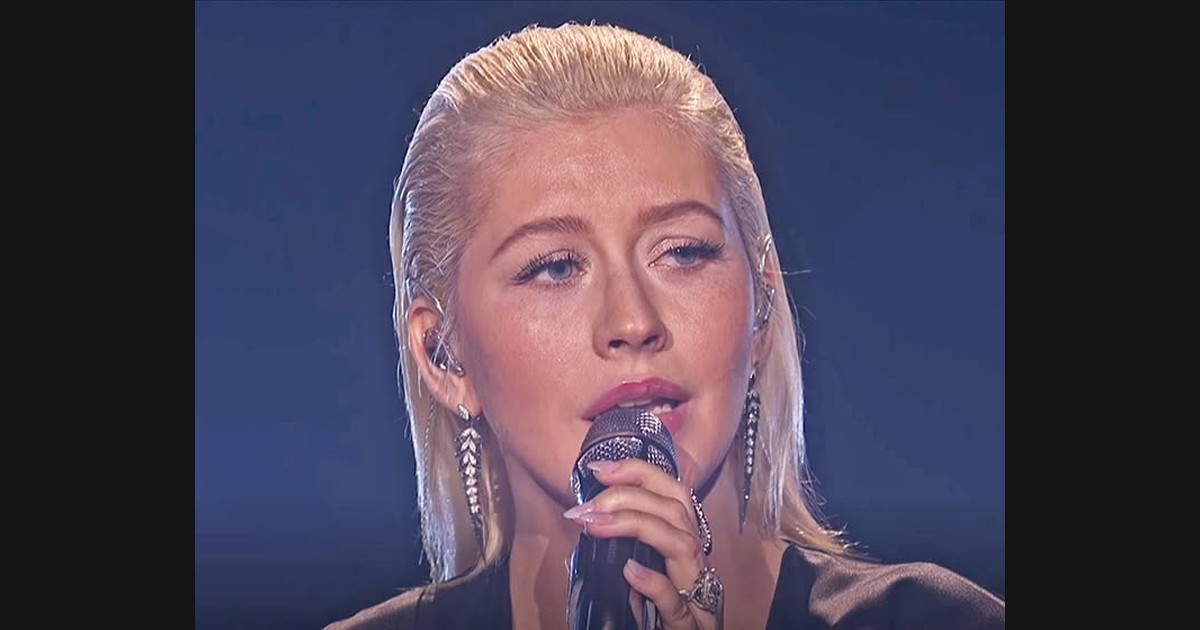
A tribute to Whitney Houston can also lead back to another songwriter. Christina Aguilera’s 2017 American Music Awards performance revisits the repertoire of The Bodyguard, including I Will Always Love You. Houston’s interpretation and Dolly Parton’s composition belong to the same history, with different creative responsibilities.
Houston’s official site announced the performance as a celebration of the film and companion album’s twenty-fifth anniversary. That occasion gives Aguilera a particular task: interpret music strongly associated with another artist while preserving the work’s continuing ability to support a new voice.
Watch on YouTube ↗
A signature recording need not be a self-written song
Houston’s official track page credits Parton as songwriter and David Foster as producer. It also preserves Houston’s own acknowledgment of Parton’s writing and her concern about how Parton would receive the changed arrangement and vocal approach.
That account treats interpretation as meaningful work. A cover can transform the public identity of a composition without erasing its author. The original writer and the later recording artist can each contribute something the listener recognizes.
For the tribute, another layer follows. Aguilera is engaging with a song through Houston’s famous place in its history. It is possible to hear that relationship while still remembering that the composition existed before the film.
A goodbye can contain affection
Parton’s official album history places her earlier recording on Jolene in 1974 and connects it with leaving Porter Wagoner’s programme. The song’s farewell context complicates an assumption that its title simply promises to remain together.
Its dramatic tension is that affection and departure can coexist. A singer has to carry both ideas: the decision to go and the continuing wish for another person’s well-being. Treating it only as a declaration of romantic permanence would flatten that relationship.
This gives an interpreter a clear action beyond reaching a famous note. The thought has to remain connected across its quieter statements and larger returns. A climactic phrase matters partly because the preceding material has established what the farewell costs.
Watch on YouTube ↗
The tribute is a selection from a larger repertoire
The second upload revisits Aguilera’s Bodyguard performance through another presentation. The anniversary is the common occasion. These are viewing versions of the tribute, rather than proof of separate ceremonies.
A medley necessarily selects from its source material. It cannot be the entire soundtrack or a complete reproduction of every original recording. Its value lies in what the selection communicates about the artist being honored.
Watch on YouTube ↗
Houston’s video gives the recording its own space
The official I Will Always Love You video returns attention to Houston’s interpretation, with its own musical scale and connection to the film. It lets the song develop without the transitions required by a tribute medley.
The comparison is most useful when it keeps contributions visible. Parton supplies the composition, Houston gives it a defining recorded interpretation, and Aguilera carries that repertoire into an anniversary performance. Each stage depends on an existing work while adding another way for it to be heard.


