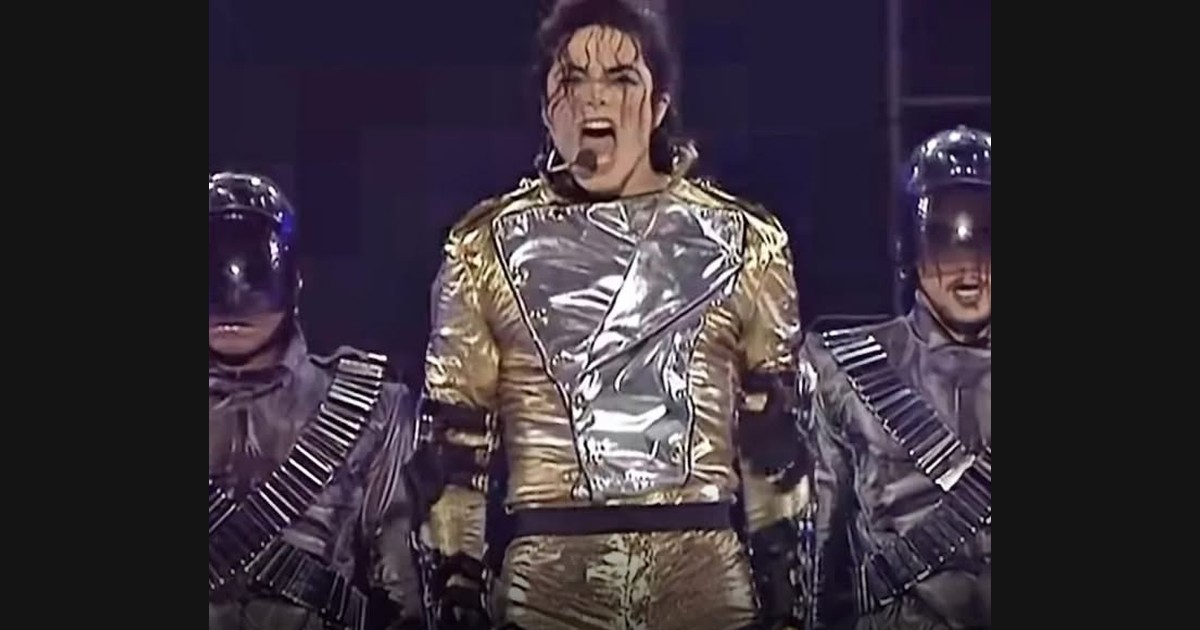
A large Michael Jackson stage presentation can direct attention toward the lead performer and the dancers around him. “They Don’t Care About Us” also invites a rhythm-focused pass, especially because drummer Jonathan Moffett publishes a companion version under his own name. His credit makes the instrumental contribution harder to overlook.
The principal upload labels the footage Munich 1997. Moffett’s own video likewise identifies Jackson, the song, and that concert context. These labels connect the viewing set without establishing that every uploaded image format or sound treatment is identical.
Pulse and accent are different layers
The pulse is the regular beat a listener can follow. An accent gives particular events emphasis. A recurring rhythmic figure can organize accents around the pulse, creating an identity more specific than simply saying that a performance has a strong beat.
Watch on YouTube ↗
For a focused pass, retain the underlying beat while attending to a repeated figure. Notice how the figure relates to the larger vocal phrase. The rhythm can remain recognizable even when the featured line continues across several repetitions.
This way of listening does not require a claim about every sound’s production source. A concert soundtrack can combine several resources; the mere presence of a drummer does not establish that all percussive sounds originate from one visible instrument.
The stage uses a shared musical reference
Coordinated movement and instrumental parts need points of connection. A musical accent can provide a reference for a gesture, while a repeating pattern can support a longer movement sequence. The relationship is one of shared time rather than a demand that every gesture illustrate an individual drum strike.
| Musical layer | Useful distinction |
|---|---|
| Pulse | The regular reference beat. |
| Repeated figure | A recognizable group of rhythmic events. |
| Accent | An event given particular emphasis. |
| Larger phrase | A statement extending across several beats or patterns. |
Following those layers helps the viewer hear structure underneath the stage picture. The dancers and singer occupy the foreground, but the performance’s continuity also depends on the musical framework surrounding them.
The drummer’s upload changes the entry point
The second video comes from Moffett’s own channel and explicitly identifies his participation. It offers a participant-published reference for the ensemble rather than an anonymous fan caption.
Watch on YouTube ↗
Use it to follow the rhythmic contribution through a corresponding passage. A different publishing frame can direct attention to a musician who is less conspicuous in the wider stage image. That does not require imagining a separate concert or assigning every production choice to the uploader.
The official music video changes the visual work
The final selection is Jackson’s official music video. It supplies another presentation of the composition, with a different visual purpose from concert documentation. It is not another view of the Munich stage performance.
Watch on YouTube ↗
For this comparison, keep the recognizable rhythmic idea in mind while noting how each visual form directs attention. A music video and a concert can use the same song without making the same image sequence or documenting the same event.
The drum-focused route adds substance to a familiar performance. Instead of seeing accompaniment as background to choreography, hear the repeated figures and accents as part of the framework that makes the stage sequence coherent.


