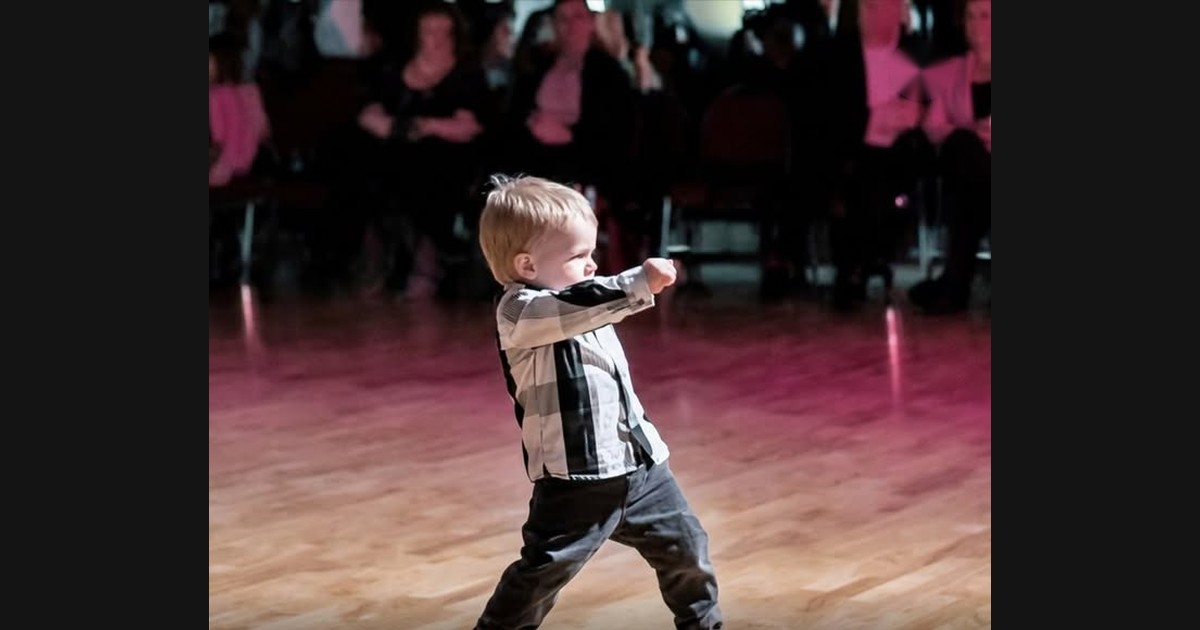
The familiar voice in William Stokkebroe’s early studio dance belongs to a much older recording world. Jailhouse Rock was made for Elvis Presley’s 1957 film of the same name, with Jerry Leiber and Mike Stoller as its songwriters. The clip brings that recorded song into another room and another generation.
Studie 43’s original account identifies William’s dance with the interval at a studio gala opening in March 2012. The song was part of the music playing there. It is not a new vocal performance by the people appearing on the dance floor.
Watch on YouTube ↗
A record carries several people’s work
Elvis’s official catalogue dates the recording to 30 April 1957 at Radio Recorders in Hollywood. It names instrumental contributors including Scotty Moore, Bill Black, D.J. Fontana, Dudley Brooks and Mike Stoller, alongside Presley and the Jordanaires.
Those credits give a fuller starting point than treating the track as one famous voice with an anonymous backing. The rhythm and instrumental responses that make a dance recording usable are parts of a coordinated musical construction.
There is also a distinction between the story in a song and the circumstances in which people later play it. A number created for a film can become music for a studio gathering without turning that gathering into a recreation of the movie’s plot.
The song supplies a sequence to move through
A dance track provides both a pulse and a larger phrase structure. Pulse gives a continuing reference; phrases give changes a place. A dancer can respond to a repeated beat while also sensing that a musical thought is approaching its end.
That difference is useful for watching the studio recording. Instead of treating every action as an attempt to imitate Elvis, consider how movement relates to the recorded sequence. The practical connection may be rhythm, emphasis or a sense of arrival rather than a copied screen gesture.
A familiar track can also let spectators follow the task. They share the same musical reference even when they do not dance. The record becomes a common clock for the people moving and the people watching.
Watch on YouTube ↗
The old age label belongs to the old footage
The companion upload describes William as newly two years old. That is a label for the historic scene, not a current biographical description. Its online circulation does not change when the underlying moment took place.
Likewise, a second upload does not establish a second performance. Keeping those distinctions clear makes the song’s long circulation easier to understand: one record can enter many events, while one event can produce many online copies.
Watch on YouTube ↗
A different dance setting follows
The final video is Studie 43’s 2018 break show featuring William and Specific Kidz. It supplies another performance context rather than another presentation of the same early Jailhouse Rock moment.
The connection between the recordings is a participant, while the opening clip’s musical history reaches further back. Remembering the songwriters and recorded players gives the dance another dimension: a new use for music whose pulse and phrases were made decades earlier.


