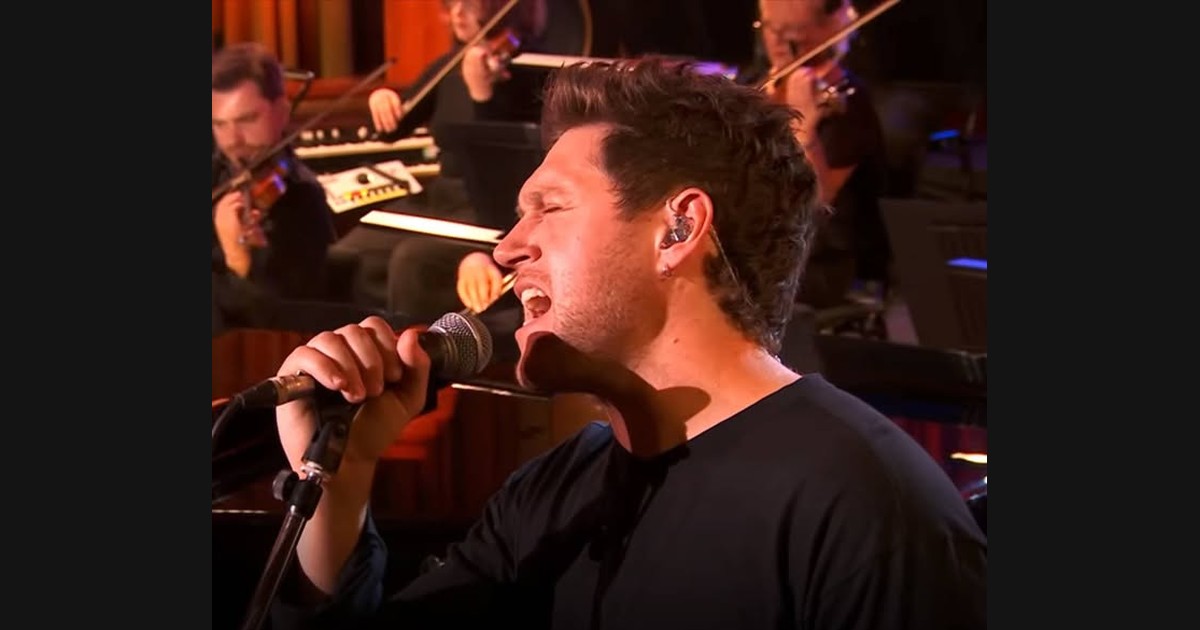
Niall Horan’s Radio 2 Piano Room “Desperado” appears here beside “Nice to Meet Ya” and “Little More Time,” with all three official BBC titles crediting the BBC Concert Orchestra. That makes the set more useful than an isolated comparison between a pop singer and a classic-rock song. A common ensemble framework connects different parts of a program.
“Desperado” supplies the Eagles repertoire reference. The other two titles belong to Horan’s solo catalog. Performing them with the same named orchestra allows a listener to consider what the musical setting contributes independently of which song is being sung.
A program title does not mean piano alone
The Piano Room label names the series. The accompanying BBC Concert Orchestra credit identifies the broader performing resource. It would be misleading to reduce the presentation to a singer and piano simply because the program’s title foregrounds that instrument.
Watch on YouTube ↗
An orchestral arrangement can distribute support across several instrumental groups. Some parts may sustain harmony, others provide a moving figure, and another may answer a vocal line. These are possible responsibilities to follow, not a claim that every section plays throughout every passage.
The cover changes the source, not the ensemble’s task
For “Desperado,” Horan interprets existing repertoire associated with another band. The arrangement has to give his vocal line a coherent setting while preserving the song’s identity. The presence of more instruments does not require constant density.
A useful listening distinction is between available forces and active texture. An orchestra may have many players available while a particular passage uses only part of that resource. Musical scale can change within a song without changing the credited ensemble.
| Variable | What to follow |
|---|---|
| Repertoire | Which composition supplies the musical material. |
| Featured voice | How the singer carries the principal line. |
| Orchestral support | Which musical responsibilities surround that line. |
| Texture | How many different layers are active at a given point. |
“Nice to Meet Ya” holds the framework steady
The second official BBC selection changes the composition while retaining Horan and the Concert Orchestra. That provides a useful comparison of repertoire within a consistent program setting.
Watch on YouTube ↗
Choose a complete vocal passage in each item and attend to the relationship with its support. Do not expect the same orchestral pattern merely because the personnel credit matches. Different songs can ask the ensemble to perform different functions.
“Little More Time” extends the program
The final BBC upload adds another Horan title to the set. It is a separate song, not an alternate name for the “Desperado” cover. Its presence makes the selection a small repertoire comparison rather than three views of one performance.
Watch on YouTube ↗
Across the three, notice how a shared presentation frame can accommodate differences. The identity of the singer and orchestra creates continuity, while the writing and arrangement determine the particular progression of each number.
A comparison without genre rankings
The cover does not need to prove that Horan has left one musical identity behind or that one genre is more serious than another. It documents an interpreter selecting material and presenting it within a specific ensemble context.
A concise description can therefore stay concrete: an Eagles cover, two titles from Horan’s repertoire, and the BBC Concert Orchestra across the program. That map gives the listener a clear route through the actual videos without adding unsupported claims about audience conversion, personal maturity, or a definitive new version.


