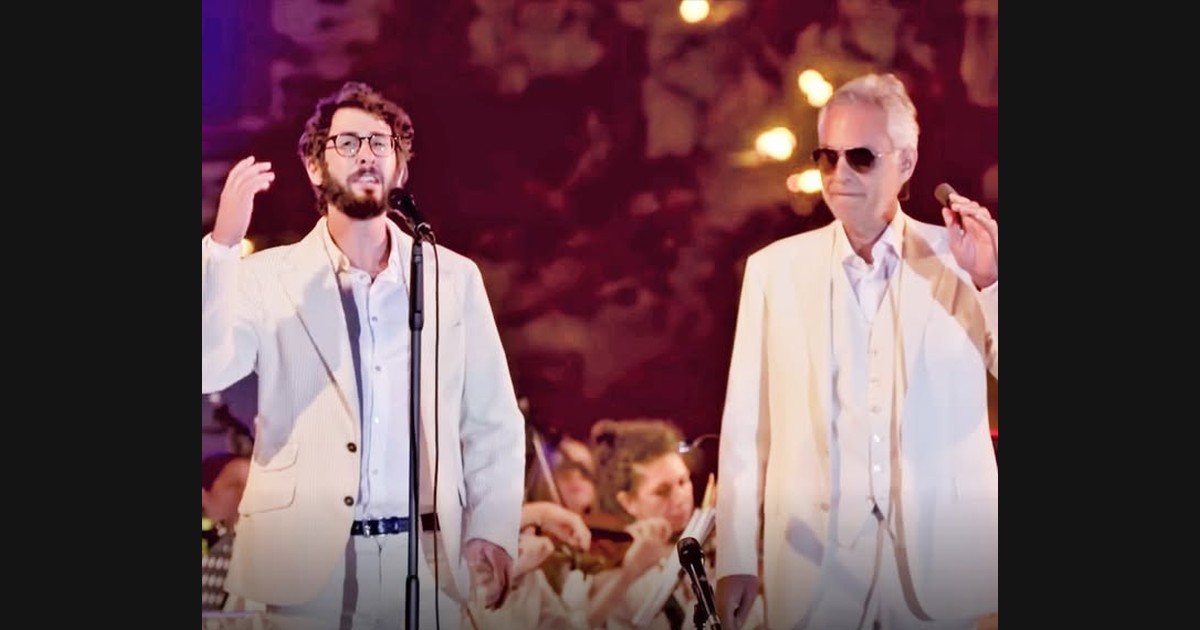
A duet can seem to consist of one singer’s phrase followed by another’s. Yet the music between those entrances often does important work. It can keep a thought moving, prepare a new arrival, or give the listener time to hear a completed idea. Josh Groban and Andrea Bocelli’s “We Will Meet Once Again” offers a useful focus for that less conspicuous part of collaboration.
Groban’s official biography identifies the Bocelli collaboration with his 2018 album Bridges. The embedded recordings include an official live presentation and official audio, allowing the song to remain a reference while its presentation changes.
Watch on YouTube ↗
Listen to the handover before naming the voices
Choose a passage where attention moves between vocal contributions. Begin slightly before the change. What is already happening in the accompaniment, and what continues through the transition? The relationship can make the next entrance feel prepared even when the voices have distinctly different sounds.
A handover does not always occur at the exact end of a musical thought. One voice can continue an idea another has begun, or a new entrance can establish a contrasting phrase. The recording should determine which description fits a particular passage.
This distinction prevents the duet from becoming a sequence of isolated judgments about each singer. The shared shape depends on how their contributions connect, including the space given to the accompaniment.
The background can carry the foreground’s direction
When a singer pauses, the music need not become inactive. An instrumental line, a continuing harmonic setting, or a recurring figure can preserve direction. A vocal rest and a complete musical stop are different events.
Follow one such interval without looking for the next face on screen. Can you hear a continuation, a preparation, or a moment of settling? Those categories explain the accompaniment’s function without requiring you to identify every instrument in the mix.
Then hear the next vocal entrance as part of that larger phrase. Its effect may depend as much on what preceded it as on the sound of the voice itself. That is a practical reason to compare complete passages rather than only prominent held notes.
Watch on YouTube ↗
The audio presentation changes visual attention
Bocelli’s official audio upload removes the expectation that a camera will tell the listener whose contribution matters most at every moment. Use it to follow the arrangement’s continuity, then return to the live presentation and notice where the screen guides your attention differently.
Do not assume that a close-up identifies every sound most prominent in the recording. The image and the musical balance have related but separate organizing roles.
A concert reference adds another perspective
Watch on YouTube ↗
The Las Vegas audience upload provides a further concert presentation. Its captured sound and viewpoint differ from an official audio release, so it should not be treated as a precise measurement of the singers’ relative volume or the stage’s complete balance.
Instead, find a recognizable transition and compare how its musical connection remains intelligible. Where details are unclear, leave the cause of a difference open.
For a final note, describe something the accompaniment does between vocal phrases. Naming that contribution makes the duet more than two celebrated voices sharing a title: it becomes a continuous musical construction in which entrances, spaces, and supporting material help the singers belong together.


