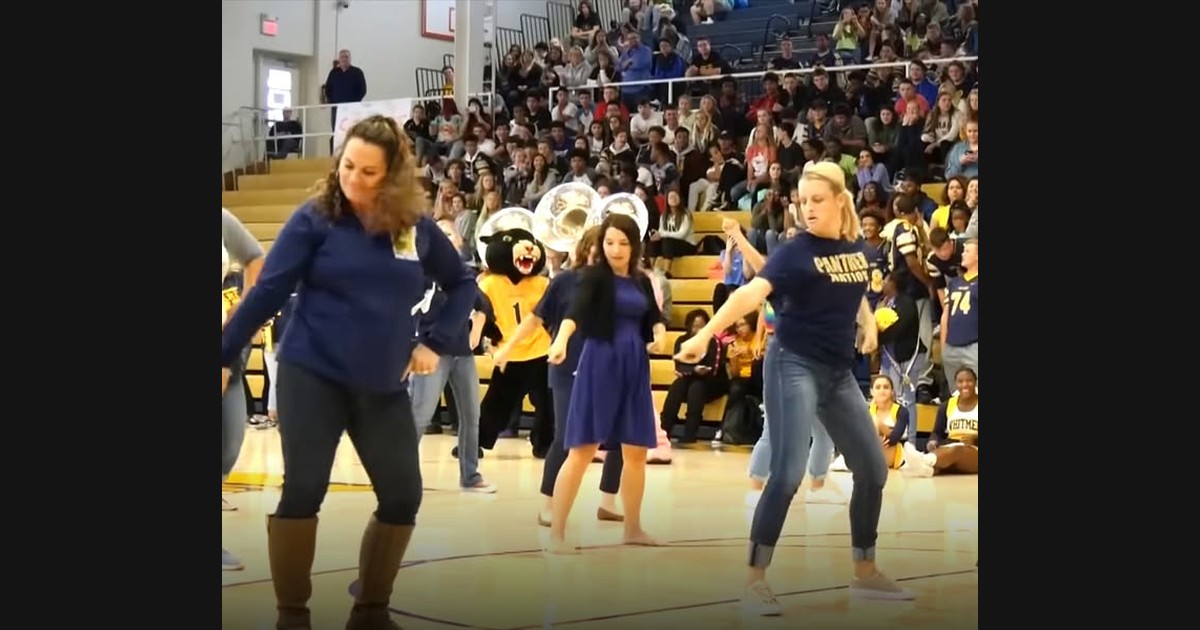
A dance on a school gym floor has more than one viewing direction. Students around the room and a camera near one part of it do not see the same picture. Whitmer High School’s Uptown Funk routine offers a useful case for thinking about that difference.
Punsalan Productions identifies the recording as the school’s teacher flash mob at the 2017 homecoming pep assembly in Toledo, Ohio, organized by Katie Peters. Those details locate the event. The choreographic question is how a group presents movement clearly in a space that is not a conventional front-facing theatre.
Watch on YouTube ↗
A formation is a picture with a viewpoint
A row, a circle and a pair of facing lines create different relationships between dancers and spectators. A pattern that looks balanced from one side can obscure performers from another. Moving a formation can therefore change who becomes visible, even when the individual steps remain simple.
This is why group choreography involves more than teaching everyone the same sequence. It has to organize positions, directions and transitions. The audience needs a way to understand where the main action is, while performers need a workable route between their places.
For a useful viewing pass, follow the floor pattern rather than one dancer. Notice when the group is functioning as a single visual unit and when attention is invited toward an individual or a smaller set of performers. These are different scales of presentation.
Repetition gives a large group a common reference
A recorded song supplies a shared sequence of musical landmarks. Returning beats and phrases can help viewers recognize that a movement belongs to a pattern, rather than reading every gesture as a new instruction.
The same principle helps a formation change remain legible. Repeated material establishes expectations; a transition can then become noticeable because it alters something the viewer already understands. Contrast depends partly on the stability that precedes it.
There is no need to infer an exact rehearsal schedule from that result. The visible performance is enough to invite attention to the relationship between repetition, movement and shared timing.
Watch on YouTube ↗
The camera makes another arrangement
An upload is not the same experience as standing in the gym. Its frame may keep one part of the floor visible while leaving another outside the picture. What appears to be the center of a recorded scene may therefore reflect the filming position as much as the room’s own focus.
The second upload revisits the Whitmer routine. It is useful as another presentation of the same event, rather than evidence that the teachers repeated it at another assembly.
Watch on YouTube ↗
The organizer’s upload keeps the occasion in view
Katie Peters also uploaded the homecoming recording under her own name. Alongside the production credit, that provides another connection to the documented school occasion.
The routine can be appreciated without reducing it to a universal account of school spirit or a reaction headline. Its concrete interest is a group making movement readable in a shared space. Watching the formations, their changes and the camera’s limits reveals another layer of work beneath the familiar song.


