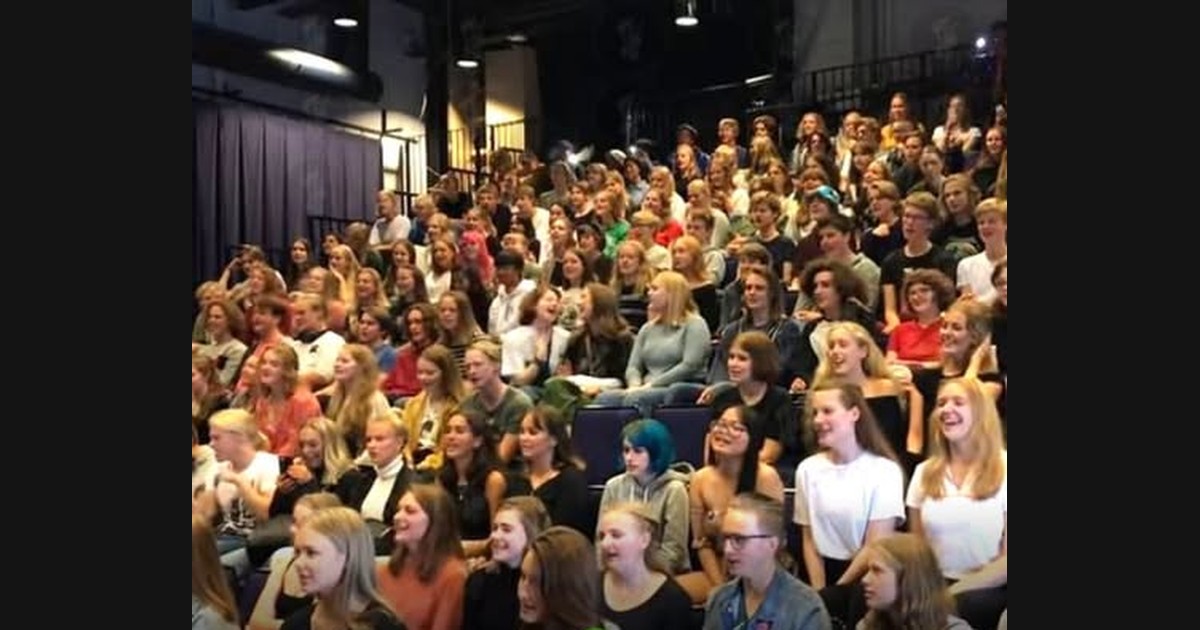
A singalong does not ask a group to behave exactly like an audience at a formal choir concert. People participate in familiar material together, often from the places where they are gathered. Øystein Fevang’s “Bohemian Rhapsody” session at Rud gives that format a concrete school setting.
The Oslo Philharmonic’s own profile of Fevang identifies him as a conductor, singer, and musician and connects the widely shared Rud singalong with autumn 2019. His participant upload and the school’s own video identify the song and gathering. Those sources establish the event without needing a claim that the students had never heard or sung the material before.
Familiar repertoire supplies a common map
A known song gives participants landmarks: an entrance they recognize, a change of section, or a returning idea. That shared knowledge can help a large gathering move through contrasting material without turning every contribution into a separately announced solo.
Watch on YouTube ↗
Queen’s “Bohemian Rhapsody” is especially useful for considering this because its identity is not limited to one repeating chorus. Its contrasting sections give a singalong a sequence of different musical situations. Recognition can operate at the level of a transition as well as a tune.
This does not establish identical preparation among all students. A group can contain participants who know different amounts of the song. The performance’s shared direction should not be turned into a biography of every person in the room.
The leader connects participation and continuity
A pianist leading a singalong can supply harmonic movement and a reference for entrances while participants contribute the vocal material. The leadership is practical as well as visible: it helps the larger group retain a common sequence.
| Element | Role in the gathering |
|---|---|
| Familiar song | Provides recognizable musical landmarks. |
| Leader and accompaniment | Help maintain continuity and a shared reference. |
| Group participation | Makes the song a collective activity rather than only a performed object. |
A collective result need not imply that every voice has the same training or musical responsibility. The interesting relationship is how individual participation contributes to the larger progression.
The school upload keeps the source close
The second video is published by Rud itself. It gives another institutional document of the singalong rather than evidence of an additional performance on another first day.
Watch on YouTube ↗
When comparing the views, keep the musical passage fixed. A different frame can emphasize the leader or the participants and thereby change the viewer’s attention. The group’s activity and the camera’s selected focus are related, but they are not the same thing.
Rustenburg is another school, not another Rud angle
The final selection is a “Bohemian Rhapsody” performance published by Hoërskool Rustenburg. It changes the performing group while retaining the composition. Its school identity should remain attached to its own presentation.
Watch on YouTube ↗
Compare how each gathering organizes participation instead of assuming that both have the same occasion, conductor, or preparation. A school-associated recording can be a singalong, a staged concert number, or another format; the title and source should guide the description.
Rud’s clip is most informative as a record of shared repertoire becoming a collective school activity. The song connects the participants, while Fevang’s leadership and the documented setting explain the particular encounter captured in the video.


