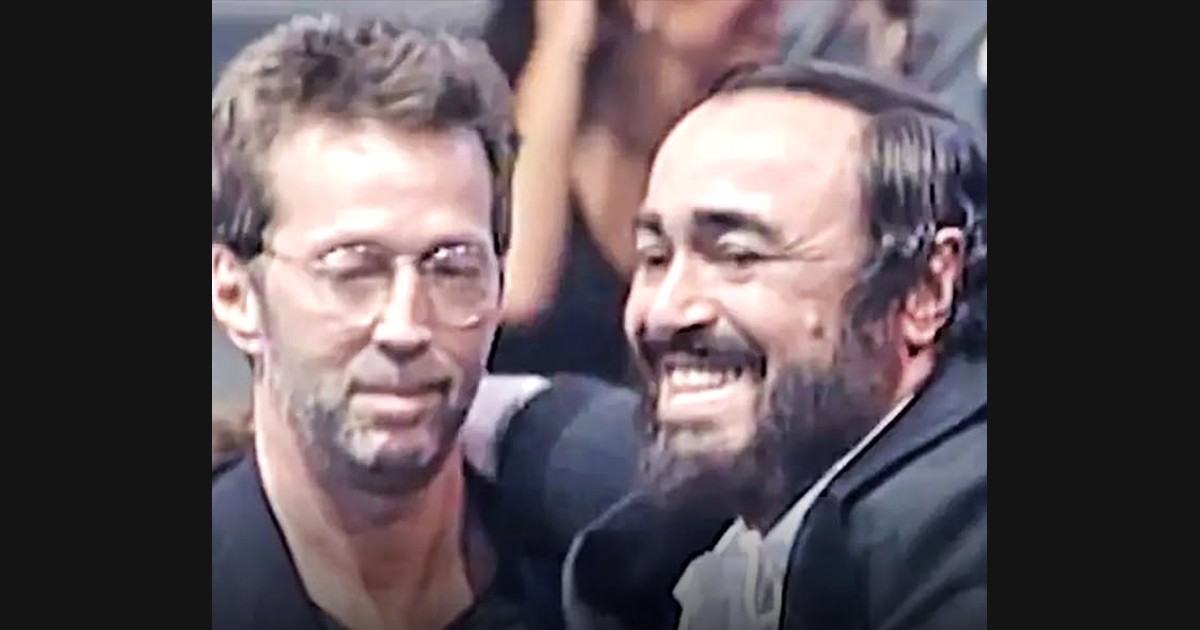
Holy Mother did not begin as an opera crossover. Before Eric Clapton, Luciano Pavarotti and the East London Gospel Choir shared it, the song appeared on Clapton’s 1986 album August. Hearing that earlier recording changes the way the collaboration can be understood.
The opening official video identifies the three featured participants and carries Decca’s 1996 recording credit. The meeting brings an existing song into a broader vocal setting. It is an interpretation of material that already had a place in Clapton’s catalogue, rather than a new composition invented for the duet.
Watch on YouTube ↗
A direct address, with room for different voices
The song is shaped as an appeal. Its narrator addresses a figure beyond the immediate situation, seeking help rather than announcing a solution already found. That dramatic position provides common ground for singers with different backgrounds.
A plea does not depend on one particular vocal size. It can be expressed through exposure, restraint, insistence or expansion. What has to remain clear is the relationship between the person asking and the hoped-for answer.
This makes the collaboration more interesting than a comparison of vocal power. The composition gives its performers a shared action to carry. Different timbres can present that action at different scales without requiring the listener to decide which voice is more sincere.
The writing belongs to two songwriters
The label credits identify Eric Clapton and Stephen Bishop as the writers. Keeping both names in view prevents a performance’s most recognizable figure from absorbing the entire history of the work.
It also separates authorship from interpretation. A singer can make a piece feel personally addressed without becoming its writer, and a later arrangement can reveal an aspect of a composition without creating that aspect from nothing.
For a useful listening distinction, follow the line’s direction before considering vocal tone. Where does a phrase seem to ask, where does it press forward, and where does it release? The same underlying gesture can survive a considerable change of performing forces.
Watch on YouTube ↗
A later release is not a later performance
The Holy Mother audio credited to Pavarotti, Clapton and the East London Gospel Choir appears on Pavarotti: The Duets. Its label information gives a 2008 release date alongside a 1996 phonographic credit.
Those dates describe different stages in a recording’s life. A compilation can introduce an existing performance to a new audience without documenting another meeting of the artists. Listening comparisons should begin with that distinction, rather than treating every album appearance as a separate event.
Watch on YouTube ↗
Return to August
The final audio returns to Clapton’s August recording, released in November 1986. Its production credits include Phil Collins and Tom Dowd. This gives the song another musical environment, with the focus on the earlier recorded interpretation rather than the later concert partnership.
The comparison restores the composition’s continuity. A song first encountered through a spectacular collaboration can still reward attention in its prior setting. The appeal at its center connects the recordings, while their different voices and resources offer different ways of making that appeal public.


