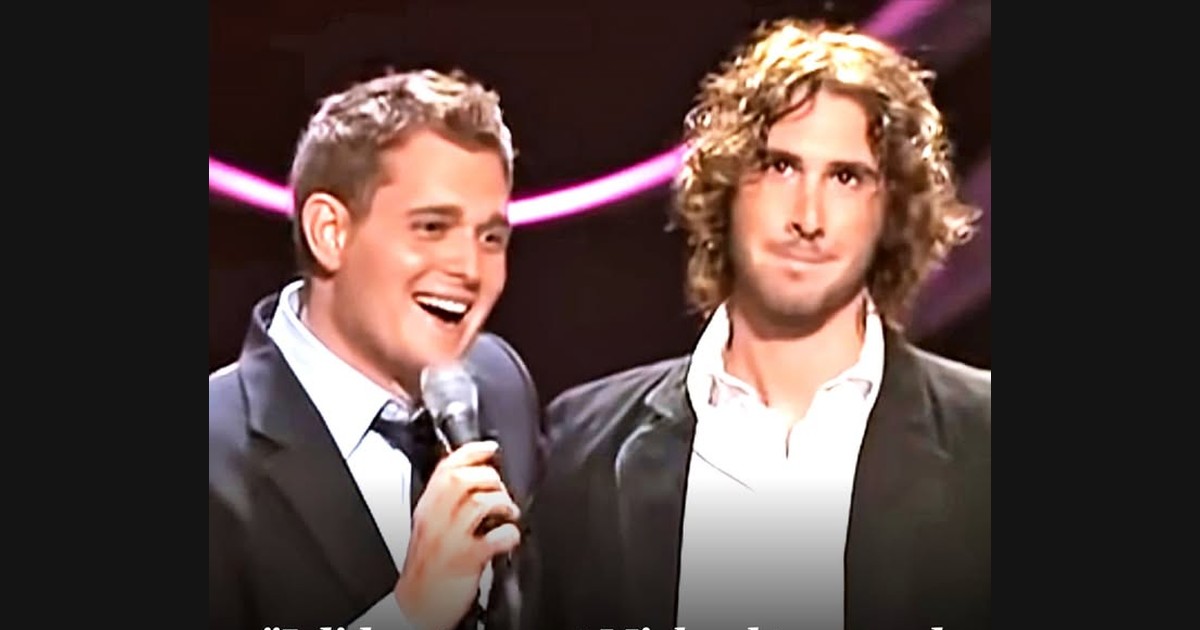
A comic stage exchange has a structure even when it appears conversational. One performer establishes a premise, another responds, and attention moves between what is spoken and what is sung. Michael Bublé and Josh Groban’s shared clip is useful to consider through that turn-taking rather than simply as a contest between two voices.
The accompanying Groban performances supply contrasting formats: a concert presentation of “You Raise Me Up” and the Andrea Bocelli duet “We Will Meet Once Again.” Together they make it possible to compare not only voices, but the different expectations each kind of performance creates.
Watch on YouTube ↗
A spoken setup changes what a sung phrase means
In a formal number, a vocal entrance may primarily develop the song. In a comic exchange, an entrance can also answer a remark, demonstrate a premise, or redirect attention toward another performer. The same kind of sound can therefore have both a musical and a conversational job.
Follow who has the floor. Does a reply continue an idea, challenge it, or make the preceding statement seem different? Then notice when attention moves from speech into singing. That boundary is often where a stage conversation acquires its particular rhythm.
A useful description names the relationship without pretending to know how the segment was prepared. Apparent informality is not proof that performers had no shared plan. A finished recording can support observations about timing while leaving rehearsal history uncertain.
Timing is relational
A pause can give a statement room to register or make the next response more noticeable. A quick reply can create another effect by arriving before the audience’s attention has fully settled. Neither is automatically better; each depends on the premise already established.
Listen for the contrast between conversational time and musical time. The spoken exchange can suspend the progress of a song, while a sung phrase can briefly impose another structure. The pleasure of the segment may come partly from moving between those systems.
Watch on YouTube ↗
A concert number offers another agreement
BBC Music identifies Groban’s “You Raise Me Up” recording with Proms in Hyde Park 2018. Here the listener is invited to follow a complete song performance. The sequence does not need a comic reply to explain the purpose of each musical phrase.
Compare how the beginning establishes attention. What would count as an interruption in a continuous concert number might be an essential part of a comic exchange. Judging the formats by the same expectation can obscure what each is trying to offer.
A duet can share attention without comic opposition
Watch on YouTube ↗
“We Will Meet Once Again” places Groban with Bocelli in a separately identified musical collaboration. The shared vocal space has another organizing purpose: developing a composition through the relationship between singers.
Follow an entrance and a handover in both the duet and the comic clip. In one, the exchange may primarily serve the song’s progression; in the other, it may also carry a joke or a change of conversational status. The comparison concerns function, not the performers’ private friendship or motives.
That is a concrete way to understand stage versatility. A singer’s contribution includes recognizing the kind of moment being created and how attention should pass to someone else, whether the next event is a musical phrase, a spoken reply, or a shared conclusion.


