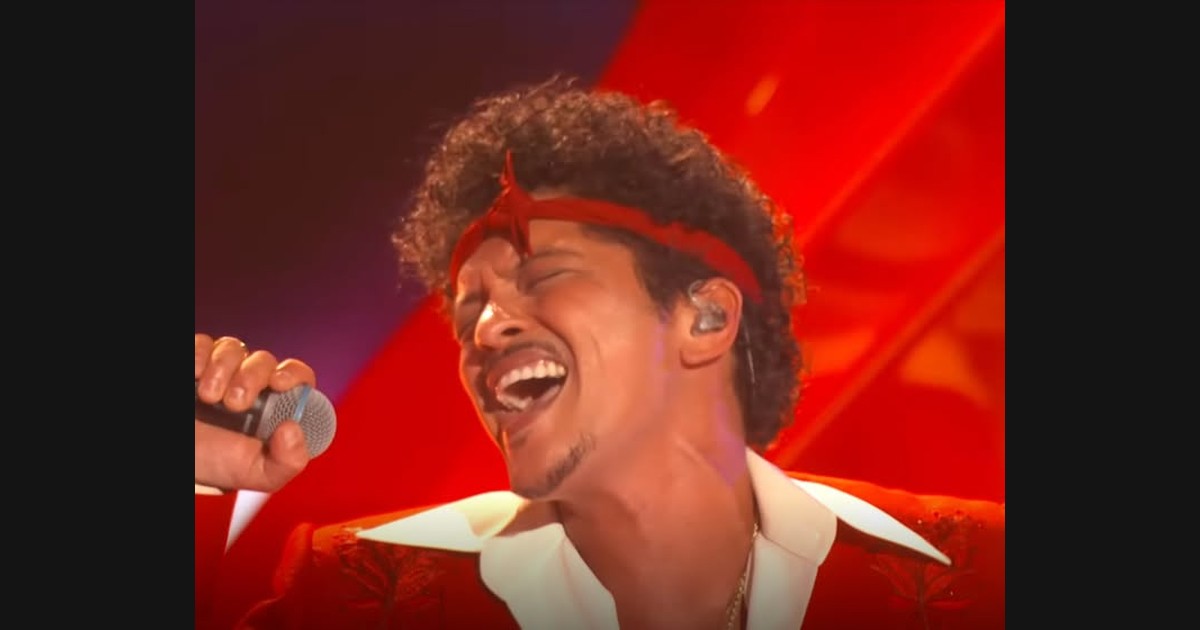
A song can feel busy without continually getting faster. Different parts can place events around a steady reference, creating motion through their relationships rather than through a rising tempo. Bruno Mars’ “I Just Might” Grammy performance provides a useful setting for hearing that distinction.
The Recording Academy identifies the number as a performance at the 2026 Grammys and describes its red-clad musicians and heart-shaped stage. Those visual choices give the presentation a clear identity, while the musical question concerns how a groove organizes attention within that frame.
Watch on YouTube ↗
Pulse and activity are not the same thing
A pulse is a recurring reference a listener can follow. Rhythmic activity includes the events placed on, between, or around those points. Adding events can make a texture feel more animated without changing the underlying reference.
First, follow whichever recurring element gives you the clearest sense of time. Then shift attention toward another part while trying to keep that reference in mind. Notice whether the second part reinforces it, fills spaces around it, or supplies a contrasting pattern.
This is a listening method rather than a measured tempo claim about the recording. Without a reliable measurement, there is no need to assign a precise beats-per-minute figure or insist that every passage maintains mathematically identical timing.
Interlocking parts make space meaningful
Two musical parts do not have to duplicate each other to feel coordinated. One can make room where another supplies an event. A short sound can become noticeable because the surrounding pattern leaves it exposed, while a sustained sound can connect several smaller actions.
Listen for the distinction between the combined effect and individual contributions. If the whole texture feels continuous, can you still identify a part that leaves gaps? That observation helps explain how an ensemble can sound full without every musician playing at every possible moment.
The vocal line belongs to the same relationship. Its placement can reinforce a familiar reference or create another kind of movement across it. Following that relationship is more informative than describing the entire performance with a single genre or mood label.
Watch on YouTube ↗
The visual rhythm supplies another layer
The organizer’s presentation returns to the same Grammy performance through another official upload. It is not a separately established concert. Use it to consider how the screen directs attention toward coordinated movement and musical events.
A gesture may coincide with a beat, a phrase ending, or a change in the arrangement. Watch for the connection where it is clear, but distinguish visible coordination from the sound’s complete production history. A camera cut cannot reveal every decision behind a broadcast mix.
Watch on YouTube ↗
The music video changes the frame
The official video provides another presentation of the song outside the awards stage. Compare how its screen construction guides attention rather than assuming that all visible movement documents a continuous live performance.
For a final pass, choose one stable reference and one part that moves around it. Describe their relationship in a sentence. That is a concrete account of groove: an organized interaction among sounds, not simply speed, constant activity, or the visual impression of performers moving together.


