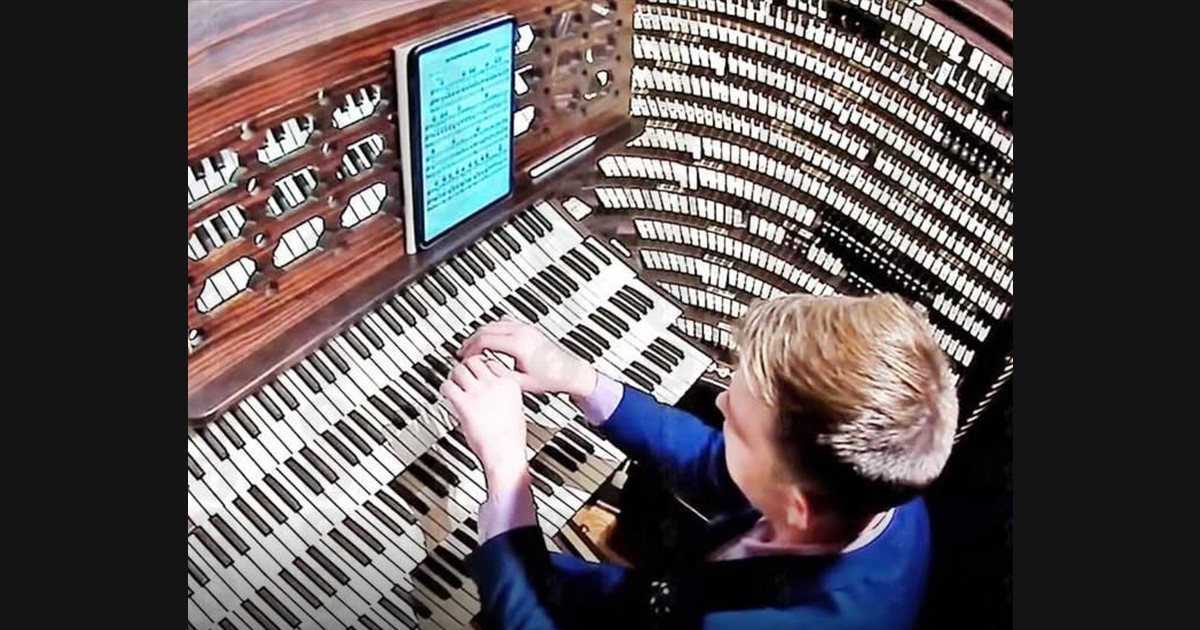
Recognizing a famous melody is one pleasure of an instrumental cover. Following what happens between its familiar moments is another. Joshua Stafford’s arrangement of Bohemian Rhapsody on the Midmer-Losh organ at Boardwalk Hall is especially useful for thinking about those connections.
Boardwalk Organs credits Stafford with his own arrangement of Freddie Mercury’s composition. The instrument changes the available sounds, but the larger challenge remains: a sequence of sharply contrasting sections has to feel like a journey, rather than a collection of recognizable excerpts.
Watch on YouTube ↗
Why the joins matter
Brian May has described Mercury bringing different sections to the piano as the song developed. He also recalled the band’s refusal to shorten the finished single to fit an expected radio length. That history helps explain why preserving the relationship between sections matters as much as preserving individual tunes.
A transition has two responsibilities. It must make the next section intelligible, and it must account for the energy left by the previous one. An arrangement that begins each new passage convincingly can still feel disjointed if the approach to it has no direction.
Think of the piece as several connected dramatic spaces: introductory questioning, an extended ballad, operatic exchanges, a heavier rock passage and a closing release. These are listening landmarks, not a claim that every version has identical timings. The interest lies in how one state becomes another.
A small map, without a stopwatch
On one pass, note only the points where the musical task changes. A line that previously carried a melody may become accompaniment; a dense passage may give way to one exposed thought. Naming that change is more revealing than simply writing down that the organ becomes louder.
- Before the change: identify the unresolved movement or expectation.
- At the join: notice whether a pause, a continuing line or a new attack carries the connection.
- After the change: establish which musical part now leads.
This does not require reading music. It requires distinguishing a new sound from a new function. A different tone can continue the same job, while a familiar tone can begin a different one.
Watch on YouTube ↗
The console view answers a different question
The second Boardwalk Organs video gives another view of Stafford working with the Midmer-Losh. It offers a practical reminder that an arrangement is performed through coordinated actions. The musical plan and the physical route through it have to support each other.
It is tempting to treat every movement between keyboards as a dramatic change in the composition. The more useful test is to listen first. A hand movement may maintain continuity rather than announce a contrast, and a major musical turn need not require the largest visible gesture.
Watch on YouTube ↗
Return to Queen for the overall shape
Queen’s official video supplies the composition in its band-and-voice setting. Compare a whole section and its approach, not just a famous few seconds. The organ version has no obligation to reproduce every studio texture; it needs a convincing relationship between its own parts.
That is the arranging achievement worth following here. Stafford’s instrument offers different resources from Queen’s recording, while the sequence of departure, contrast and return remains the thread that lets the piece hold together.


