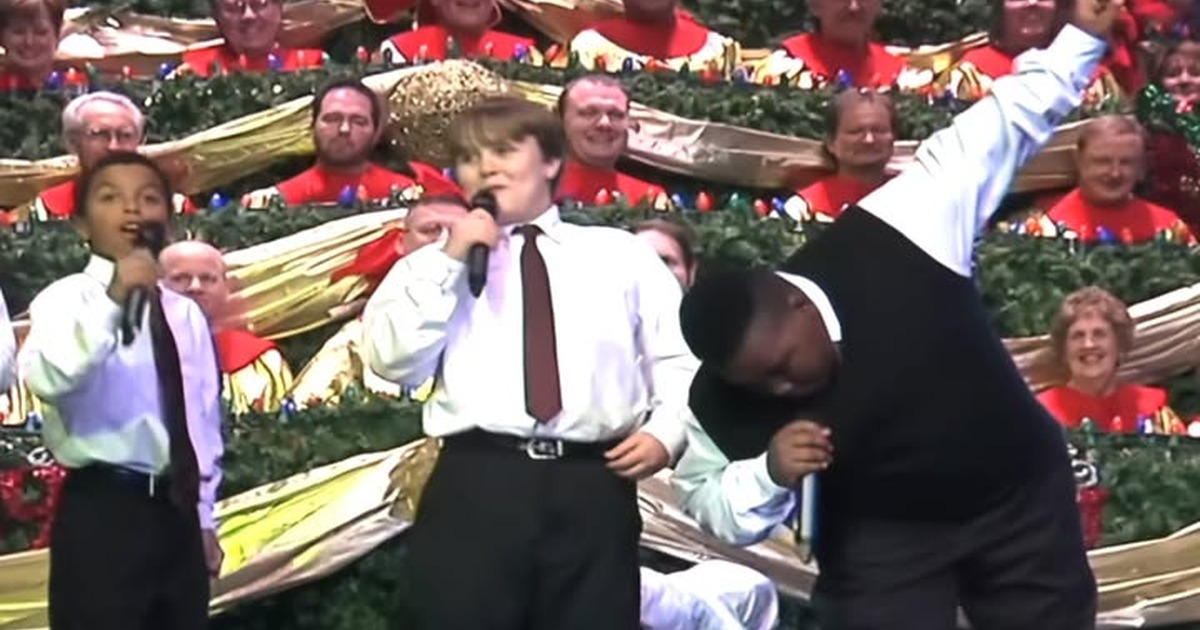
The most useful fact about the FBT Little Quartet is also the easiest to lose in a short caption: the children are lip-syncing. Recorded voices supply the singing; the performers supply the visible characters. Understanding that division identifies where the live comic work takes place.
FBTChannel published the clip in December 2011 and described it as part of the annual Living Christmas Tree. The channel points viewers to Florence Baptist Temple. That is a church production context, rather than evidence for an unidentified school talent show or a claim that the children produced the recorded vocal registers.
The Little Quartet routine
Watch on YouTube ↗
A clear rule makes the joke readable
A mime routine establishes a working rule: the audience accepts a connection between a visible performer and a sound coming from somewhere else. The pleasure comes from watching that connection sustained, exaggerated or placed under pressure.
Timing becomes part of characterization. A mouth movement belonging to a vocal entrance helps assign a voice to one person. A pause gives someone else room to become its apparent source. These general mechanisms explain why dividing roles clearly matters more than pretending the soundtrack is a secret.
A mismatch between a child performer and a recorded adult-style part supplies a comic premise. That premise still needs structure. If everyone claims every sound simultaneously, the audience loses the relationship making the contrast understandable. A quartet is small enough for separate roles to remain legible.
The soundtrack and stage have different jobs
Recorded music gives performers a fixed sequence. Unlike a live accompanist, it cannot ordinarily wait for a delayed gesture or extend a phrase to rescue an entrance. Preparation around that sequence is therefore a practical component of the performance, even when the finished routine appears to be effortless entertainment.
This also changes what receives credit. Viewers can enjoy the children’s characterization while recognizing the vocal recording as another layer of the production. Calling it a remarkable live singing display credits the wrong task. Calling it only a recording misses the visible performance built around it.
Change to a vocal ensemble
Pentatonix’s official Silent Night presentation supplies a contrasting kind of group work. These performers are presented as the singing ensemble, rather than characters assigned to a prerecorded quartet soundtrack.
Watch on YouTube ↗
A vocal ensemble coordinates people producing musical parts; a lip-sync routine coordinates visible actions with an existing musical sequence. Both involve timing, but responsibility for the sound lies in different places. The comparison clarifies the formats without requiring a ranking.
A third kind of Christmas presentation
The last official upload is labeled Last Christmas at Wembley Arena in December 2006. It moves the selection toward a concert presentation of a seasonal pop song. Its event label belongs to that recording, rather than dating the church routine.
Watch on YouTube ↗
The three clips show why a holiday theme does not imply one performance format. Mime, a featured vocal ensemble and a concert song ask different things of their performers. The FBT routine is enjoyable on its own terms: recorded singing supplies a dependable frame, while the children turn the relationship between sound and character into the joke.


