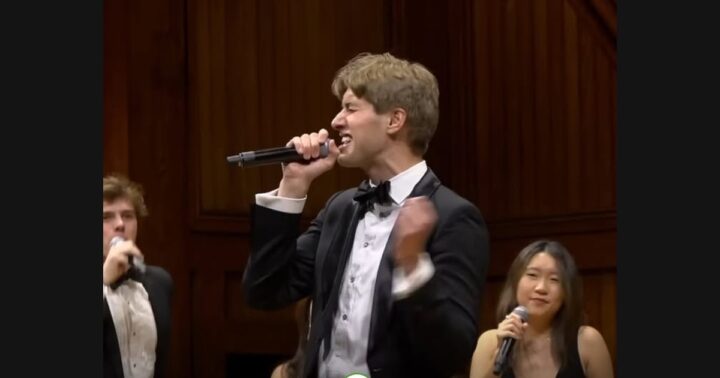
Theatre music does not lose its identity when it leaves the theatre, but the surroundings can change the task it performs. The airport sing-off between The Lion King and Aladdin casts is a useful case. Disney’s own presentation describes a friendly exchange after a six-hour delay, with the performers entertaining airport guests.
That is a documented premise, not an invitation to reconstruct every person’s reaction. The main selection comes through a separate uploader, while Disney also published the encounter. The musical interest lies in how repertoire prepared for a stage can function in a shared public waiting space.
The airport selection
Watch on YouTube ↗
Recognition supplies part of the stage
A theatrical song normally appears with a larger framework: a character, a scene, costumes, lighting and material that has led toward it. Outside that framework, a familiar melody or a recognizable vocal identity may do more of the introductory work. Listeners can connect the material with a show even when the show itself is absent.
That makes recognition a resource, but not a complete explanation. The performers still need to establish a shared pace and make an exchange readable. Follow how one contribution becomes connected to another. The relevant relationship may be a musical answer, a common pattern or a clear change of focus.
A sing-off is a performance format
The phrase sing-off suggests comparison, yet a friendly exchange can make the connection between groups more interesting than a winner. Each contribution gives the other something to respond to. The form can therefore organize participation without requiring an elimination or a score.
Describe one transition between contributions rather than summarizing the clip as a spontaneous event. What marks the change, and what remains continuous? This keeps the account attached to the musical exchange instead of treating an unusual location as the entire achievement.
The setting also changes how a viewer encounters the work. An airport is not a theatre with one shared sightline and a program everyone has chosen to attend. A video selects a view of that space. Its frame gives access to an encounter without establishing everything that happened outside the selection.
A cast reunion carries a different shared history
The next official AFI selection identifies Julie Andrews reunited with the Sound of Music children at its 48th Life Achievement Award tribute. Here the gathering is part of a named celebratory program. Shared theatrical history becomes the reason for bringing performers together, rather than a way to occupy a travel delay.
Compare what the audience is expected to recognize in each case. A repertoire, a cast relationship and a remembered screen or stage production are different sources of familiarity. More than one can be active at the same time.
Watch on YouTube ↗
A duet returns theatrical material to a concert
Josh Groban’s official All I Ask of You selection from Stages Live offers a more focused partnership. Instead of two casts exchanging material, the presentation centers a duet within a concert program. Follow how the musical address is shared between the featured participants.
Watch on YouTube ↗
Across these settings, theatrical music acts as portable material rather than a complete reproduction of the original show. The airport exchange makes that portability especially visible: performers bring a shared repertoire into a different situation, and recognition helps connect their contributions. The comparison becomes richer when place, performance format and the music’s theatrical history remain distinct.