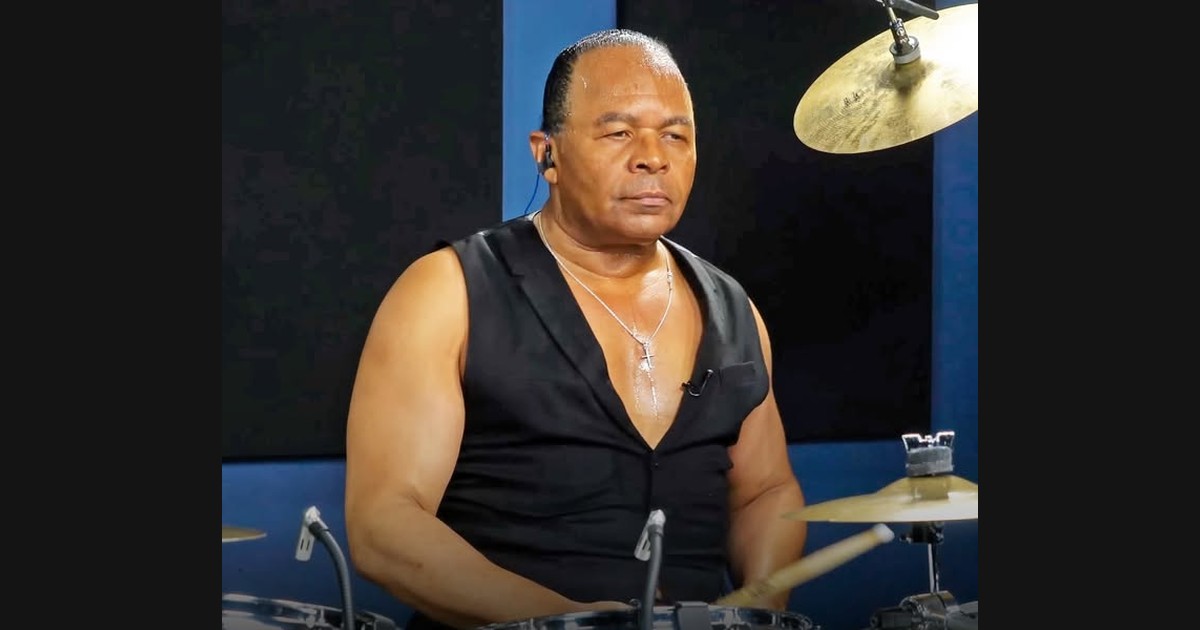
Playing a recognizable drum part and responding to an unfamiliar track are different tasks. One asks a musician to preserve relationships an audience may already know. The other asks the musician to make provisional choices as information becomes available. Drumeo’s Jonathan Moffett videos make that distinction a useful subject in its own right.
The “Smooth Criminal” performance provides the familiar-repertoire reference. The accompanying “Numb” feature is presented by Drumeo as a first-listen challenge. The comparison does not require treating a program title as independent access to a musician’s entire listening history; the stated formats already establish different expectations.
Watch on YouTube ↗
Recognition places constraints on a performance
When a drum part is strongly associated with a song, a listener may recognize its role before identifying every sound. Reproducing that role involves relationships between recurring patterns, accents, and the surrounding track. It is not simply a question of adding as many notes as possible.
Drumeo’s own Michael Jackson grooves material emphasizes Moffett’s account of precision when replicating “Smooth Criminal” in an arena setting. That provides a practical context: a recognizable part must support a larger performance, not merely demonstrate what the drummer can play in isolation.
For this video, follow the points that make the pattern feel stable. Then notice where an added event directs attention toward a transition. Stability and variation can coexist; an embellishment becomes meaningful partly because the underlying reference remains legible.
New information changes the decision process
Watch on YouTube ↗
The “Numb” challenge changes the problem from preserving a known account to responding within the producer’s unfamiliar-song premise. A musician in such a format can use recurring sections and musical cues to revise a working idea of the track.
Listen for the distinction between a continuing pattern and a response to something newly encountered. Does a later return make an earlier choice more understandable? Does a section boundary invite another approach? These questions focus on adaptation without requiring a claim that every action was unplanned or that the upload includes every attempt.
There is also an important difference between inventing a compatible part and reproducing a record’s original part. Both can be musically useful, but they are not identical objectives. Judging an adaptation only by whether it matches another drummer’s recording may miss the task the feature has set.
Expertise includes choosing what to preserve
Watch on YouTube ↗
The career feature places the demonstrations within a broader account of Moffett’s work. Use it to consider the kinds of decisions a working drummer encounters: keeping recognizable material dependable, supporting other performers, and adapting to changing musical information.
That perspective is more revealing than assuming that expertise means making every task look the same. A controlled repetition can be appropriate in one context; a tentative choice that develops as the track unfolds can be appropriate in another.
After comparing the first two videos, describe the objective before describing the result. Was the task to preserve a familiar framework or to build a response? That small distinction gives a fairer account of both performances and makes the musical decisions easier to hear.


