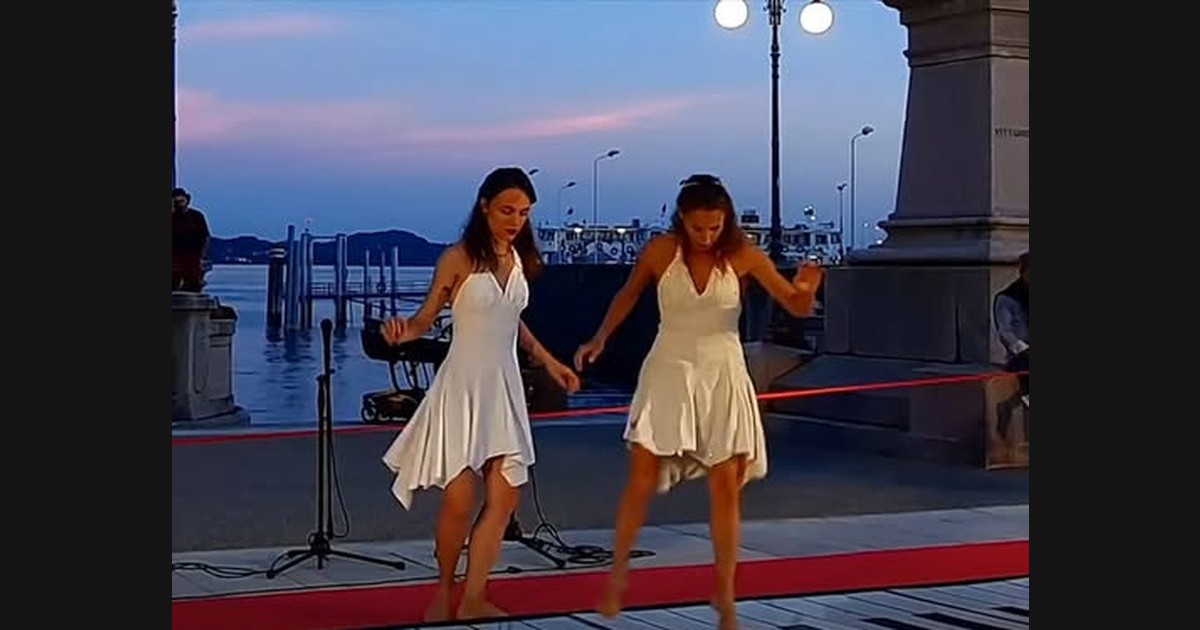
A keyboard played with feet turns a familiar layout into a much larger shared space. Il Grande Piano’s “Bohemian Rhapsody” interpretation makes movement between musical positions visible at the scale of a body. The attraction is not only a novel instrument: it is the coordination required when two performers must share its playing area.
The group’s own uploads identify the Queen song and provide two presentations of the floor-keyboard performance. Queen’s official video supplies the repertoire reference. The song dates to 1975, and the official Queen store credits its composition to Freddie Mercury.
A larger interface changes the physical task
On a conventional keyboard, a player can reach several nearby keys with the fingers of one hand. A floor-sized layout expands the distance between comparable positions. Moving toward another note can therefore require a step or a shift of body position rather than a small hand movement.
Watch on YouTube ↗
For two performers, space becomes another resource to share. A musical part can be divided between them, but their routes also have to remain compatible. Arriving at a position on time is part of the same task as leaving space for the other performer’s next move.
This is a description of the visible coordination problem, not a technical claim about the instrument’s internal triggering or the finished audio. The video alone does not supply a complete account of how every sound was generated or prepared.
Separate three kinds of coordination
- Musical timing: notes and entrances need to fit the common sequence.
- Physical position: a performer needs to be in the appropriate area when that entrance arrives.
- Shared space: one route must allow the other performer to continue.
The most conspicuous step is not necessarily the most important musical event. A large movement may connect positions, while a small action may mark an identifying note. Watching only the distance traveled can therefore miss the relationship between the movement and the tune.
The full presentation offers another scale
The next Il Grande Piano upload is labeled as a full version. Use it to follow a longer sequence instead of evaluating the performance through one short recognizable passage. A piece with contrasting sections creates a larger coordination problem than a single repeated melodic fragment.
Watch on YouTube ↗
Choose a transition and follow both performers before, during, and after it. Notice where each needs to be when the next musical idea begins. That reveals preparation as part of the performance: movement can be directed toward an upcoming event rather than merely illustrating what is already sounding.
Return to Queen for the song’s larger structure
The official Queen video changes the medium back to the band’s recording and visual presentation. It provides a reminder that the floor-keyboard version is an interpretation of existing repertoire, not the source of the song’s composition.
Watch on YouTube ↗
| Reference | What to follow |
|---|---|
| Il Grande Piano | Division of musical responsibility and physical space. |
| Longer floor-keyboard presentation | Preparation and continuity across sections. |
| Queen | The recognizable song behind the instrumental reinterpretation. |
The comparison need not become a contest between a band recording and a physical performance device. They offer different forms of access to the same repertoire. Il Grande Piano makes part of the coordination problem visible, allowing the viewer to connect a musical sequence with the work of sharing an unusually large keyboard.


