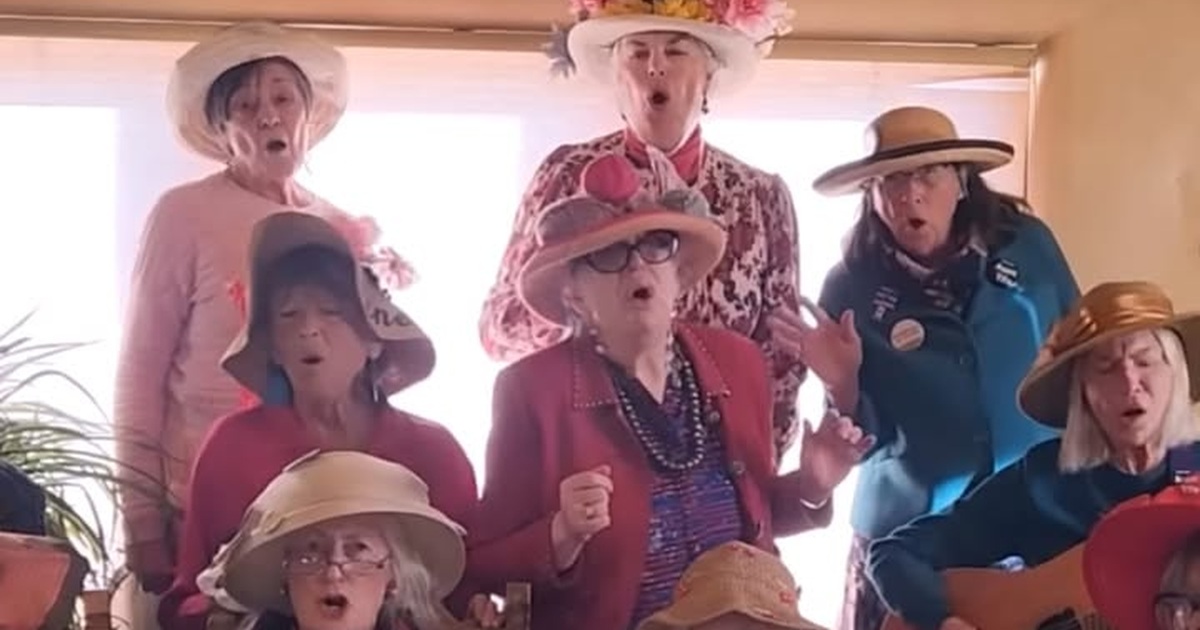
The title of the Santa Fe Raging Grannies’ Hit the Road, ICE! announces its method before the music begins. A personal name becomes the name of an agency, redirecting a familiar dismissal toward U.S. immigration enforcement. The performers’ opposition supplies the political position; the borrowed song supplies a musical shape a listener may already recognize.
That combination raises a useful question about parody: how much can change when the audience already knows where a refrain is going? Listen for the relationship between expectation and replacement, rather than assuming that recognizing the tune means accepting the argument.
A familiar recording, a different addressee
Hit the Road Jack is closely associated with Ray Charles, whose 1961 single is listed in the Recording Academy’s Hall of Fame. The Grannies’ version belongs to another setting: topical protest singing. Their international network describes autonomous local groups that adapt familiar songs, and the Santa Fe group maintains a songbook organized around its activist concerns.
The changed title shifts the scale of the address. A line aimed at a person becomes a statement about an institution. That is a rhetorical change, not simply a new label attached to the same story. The group is using the familiarity of the original to present its own viewpoint on immigration enforcement.
Watch on YouTube ↗
Follow what the replacement asks the melody to carry
Begin by noticing when you recognize the musical source. Is it the shape of the tune, the pacing of the title, or your memory of the older recording? Then listen for the new subject. The two moments may occur together, but separating them helps explain how the adaptation communicates so quickly.
On another pass, follow the syllables around the substituted name. Does the replacement sit easily in the phrase, or does a change of emphasis draw attention to it? You can assess that relationship without identifying a chord progression or treating this recording as a copy of Charles’s arrangement.
| Part to follow | Listening question |
|---|---|
| Recognition | What tells you which earlier song is being adapted? |
| Address | How does the meaning change when the target becomes an agency? |
| Return | What do the intervening verses add when the title comes back? |
Keep the refrain and the argument in view
A short refrain can compress a position more easily than it can explain one. Try summarizing the performers’ position in one sentence, then ask what the verses contribute beyond that sentence. Do they offer examples, intensify the language, or widen the subject? Those are different writing choices, even when they lead back to the same title.
Also consider whose voice you understand yourself to be hearing. Does the address feel like a character speaking inside a song, or a group speaking publicly? The answer may affect how the repetition registers. A repeated phrase can become more familiar without becoming better evidence for the assertions around it.
Compare the framing in ‘We Gotta Stop the Raids’
The next selection keeps immigration enforcement as its subject but changes the title’s grammatical focus. Hit the Road, ICE! addresses a target; We Gotta Stop the Raids foregrounds a collective speaker and an action. Listen for whether that difference changes your sense of who is speaking to whom.
Keep one question constant across the two songs: what can you anticipate before a phrase finishes? That allows a comparison of accessibility and emphasis without needing to rank the performances or endorse either position.
Watch on YouTube ↗
Compare a different borrowed tune
The group identifies When We Make Peace Instead of War as an adaptation of When the Saints Go Marching In. Here the title describes a proposed condition rather than dismissing an addressee. Ask how that different sentence shape works with a familiar melody, and whether you follow the words or the remembered tune first.
Watch on YouTube ↗
These comparisons make the main parody easier to describe precisely. Its defining move is a change in address carried by musical familiarity. What matters for the cultural reading is how those two elements work together, while the political judgment remains the performers’ own.