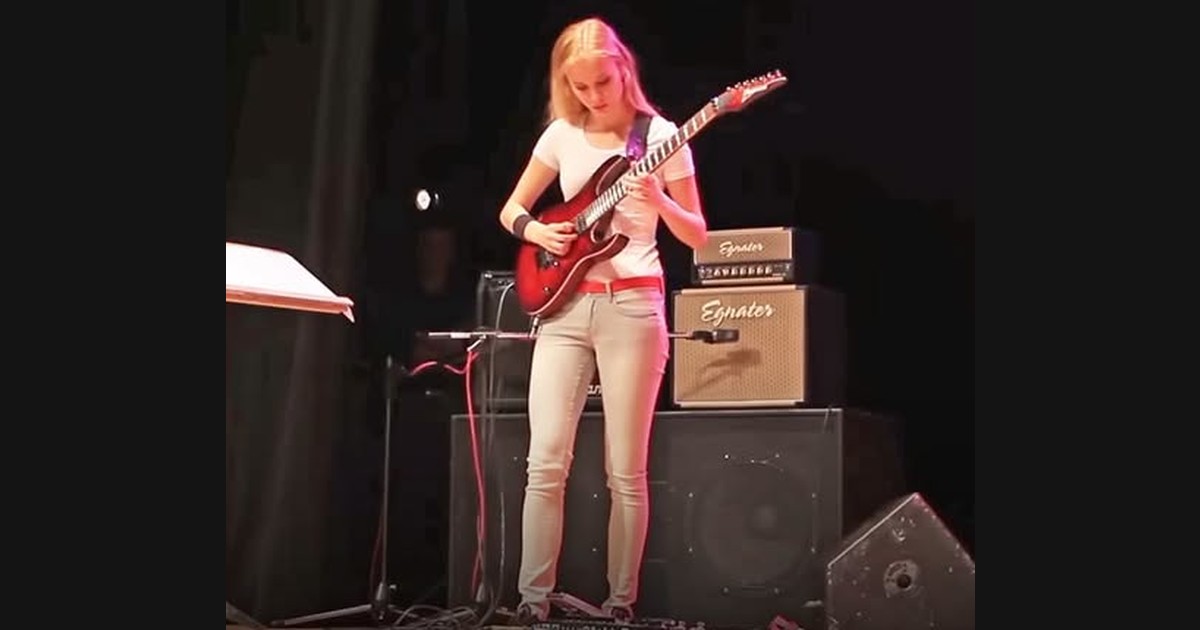
A finished performance and a lesson can use the same notes while answering different questions. A performance asks how the material becomes a continuous musical experience. A lesson asks how a learner can examine particular material closely enough to understand it. Laura Lace’s “Canon Rock” cover and the accompanying lesson with Victor provide a clear way to separate those purposes.
The main video’s publisher identifies it as a student concert organized by teacher Victor. That is useful context, but the musical interest does not depend on inventing the amount of practice involved or treating the upload date as the exact concert date.
Watch on YouTube ↗
Continuity is part of the finished result
In a performance, one passage prepares the next. A technically busy section may feel purposeful because it follows a contrasting idea; a repeated figure may acquire significance through its return. Watching only the most elaborate moments can remove the relationships that make the whole arrangement intelligible.
Try following one transition rather than one difficult-looking gesture. Identify the material before it, the change itself, and the musical state afterward. You do not need to name a scale or a picking technique to hear that a passage has changed direction.
This also distinguishes musical fluency from a collection of isolated demonstrations. A phrase can be clear on its own yet feel different when it has to connect with the preceding and following material. The complete cover lets a listener hear that larger continuity.
The arrangement reference supplies a map
Watch on YouTube ↗
The JerryC reference keeps attention on “Canon Rock” as an arrangement that another guitarist can interpret. Rather than using it to judge every local difference as an error, identify the sections and their order. That map makes later discussion of an excerpt more specific.
For example, describe a passage as the return of an earlier idea or the transition into a contrasting section. Those descriptions explain function. Calling it simply “the fast part” may identify a surface feature while missing why it is located there.
Keep the source layers distinct: an arrangement, a cover performance, and an instructional presentation are related documents. They do not become the same recording because the musical material overlaps.
Watch on YouTube ↗
A lesson deliberately interrupts the flow
The companion upload is labeled “Lesson Part 1.” Its scope matters. A first installment can introduce material without claiming to explain the entire arrangement. Instruction may separate a phrase from its context, repeat it, or draw attention to an individual action that a complete performance passes through continuously.
When comparing the lesson with the cover, ask what becomes easier to identify after the material is isolated. Then return to the finished performance and hear where that material belongs. This connects close study with musical purpose instead of letting a fragment become the whole objective.
A useful listening note has two columns: “what the passage contains” and “what the passage does.” The lesson may clarify the first; the complete performance helps restore the second. Keeping both questions alive makes the videos useful to musicians and nonplayers alike, without pretending that watching a short installment reproduces the preparation behind a concert.


