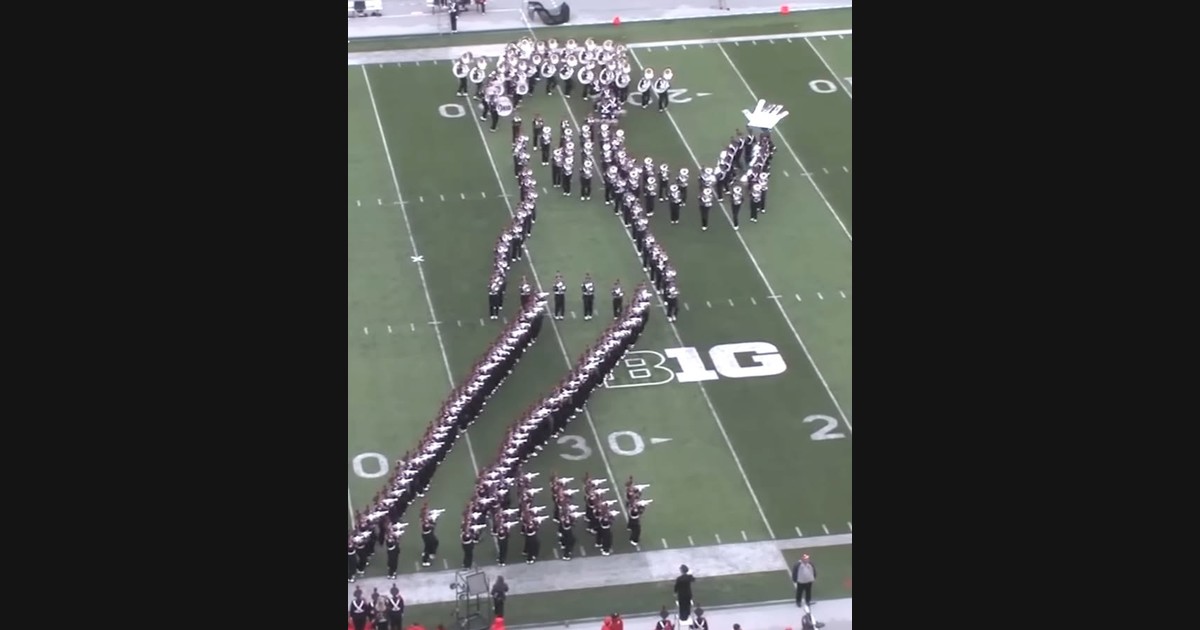
Ohio State’s Michael Jackson halftime tribute is easy to remember as a large moving field image. Yet the image occupies only one layer of the performance. The band also has to make familiar songs readable through an instrumental arrangement, with melodies, supporting parts, and transitions organized for an ensemble rather than a solo pop vocalist.
The university’s own video identifies the occasion as the October 19, 2013, football game against Iowa. Its School of Music biography credits William “Ted” McDaniel’s music arrangements for the 2013 Jackson halftime show. That credit directs attention toward work the elevated camera can make less immediately visible: the construction of the sound.
The song must remain recognizable without its original lead vocal
An instrumental arrangement cannot rely on the original singer to carry every identifying detail. It redistributes material among players. A melody can become a section’s responsibility, while rhythmic figures and supporting harmonies give it the surrounding character needed to belong to the song.
Watch on YouTube ↗
This does not mean every instrument plays the tune at once. Contrast depends on different responsibilities. A prominent melodic line needs a supporting background; a repeated rhythmic idea can establish continuity while another part changes. The arrangement shapes which details should reach the listener clearly at a particular moment.
Music arranging and field design are different jobs
| Musical layer | Visual layer |
|---|---|
| Distributes notes and musical roles. | Distributes positions across the field. |
| Connects phrases and repertoire. | Connects formations and movement. |
| Shapes audible emphasis. | Shapes the larger visible image. |
The two layers must share a timeline, but their credits should not be collapsed. A documented music-arranging credit is not automatically a credit for every formation or marching decision. Likewise, the performers who realize a field picture remain musicians contributing to the arrangement at the same time.
Try an audio-first pass
The band’s own full halftime upload supplies another document of the show. For one section, listen without following the field image. Locate the principal melody, then attend to the accompanying rhythm. Notice the point at which the music moves toward a new section rather than treating every recognizable tune as an isolated excerpt.
Watch on YouTube ↗
On the next pass, restore the picture and consider how musical and visual emphasis align. A formation may become readable at a musical arrival; movement may continue while the accompaniment holds the performance together. These are relationships to examine in the sequence, not reasons to reduce the show to one screenshot.
Another camera view changes the balance of attention
The Lantern TV recording is a third account of the same October 19 show. A different camera perspective may make some parts of the visual design more evident and others less so. It does not create another arrangement simply because the viewer’s access changes.
Watch on YouTube ↗
Keep those documentary differences in mind when assessing the music. The recording position can affect the apparent prominence of sections, and a close view of a formation can pull attention away from the larger phrase. No single video frame is a complete account of the ensemble’s contribution.
Give the sound a place beside the spectacle
The tribute becomes more substantial when it is heard as arranged music as well as seen as coordinated movement. McDaniel’s documented contribution provides a concrete starting point for that shift in attention.
Rather than asking only how a giant figure moves, follow how the band carries a melody, supports it, and connects it with the next musical idea. The field picture remains memorable, but it now has an audible structure around it.


