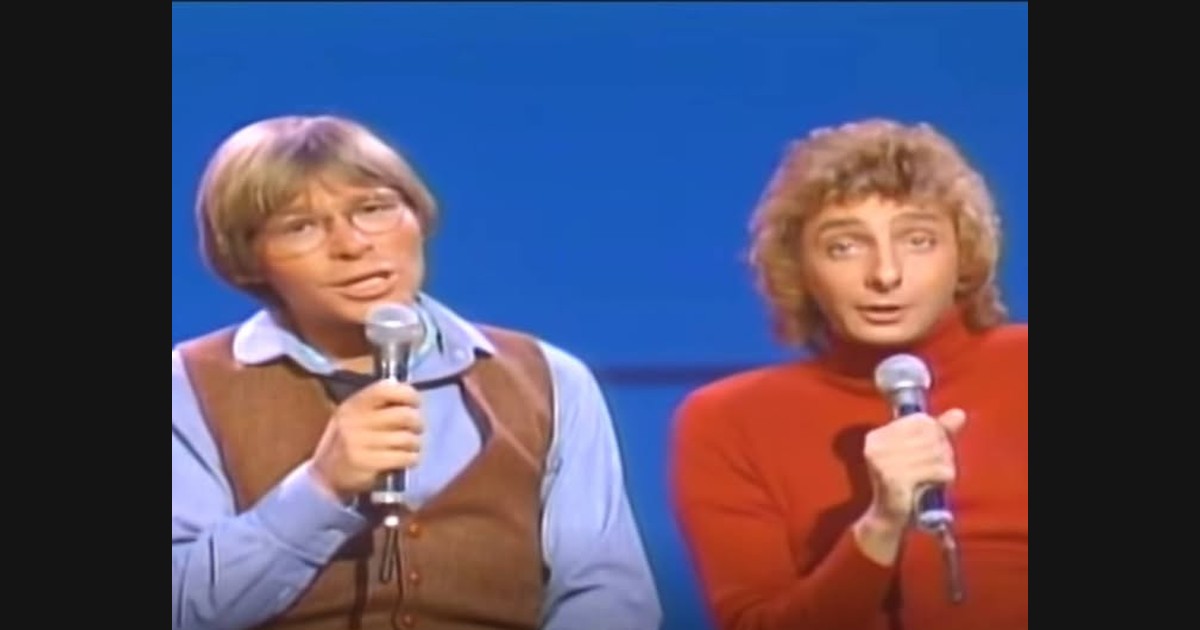
John Denver and Barry Manilow’s Everly Brothers medley has a clear musical premise: two performers with established individual identities interpret repertoire closely associated with a vocal partnership. The interest is not only in recognizing the songs, but in hearing how another pair occupies that shared space.
The circulating television clip identifies Denver and Manilow together. The uploader describes it as coming from Manilow’s third special, but the performance can be considered without assigning an unverified broadcast date. The available footage supplies the musical pairing; the Everly Brothers recordings provide the repertoire reference.
Watch on YouTube ↗
Two solo identities do not have to disappear
A duo creates its character through relationships between voices. Different tones can remain distinguishable while sharing a phrase. Harmony does not require the listener to forget that two people are singing.
This becomes especially noticeable when the participants are already familiar as individual performers. Each brings an established sound into the arrangement. The task is to connect those sounds rather than make one singer vanish into the other.
A medley creates another layer of partnership
The singers also need to move between selected musical ideas. A medley chooses where to enter a song, how long to remain and how to approach the next selection. The transitions become part of a new structure built from existing material.
For a focused listen, follow one complete exchange between the voices. Then notice how the next section begins. Does the partnership provide continuity while the musical reference changes? That relationship helps the sequence feel like one act rather than separate excerpts placed beside each other.
The Everly Brothers in a documented 1960 recording
Reelin’ in the Years Archives identifies the second video as “All I Have to Do Is Dream” and “Cathy’s Clown,” filmed during the Everly Brothers’ 1960 UK tour. Its description names the Crickets as the backing band.
Watch on YouTube ↗
This gives the comparison a specific archival reference. It is not merely another recent cover of the same songbook. The artists associated with the repertoire appear within a documented earlier performance setting.
Compare how the paired voices share a melodic thought. The useful question is not whether Denver and Manilow duplicate every vocal feature. It is what remains identifiable when another partnership interprets the material.
A single recording isolates one composition
The final artist audio presents “All I Have to Do Is Dream” on its own. Removing the surrounding medley allows the song’s independent structure to become the main focus.
Watch on YouTube ↗
A complete song has room to establish and return to its own landmarks. A medley may use those landmarks more selectively, depending on what it needs to connect next. Both formats can preserve recognition while organizing the listener’s time differently.
The television pairing is rewarding because the performers undertake two related tasks: sharing a vocal arrangement and connecting a songbook. The Everly Brothers references keep that work grounded in identifiable material. Denver and Manilow do not need to become the original duo to honor the partnership; their own relationship within the music gives the interpretation its reason to exist.


