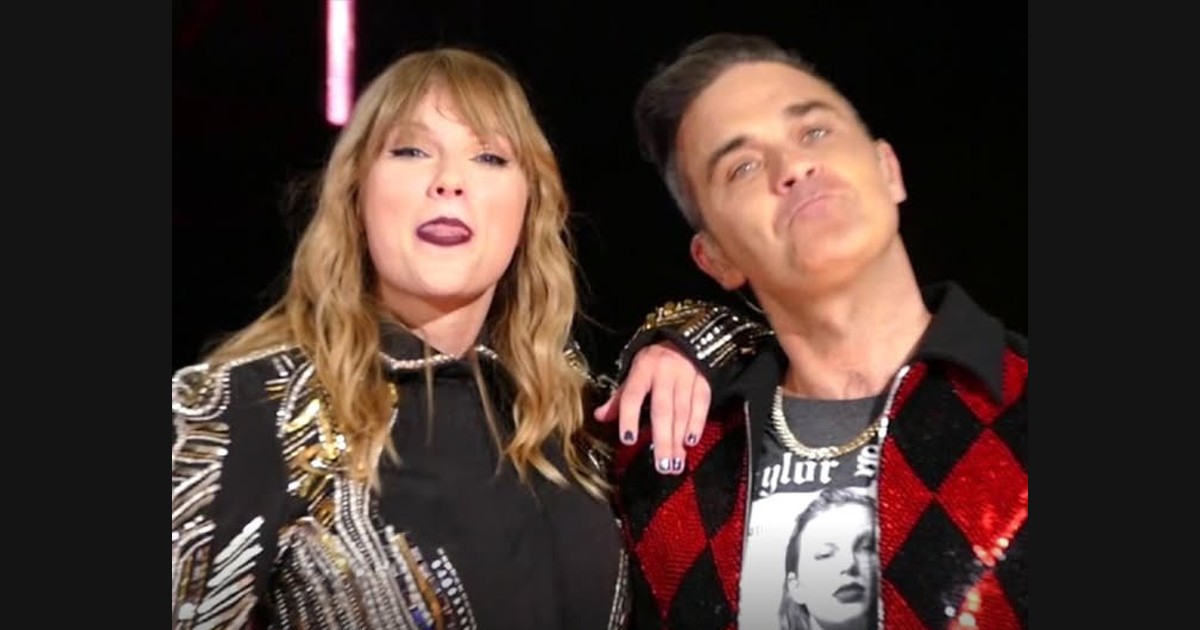
A song can acquire a new performing partnership without becoming a new song, and a performance can acquire several uploads without becoming several performances. Robbie Williams joining Taylor Swift for “Angels” is a useful example of both distinctions. The official Swift upload identifies the reputation Stadium Tour pairing; the accompanying audience uploads place their views at Wembley.
Start with the song’s earlier identity. Official Charts dates Williams’s “Angels” single to December 1, 1997, from Life Thru a Lens. Its existence long before this tour explains the nature of the guest spot: Swift is sharing a piece of Williams’s established repertoire, rather than introducing a newly written Swift–Williams release.
The official performance is the reference point
The first video comes from Swift’s official channel. That makes its title a useful starting point for identifying the participants and tour. It should not be confused with a studio single announcement or a claim that every sound heard was produced in one particular way. The practical description is simpler: this is the tour’s presentation of the two artists performing “Angels.”
Watch on YouTube ↗
When comparing the other clips, keep that event identity fixed. Camera distance, framing, and the recording position can change what feels prominent. A wide view can emphasize the scale of a setting; a closer view can make a shared cue easier to follow. Those are differences in access to the performance, rather than proof that the artists made different musical decisions on separate nights.
What a second view can add
An audience upload is most useful when it answers something the principal view leaves unclear. It might provide a more continuous view of both singers, or let a viewer understand where the guest stands in relation to the host. It need not become a competition over which recording is more authentic.
Watch on YouTube ↗
- Keep the event label separate from the upload date. A later publication does not establish a later concert.
- Follow the same passage. Comparing unrelated sections can exaggerate a difference in vocal balance.
- Account for perspective. A phone’s position can make the surrounding room more noticeable.
- Do not count uploads as collaborations. Several recordings can document one guest appearance.
A genuinely new recording is a different category
Williams’s own catalog supplies a useful contrast. His official announcement for XXV, released in 2022, describes songs newly orchestrated and re-recorded with the Metropole Orkest, including “Angels.” That is a new recorded treatment of existing repertoire. An alternate view of the Wembley duet is not automatically the same kind of revision.
This distinction helps when choosing what to hear next. Someone interested in the Swift–Williams encounter benefits from another concert angle. Someone interested in how Williams has revisited the arrangement across his career needs a separately documented recording, with its own production context. The two searches answer different questions.
Watch on YouTube ↗
The guest relationship is the main event
Consider the duet as a meeting between a touring host and the artist closely associated with the chosen song. Shared repertoire creates an immediate connection between their catalogs without requiring an album collaboration. That is enough to make the occasion distinctive.
The three videos work best as a small viewing set: one principal tour presentation followed by alternate perspectives. Keeping the underlying song, the particular concert encounter, and the individual uploads on separate levels makes each clip more informative.


