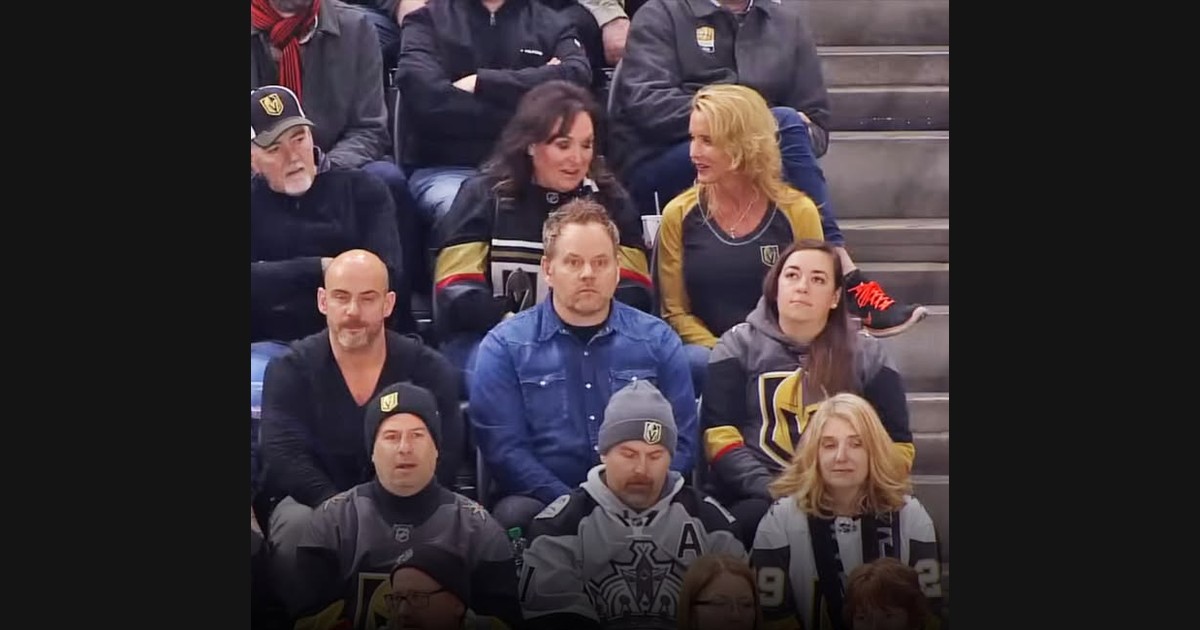
Cameron Hughes’s “Vegas Golden Cheers!” does not have only one audience. People beside him see an entertainer in their seating area; other spectators can encounter the act through an arena screen; online viewers later watch a finished clip. Those positions create different ways to participate in the same public moment.
Hughes identifies T-Mobile Arena and the Golden Knights setting in his own upload. His professional site describes work that turns spectators into willing participants. The word “willing” is useful: involvement is not one identical action demanded from every person in the building.
Watch on YouTube ↗
The nearby audience supplies a local frame
People close to a crowd performer can see the action at ordinary human scale. Their seating area becomes a temporary point of focus inside a much larger venue. A glance, a response or simply making room can be part of the surrounding interaction.
That is different from assuming that every person must stand up and dance for the act to work. An audience can remain attentive while participating in different ways. The entertainer’s task is to create a readable invitation, not to make everyone indistinguishable.
The screen creates another distance
An arena camera can make one small area visible to people far away. A movement that is locally ordinary may become significant when framed as the current event on the screen. The camera does not need to create the action to change its public scale.
This gives the performance two spatial relationships at once. Hughes can work among spectators while the image reaches beyond them. A clear gesture or visual change helps connect the local action with the larger view.
The online viewer arrives after the occasion
A short publication preserves selected material for people who were not at the game. The viewer receives a clip with a beginning and ending chosen for later viewing, rather than every part of the arena’s running order.
Hughes’s own account identifies the setting and his role as a performer. That changes how the moment reads: a professional crowd entertainer is creating an opportunity for participation, rather than a randomly discovered fan simply interrupting the programme. It also leaves room to appreciate the act without inventing the exact reactions of the whole arena.
A timeout in another building
The Ottawa Senators recording names a timeout directly. It provides another setting in which a temporary focus can form among people who came primarily for sport.
Watch on YouTube ↗
For a focused comparison, consider which audience position the camera makes easiest to follow. Do you notice the entertainer, nearby people or the scale of the room? Each view emphasizes a different relationship with the action.
An Oilers occasion broadens the comparison
The final video comes from Hughes’s own Oilers publication. The broad performance identity continues while the particular sporting audience changes.
Watch on YouTube ↗
The three recordings make participation more specific than a general claim that everyone became excited. Watching, responding and entering the visible action are different contributions. An effective crowd act can accommodate those differences while maintaining a clear musical and visual thread. Hughes’s work is interesting because it makes a place within the audience into a performance space without requiring every person to occupy the same role.


