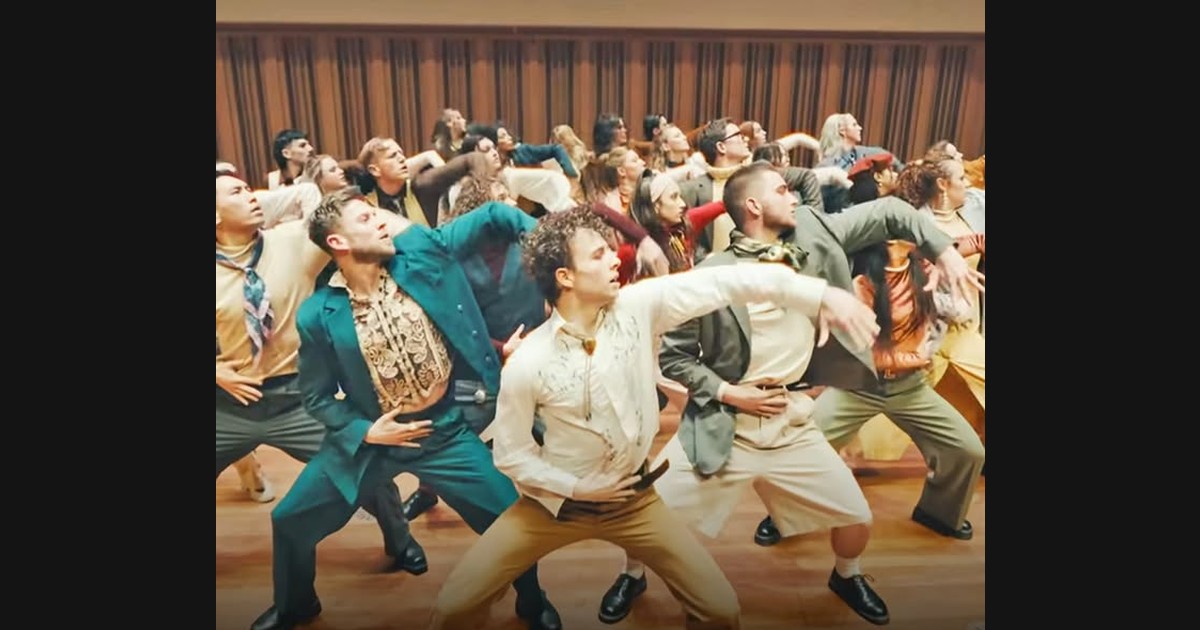
A group dance can share music without asking every dancer to do the same thing at the same instant. CDK’s “Somebody That I Used to Know” provides a useful setting for noticing different relationships in ensemble timing.
The San Francisco Dance Film Festival’s program credits Sergio Santos Reis, Jowha van de Laak, and Mauro van de Kerkhof as choreographers. That identifies a collaborative creative team rather than assigning every movement to the person whose channel publishes the video.
Watch on YouTube ↗
Timing has more than one arrangement
Educational dance resources distinguish unison from canon. Unison places an action at the same time; canon has a movement or phrase presented successively. The terms describe relationships among performers rather than an automatic measure of difficulty or quality.
Use them as questions for the film, not as a claim that every passage must fit one label. Where do dancers share an action? Where does related material appear at different moments? Where does one person’s stillness change the visibility of another’s movement?
For example, imagine the same short gesture moving from one dancer to another. The material can remain recognizable while the staggered timing produces another group effect. If everyone performed it simultaneously, the visual relationship would change even though the individual gesture stayed the same.
Stillness belongs to the timing
A participant who pauses can remain part of the composition. The pause can leave another action legible, define a boundary, or establish contrast with the next movement. Constant activity is not the only way to contribute.
Choose a short passage and follow one dancer through movement and stillness. Then watch the group relationship during the same material. This separates an individual sequence from the larger organization without requiring a complete notation of the choreography.
Keep the description observable. “One dancer remains still while another moves” is different from assigning a private motive or a fictional biography to each person. A familiar song does not require a dance film to illustrate every word literally.
The soundtrack and movement have separate patterns
The musical beat is one reference, but dancers can also organize attention through duration, delayed entrances, and changes of grouping. A movement’s relation to music may become clearer when its preparation and continuation remain in view.
That is why an isolated pose or short highlight cannot explain the whole ensemble design. Follow the relationship across enough time to see what changes.
“Bittersuite” changes the musical material
Watch on YouTube ↗
The CDK “Bittersuite” selection moves to Billie Eilish’s repertoire. Carry the question about group timing into it, while allowing another composition to produce different relationships. A shared company identity does not require one repeated choreographic solution.
The showcase adds another context
Watch on YouTube ↗
The official World of Dance upload labels CDK’s Eindhoven 2024 appearance a showcase. That event description should remain separate from the festival identity of the Gotye dance film.
A useful comparison names one timing relationship in each selection. It can distinguish shared action, staggered repetition, and meaningful pauses without pretending to know every choreographer’s intention. The resulting account gives ensemble coordination a vocabulary beyond the general compliment that a group is synchronized.


