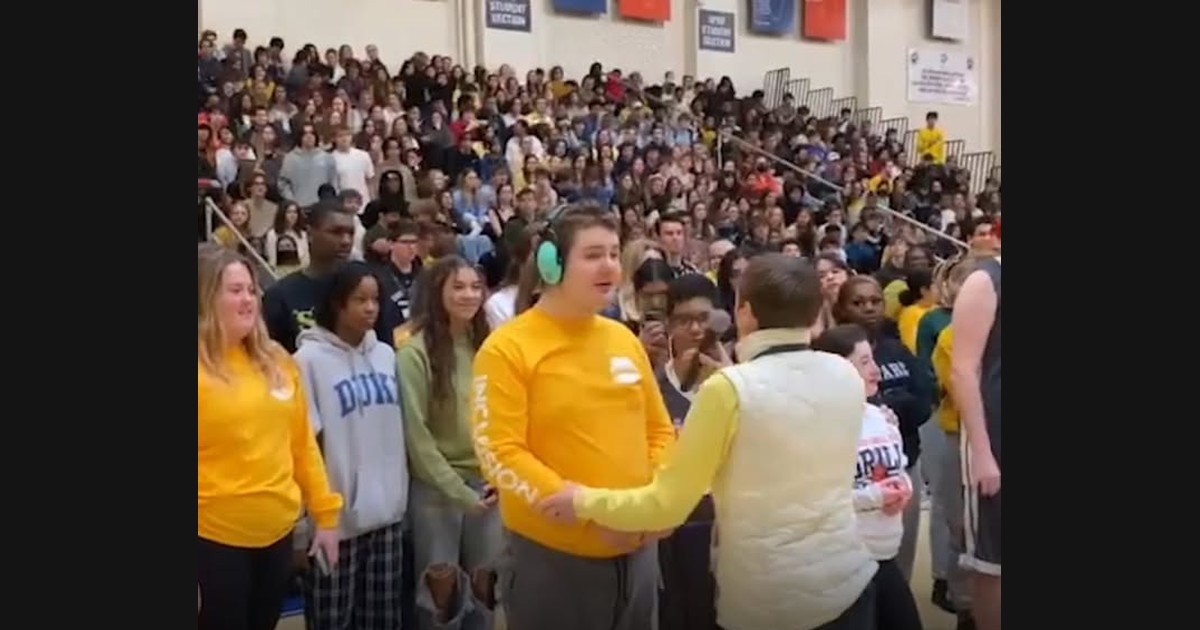
A school ensemble singing before a basketball game can make participation the center of a familiar ceremony. The source account for this story describes a teacher helping students move through “The Star-Spangled Banner,” passing the microphone as individual voices contribute to the shared sequence.
The opening video is a separate performance, not footage of that student group. Malea Emma’s own upload identifies her anthem at UCLA men’s basketball on February 23, 2019, in Pauley Pavilion. Keeping the two occasions separate matters: a related recording can offer a comparison without becoming evidence of another school’s event.
Watch on YouTube ↗
A familiar structure can support different contributions
An anthem gives singers a known sequence of phrases and gives listeners a recognizable route through the performance. That shared reference can make individual turns understandable within a larger musical statement. A contribution does not have to contain the entire song to belong meaningfully to it.
In the school account, the teacher’s role is practical: helping a singer enter the next line and allowing the sequence to continue. Describing that action is more useful than inventing a diagnosis for a student or making a general claim about what every member of the audience felt.
Support can preserve the performance
A public song does not need to become a test of whether someone can manage every moment alone. Another person can provide an entry, a reference or a shared line. Those actions can keep the musical event coherent while leaving the featured singer’s contribution visible.
The distinction is between assistance and substitution. Assistance helps a person participate in the continuing task; substitution removes that person’s role. In a shared vocal presentation, the arrangement can be designed around the first rather than treating solitary completion as the only worthwhile result.
A documented example from professional sport
The Portland Trail Blazers’ own recording identifies Maurice Cheeks helping Natalie Gilbert sing the anthem at a game. It supplies another, separately documented instance in which someone joins a singer to help the public performance continue.
Watch on YouTube ↗
The useful comparison concerns the action of support, not an assumption that the circumstances or performers are identical. One person can share a musical reference with another without the surrounding occasion becoming the same event.
For a focused viewing, attend to how the song maintains continuity when another person participates. The familiar melody gives both performers and audience a common point of orientation.
A third individual recording
The final upload presents another anthem singer. Its promotional title includes medical and disability labels that the brief description does not independently document, so those labels are unnecessary to appreciating the performance here.
Watch on YouTube ↗
The three videos remain separate from one another and from the school ensemble account. Each provides a different reference for a public song performed within a larger occasion.
The central idea is straightforward: participation can be organized around a shared musical structure and practical help. A teacher’s cue or another person’s voice can become part of the performance rather than an interruption of it. Keeping each source and event identifiable lets that idea remain concrete without turning one clip into a story it does not actually show.


