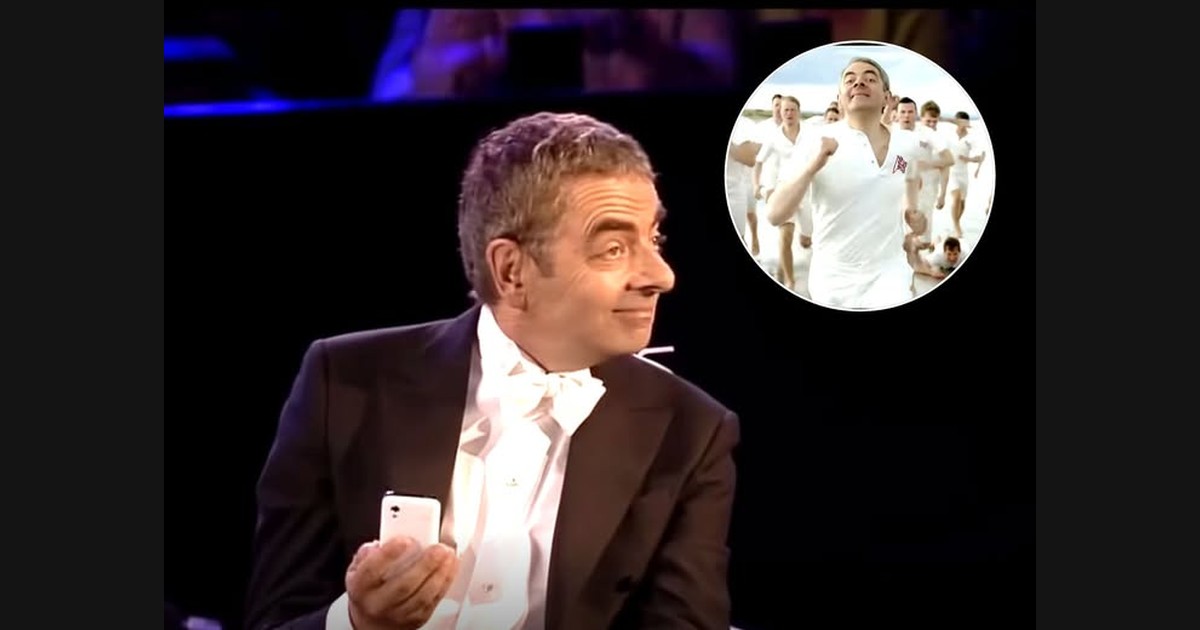
Rowan Atkinson’s Mr Bean appearance at London 2012 places a familiar comic character inside an orchestral presentation of Chariots of Fire. The official ceremony guide identifies the London Symphony Orchestra and conductor Simon Rattle, along with a filmed sequence connected with the movie’s beach-running scene.
That frame matters because the comedy does not require the orchestra itself to be a joke. A formally organized musical event provides the setting in which the character’s relationship with a small repeated task becomes conspicuous.
Watch on YouTube ↗
The task establishes a reference
A repeated keyboard contribution is easy for a viewer to recognize as a continuing responsibility. Once the task is clear, attention can move toward what the character does around it: how he treats repetition, how he occupies his place, and how his focus departs from the surrounding event.
The contrast supplies a comic premise. A very small musical assignment exists within a very large public presentation. The character can appear absorbed in matters that do not match the scale or formality of the occasion.
That is different from saying the actor is incapable of music or that the real orchestra loses control. A fictional role is being performed inside a prepared ceremony. The stage character’s behavior should not become a literal account of the actor’s skills or the musicians’ professionalism.
Repetition creates room for another layer
A continuing pattern gives the viewer something stable while another activity develops. In comedy, that stability can make distraction especially legible: the assigned job remains simple enough to remember while the character’s attention goes elsewhere.
For example, imagine a performer whose only visible responsibility repeats at regular intervals. Any increasingly elaborate attempt to deal with something outside that task creates a relationship between duty and distraction. This is a general model for the comic device, not a claim about an unrehearsed mishap.
The film sequence changes the performing space
The ceremony guide identifies a filmed Chariots of Fire sequence made at St Andrews. That supplies an explicit production context when the presentation moves beyond the orchestra’s immediate stage setting.
A cut into a filmed scene can expand a character’s imagined world without requiring the audience to believe that the actor has physically left the ceremony at that instant. Screen and stage cooperate within one comic selection.
Another ceremony uses repetition differently
Watch on YouTube ↗
The official Beijing 2008 drumming excerpt offers a useful contrast. Shared timing is presented as a collective ceremonial action, rather than as the background for one comic character’s distraction.
Compare the function of repetition, not the worth of the performers. The same broad resource can support coherence in one presentation and create a stable frame for comedy in another.
A field image adds another group task
Watch on YouTube ↗
Ohio State’s Michael Jackson tribute changes both event and medium. Its coordinated band formation supplies a group visual idea alongside the music. It is not part of the London ceremony.
Returning to Mr Bean makes the main device clearer: a small continuing responsibility sits inside an exceptionally large frame. The prepared contrast lets a character’s attention become the subject while the surrounding musical structure remains recognizable.


